
ASML’s Near-Death Journey to Global Semiconductor Monopoly
The story of ASML's rise from a struggling joint venture to the indispensable linchpin of global advanced chip manufacturing, detailing its strategic decisions and the technological hurdles overcome.
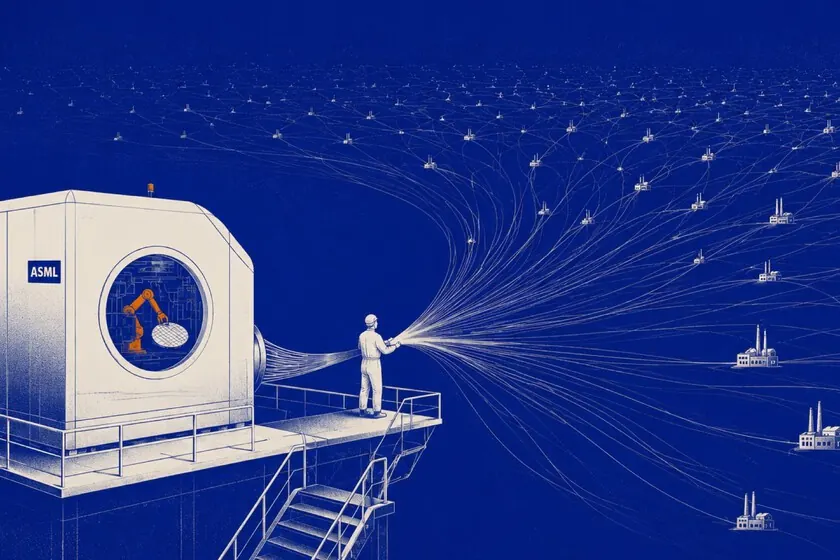
The advanced chips powering everything from smartphones to artificial intelligence models and critical defense systems rely on a single company for their creation: ASML. This Dutch firm has achieved a level of market dominance that few companies in any industry can match, controlling the entire global supply of essential chip-manufacturing machinery. Its position is not the result of organic growth from a dominant early stage, but rather a hard-won battle against near-failure, marked by critical strategic choices that its rivals did not replicate.
The company’s origins trace back to 1984 as a tentative joint venture between Philips and ASM International. Initially focused on selling the PAS 2000 stepper, its early days were fraught with challenges. Delays, cost overruns, and the necessity to quickly pivot from a hydraulic to an electrical solution for a critical machine component plagued the nascent venture. Financial support from Dutch and European public entities was crucial even before ASML was formally established. By 1988, ASM International withdrew, leaving ASML on the brink of collapse, only surviving due to a last-minute rescue by Philips. This precarious beginning forged a company ethos of necessity-driven negotiation and collaboration, a stark contrast to its stronger, more integrated Japanese competitors, Nikon and Canon, at the time.
Por que importa
A significant turning point arrived in 1991 with the PAS 5500. This machine marked ASML’s transition from a distant third player to a credible competitor, building a reputation for reliability and product longevity. A testament to this was that over 90% of PAS 5500 machines produced were still operational thirty years later. This underscored ASML’s early understanding that selling a machine was just the beginning of a long-term customer relationship built on service, updates, and lifecycle support – a “relationship sale” rather than a one-off transaction.
The 2000s saw further evolution with the TWINSCAN system and immersion DUV (Deep Ultraviolet) lithography. ASML strategically expanded its offerings beyond pure optical resolution, acquiring Silicon Valley Group in 2001 and Brion in 2007, and launching YieldStar in 2008. These moves transformed ASML from a scanner manufacturer into a provider of integrated solutions that dictated chip factory performance.
Contexto
The most significant gamble, however, was the development of Extreme Ultraviolet (EUV) lithography. Producing light at a 13.5-nanometer wavelength for industrial chip production presented immense technical hurdles, including developing a viable light source, precision reflective optics (in partnership with Zeiss), masks, and nanometric defect detection systems. ASML systematically addressed these challenges by acquiring key technology providers: Cymer in 2013 for the light source, HMI in 2016 for inspection, and securing a significant stake in Carl Zeiss SMT. This approach, leveraging a vast network of over 5,100 suppliers, allowed ASML to focus on system architecture, software integration, and customer relationships, while its rivals like Nikon and Canon pursued more vertically integrated strategies.
A pivotal moment in solidifying ASML’s dominance came in 2012 when it launched a co-investment program for EUV development, drawing significant funding from its key future customers: Intel, TSMC, and Samsung. This strategic move not only accelerated EUV’s development but also deeply intertwined the roadmaps of the world’s leading chipmakers with ASML’s success, creating an unprecedented level of dependency.
Despite its current monopoly status, ASML’s journey was not without setbacks. The company paused its 450mm wafer development program in 2013 due to uncertain demand, redirecting resources to EUV. Incidents like fires at Prodrive in 2018 and its Berlin plant in 2022 served as stark reminders that ASML’s seemingly unassailable position relies on a fragile network of critical, often irreplaceable, components and suppliers.
The economic impact of ASML’s strategy is profound. In 2025, the company reported €32.7 billion in sales, with a gross margin of 52.8%, and net profit of €9.6 billion. A substantial portion of this revenue, nearly a quarter, stems from maintenance and upgrades for its installed base, creating a recurring revenue stream and further cementing customer loyalty. ASML projects revenues of €44-60 billion by 2030, indicating its continued role in setting the pace for the entire semiconductor industry.
ASML’s influence extends into geopolitics, with governments in the Netherlands, Germany, and the EU actively supporting its operations. The US has also played a significant role, both as an enabler and as a driving force behind export restrictions aimed at China. This has led to a complex web of controls and a declared industrial objective by China to develop its own equivalent capabilities, though replicating ASML’s integrated ecosystem remains a formidable challenge.
The future may hold new competitive pressures. ASML is developing its next-generation High-NA EUV machines, which are prohibitively expensive. Furthermore, value may shift to other areas of chip manufacturing, such as advanced packaging, where ASML is already making inroads. Rival technologies like Canon’s nanoimprint lithography and Nikon’s digital lithography for packaging offer alternative, lower-cost approaches, though they do not currently threaten ASML’s lead in cutting-edge logic chip production.
Ultimately, ASML represents a brilliant, yet cautionary, tale of extreme market concentration born from relentless innovation and strategic foresight. The global semiconductor industry, and by extension the AI, cloud, and defense sectors, rests heavily on the continued flawless operation of a single European company, its German optical partner, a vast supplier network, and a complex international export control regime.
Key facts
| Aspect | Detail |
|—|—|
| Founding | 1984 as a joint venture between Philips and ASM International |
| Critical Technology | EUV (Extreme Ultraviolet) lithography machines |
| Key Strategic Decisions | Focus on supplier network over vertical integration, co-investment program with major chipmakers, long-term customer relationships |
| 2025 Sales | €32.7 billion |
| Current Competitive Landscape | Sole global provider of EUV lithography machines |
Source: ASML se ha convertido en el monopolio más importante del mundo. Esta es la historia completa, Xataka, https://www.xataka.com/empresas-y-economia/asml-se-ha-convertido-monopolio-importante-mundo-esta-historia-completa
Datos clave
| Punto | Detalle |
|---|---|
| Fuente | Xataka IA |
| Fecha | 2026-07-09T10:45:18+00:00 |
| Tema | ASML se ha convertido en el monopolio más importante del mundo. Esta es la historia completa |
Source
Xataka IA Publicacion original: 2026-07-09T10:45:18+00:00
Related articles

Nepal’s “Flood-Proof” Google Maps Landmark Is Not a Verified Safety Rating
A house that survived a destructive Himalayan flood reportedly appeared on Google Maps as a “flood-proof” attraction. The viral label should not…
Read article
Perplexity Deploys GPT-6 Astra for End-to-End Production and Communication Systems
Perplexity has integrated OpenAI’s GPT-6 Astra to handle communications, software changes, and production monitoring, reducing the need for frequent human check-ins compared…
Read article
Privacy Reports Put AI Smart Glasses Under Scrutiny in France
French association e-Enfance says it has received more than 20 reports involving women allegedly recorded without their knowledge by connected glasses, bringing…
Read article
Snowflake Publishes GTM Blueprint for Closing the AI-to-Revenue Gap
Snowflake’s sales and marketing teams share a repeatable RAMP framework and four revenue leaks they fixed to turn AI pilots into measurable…
Read articleWiki relacionada

AI Model API Pricing and Context Window Comparison: Current Rates and Limits
Compare the latest API pricing, context windows, and capabilities of leading AI model providers including OpenAI, Anthropic, Google, and Mistral. Practical guidance…
Read article
AI Agent Evaluation Frameworks: How to Benchmark Agentic Systems
A practical guide to evaluating AI agents — from task completion metrics to safety, cost, and robustness. Covers major frameworks, primary sources,…
Read article
LLM Benchmarks Decoded: What MMLU, HumanEval, and GSM8K Actually Measure for Developers
A developer-focused breakdown of the most-cited LLM benchmarks — MMLU, HumanEval, GSM8K, MATH, Chatbot Arena — including what they test, their hidden…
Read article
What Is RAG? A Practical Guide to Retrieval-Augmented Generation in 2025
Retrieval-Augmented Generation (RAG) grounds LLM outputs in external data, reducing hallucinations and enabling enterprise use cases. This guide covers how RAG works,…
Read article