
Swiss Alps Solar Project Achieves Remarkable Winter Performance, Defying Expectations
A solar installation at 2,500 meters in the Swiss Alps is outperforming expectations, with the unexpected ally of snow contributing to its success during winter months.
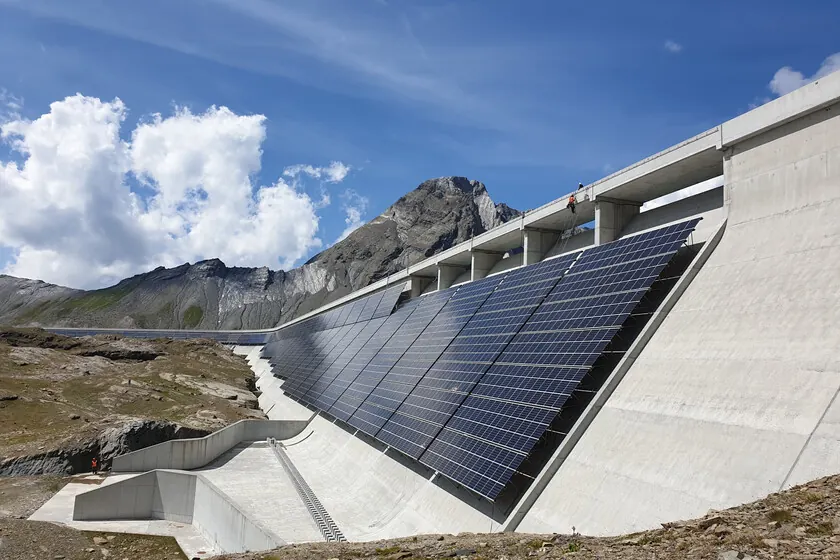
A pioneering solar energy project nestled high in the Swiss Alps has demonstrated an extraordinary performance, particularly during the winter months, challenging conventional wisdom about solar panel placement. The AlpinSolar installation, situated at an altitude of 2,500 meters on the Muttsee dam in the canton of Glarus, has found an unexpected ally in snow, contributing significantly to its energy output during the very season Switzerland most needs power.
Unexpected Location, Unexpected Success
The prevailing logic in the solar industry suggests that panels are best placed at lower, warmer altitudes with accessible infrastructure. However, the AlpinSolar project, operational since 2022, has defied these assumptions. The installation comprises approximately 5,000 bifacial solar panels manufactured by Swiss company Megasol, covering over a kilometer of the dam’s south-facing wall. This unique location, above the typical fog line, ensures cleaner air and more direct sunlight.
The initial setup was a complex logistical feat. As the dam is inaccessible by road, every component, including the installation crane, had to be transported by helicopter. Despite these challenges, the plant boasts an installed capacity of 2.2 MW, generating an estimated 3.3 million kWh annually, capable of powering between 700 and 750 homes.
The Snow Advantage
Switzerland faces a significant energy deficit in winter, a situation that could be exacerbated by the planned closure of its nuclear power plants. Traditional solar installations in valleys typically produce only a quarter of their normal output in winter, often hampered by persistent fog. AlpinSolar, however, thrives in these conditions.
The key to its success lies in its altitude and the snow. Being above the fog layer allows for unobstructed sunlight. Furthermore, the cold temperatures, contrary to common belief, enhance the efficiency of solar panels by preventing overheating. Most crucially, the snow covering the surrounding landscape acts as a giant mirror, reflecting additional sunlight onto the bifacial panels through the albedo effect, a phenomenon that can dramatically boost energy production.
Winter Production Surpasses Expectations
The results have been striking. AlpinSolar generates nearly half of its total annual production during the winter, a period when Switzerland’s energy demand is highest. During February and March, the plant can produce up to three times more energy than a comparable installation at lower altitudes. This remarkable winter performance has already secured a 20-year power purchase agreement with the supermarket chain Denner, in a collaboration with project developers Axpo and IWB.
Government Support and Future Prospects
The success of AlpinSolar has garnered attention from the Swiss government, which has approved a fast-track law, dubbed “Solar Express,” to facilitate the development of similar high-altitude solar projects. These new initiatives aim to further expand solar energy capacity in both low-lying and mountainous regions. Several other alpine solar projects are in development, with countries like Austria and Italy closely monitoring the Swiss experiment.
Key facts
| Aspect | Detail |
|---|---|
| Project Name | AlpinSolar |
| Location | Muttsee dam, Swiss Alps (2,500 meters altitude) |
| Installed Capacity | 2 MW |
| Annual Generation | Approx. 3.3 million kWh |
| Key Performance Factor | Enhanced winter output due to altitude, clean air, and snow’s albedo effect |
| Operational Since | 2022 |
This development is significant for the AI and technology sector as it highlights innovative applications of renewable energy technology in challenging environments. The success of AlpinSolar could inspire further research and development in distributed energy generation, grid stability, and the integration of AI in optimizing renewable energy systems for unpredictable climates.
Source: Suiza pensó que poner 5.000 paneles solares a 2.500 metros de altura era una locura. Tuvo un aliado inesperado: la nieve – Xataka (https://www.xataka.com/energia/suiza-penso-que-poner-5-000-paneles-solares-a-2-500-metros-altura-era-locura-tuvo-aliado-inesperado-nieve)
Source
Xataka IA Publicacion original: 2026-07-11T08:31:57+00:00
Related articles

IBM CEO Puts a Number on the Open-Weight AI Value Proposition: 90% of the Performance at 10% of the Token Cost
IBM CEO Arvind Krishna told analysts that open-weight models now deliver about 90% of frontier-model effectiveness while costing between 10% and 25%…
Read article
OCU Finds Spanish Homeowner Communities Overpaying Up to €1,500 on Electricity and €3,515 on Gas—Can AI Tools Optimize Shared Energy Bills?
A new OCU analysis of Spanish homeowner community bills reveals widespread overpayment due to non-competitive tariffs and excess contracted power. Could AI-driven…
Read article
Mayotte fiber dispute does not meet ReviewArticle’s AI news brief
Le Monde reports that France’s competition authority has ordered Orange to suspend part of its fiber-optic rollout in Mayotte. The dispute is…
Read article
DiffEEG Model Uses Diffusion Pre-Training to Improve Seizure Detection from Minimal Labeled Data
Researchers have introduced DiffEEG, a 9.6-million-parameter foundation model that combines denoising diffusion pre-training with reinforcement learning fine-tuning to detect seizure events from…
Read articleWiki relacionada

AI Model API Pricing and Context Window Comparison: Current Rates and Limits
Compare the latest API pricing, context windows, and capabilities of leading AI model providers including OpenAI, Anthropic, Google, and Mistral. Practical guidance…
Read article
AI Agent Evaluation Frameworks: How to Benchmark Agentic Systems
A practical guide to evaluating AI agents — from task completion metrics to safety, cost, and robustness. Covers major frameworks, primary sources,…
Read article
LLM Benchmarks Decoded: What MMLU, HumanEval, and GSM8K Actually Measure for Developers
A developer-focused breakdown of the most-cited LLM benchmarks — MMLU, HumanEval, GSM8K, MATH, Chatbot Arena — including what they test, their hidden…
Read article
What Is RAG? A Practical Guide to Retrieval-Augmented Generation in 2025
Retrieval-Augmented Generation (RAG) grounds LLM outputs in external data, reducing hallucinations and enabling enterprise use cases. This guide covers how RAG works,…
Read article