
Ancient Shipwreck Discovered During Construction of World’s Largest Offshore Wind Farm
Construction of Denmark's Hornsea 3 wind farm in the North Sea was briefly halted after the discovery of a 17th-century shipwreck laden with lead ingots, offering insights into early modern trade routes.
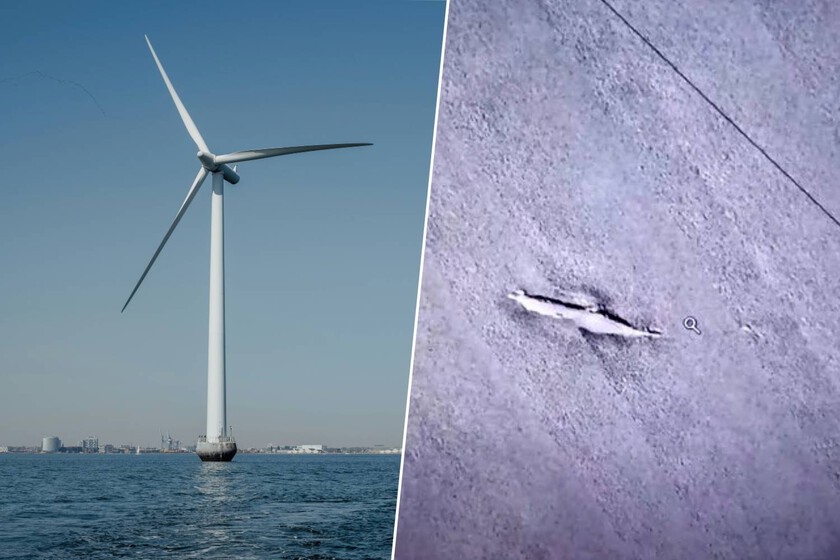
Construction of what is slated to be the world’s largest offshore wind farm, Denmark’s Hornsea 3, has been accompanied by an unexpected historical find: a 17th-century shipwreck. During seabed surveys in the North Sea, marine archaeologists stumbled upon a vessel carrying a significant cargo of lead ingots.
The discovery occurred approximately 120 kilometers off the coast of Norfolk, England, at a depth of about 40 meters. Initial seabed safety assessments, conducted by the energy company Ørsted, were focused on identifying potential unexploded wartime ordnance when the anomaly was detected.
Unexpected Cargo
The survey monitors revealed three lead ingots, each weighing approximately 70 kilograms, still stacked in their original positions on the seafloor. Remnants of the ship’s wooden structure and hull were also visible. The ingots bear distinct marks from their smelter, which are crucial for potentially tracing their origin and the vessel’s trade route. Preliminary analysis suggests a link to Derbyshire, England, a historic lead-mining region.
Historical Significance
This find provides tangible evidence of the English lead trade during the early modern period. The shipwreck’s location places it directly on a historical maritime route connecting Hull, England, with the Netherlands across the North Sea.
During the 17th century, England, particularly the Peak District and Derbyshire, was a major producer of lead. This metal was extensively used for various applications, including pipes, cookware, and weaponry, before its toxic properties were fully understood. Transporting lead in ingot form facilitated its trade as a commodity.
Contextual Regulations
The discovery also underscores the importance of archaeological surveys mandated by heritage legislation in the United Kingdom before major infrastructure projects, especially in marine environments. Similar archaeological requirements have led to other significant finds in recent years, including a Roman anchor at a different British offshore wind farm site.
Preliminary Investigation
The ingots recovered bear three specific engraved marks: “IS,” “EB,” and “H.” These markings bear resemblance to those found on the Kennemerland, a Dutch East India Company ship that sank in 1664 near the Shetland Islands. Based on this similarity, the research team currently hypothesizes that the vessel was likely Dutch and was en route back to the Netherlands with its lead cargo.
However, researchers emphasize that these are preliminary findings. Further in-depth investigation is required to definitively determine the ship’s origin and establish a more precise dating beyond the 17th century. Analytical confirmation of the lead’s geological origin is also pending.
Key facts
| Item | Detail |
|—|—|
| Discovery | 17th-century shipwreck with lead ingots |
| Location | North Sea, approx. 120 km off Norfolk coast, UK |
| Wind Farm Project | Hornsea 3 (Denmark) |
| Cargo weight | Approx. 210 kg (three 70 kg ingots) |
| Potential Origin of Lead | Derbyshire, England |
| Hypothesized Vessel Origin | Dutch |
This discovery is relevant to ReviewArticle readers interested in the intersection of technological advancements like renewable energy projects and unexpected historical findings. It highlights how large-scale industrial development can uncover valuable archaeological information, offering new insights into historical trade and maritime practices. The rigorous archaeological protocols in place for such projects also demonstrate a commitment to preserving historical heritage alongside modern infrastructure development.
Source: Dinamarca estaba construyendo el mayor parque eólico del mundo cuando se encontró un barco hundido de hace 400 años – Xataka: https://www.xataka.com/magnet/dinamarca-estaba-construyendo-mayor-parque-eolico-mundo-cuando-se-encontro-barco-hundido-hace-400-anos
Datos clave
| Punto | Detalle |
|---|---|
| Fuente | Xataka IA |
| Fecha | 2026-07-11T18:01:57+00:00 |
| Tema | Dinamarca estaba construyendo el mayor parque eólico del mundo cuando se encontró un barco hundido de hace 400 años |
Source
Xataka IA Publicacion original: 2026-07-11T18:01:57+00:00
Related articles

Nepal’s “Flood-Proof” Google Maps Landmark Is Not a Verified Safety Rating
A house that survived a destructive Himalayan flood reportedly appeared on Google Maps as a “flood-proof” attraction. The viral label should not…
Read article
Perplexity Deploys GPT-6 Astra for End-to-End Production and Communication Systems
Perplexity has integrated OpenAI’s GPT-6 Astra to handle communications, software changes, and production monitoring, reducing the need for frequent human check-ins compared…
Read article
Privacy Reports Put AI Smart Glasses Under Scrutiny in France
French association e-Enfance says it has received more than 20 reports involving women allegedly recorded without their knowledge by connected glasses, bringing…
Read article
Snowflake Publishes GTM Blueprint for Closing the AI-to-Revenue Gap
Snowflake’s sales and marketing teams share a repeatable RAMP framework and four revenue leaks they fixed to turn AI pilots into measurable…
Read articleWiki relacionada

AI Model API Pricing and Context Window Comparison: Current Rates and Limits
Compare the latest API pricing, context windows, and capabilities of leading AI model providers including OpenAI, Anthropic, Google, and Mistral. Practical guidance…
Read article
AI Agent Evaluation Frameworks: How to Benchmark Agentic Systems
A practical guide to evaluating AI agents — from task completion metrics to safety, cost, and robustness. Covers major frameworks, primary sources,…
Read article
LLM Benchmarks Decoded: What MMLU, HumanEval, and GSM8K Actually Measure for Developers
A developer-focused breakdown of the most-cited LLM benchmarks — MMLU, HumanEval, GSM8K, MATH, Chatbot Arena — including what they test, their hidden…
Read article
What Is RAG? A Practical Guide to Retrieval-Augmented Generation in 2025
Retrieval-Augmented Generation (RAG) grounds LLM outputs in external data, reducing hallucinations and enabling enterprise use cases. This guide covers how RAG works,…
Read article