
Why a $55 Pillow Outperforms AI Sleepbuds – A Reality Check
The Verge’s review of the Blissbury Ear Pillow highlights a growing disconnect: expensive sleepbuds marketed with AI features often fail to deliver, while a simple foam pillow solves the same problem.
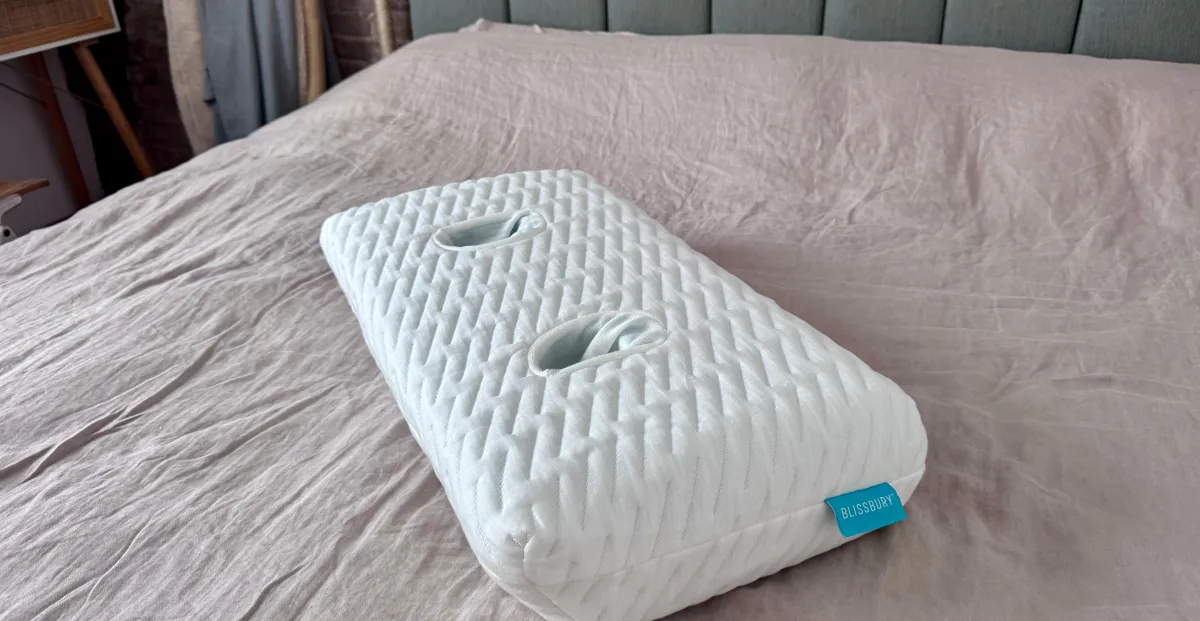
A recent review on The Verge argues that a $55 piercing pillow from Blissbury is a better investment than premium sleepbuds from Anker and Ozlo. The article, written by Thomas Ricker, is ostensibly about a foam pillow with ear cutouts. But for readers tracking the AI consumer market, the piece offers a more useful lesson: many “smart” sleep products carry AI branding that is thin or nonexistent, while low-tech solutions often outperform them.
The review is straightforward. The Blissbury Ear Pillow uses memory foam, has two ear holes, and costs $55. It never needs charging, never loses a Bluetooth connection, and will not wear out in a few years. The author claims it works better than the $200-plus Anker Soundcore Sleep A30 earbuds he used for nearly a year. The Sleep A30s, despite firmware updates, still suffer from battery limits, muffled audio, and the need to adjust one’s pillow. The pillow, by contrast, simply works.
The Pillow That Does Not Need AI
The Blissbury pillow contains no electronics, no sensors, no software. Its “intelligence” is limited to the placement of two oval cutouts that suspend the ear while sleeping. The Verge review notes that the pillow is also marketed for people with freshly pierced ears, but the author found it works equally well for side-sleepers who wear standard earbuds overnight. The pillow’s thickness is adjustable between 4 and 5 inches via a removable insert. The cover is washable. The price is $55.
The Sleepbuds That Barely Use AI
The article contrasts the pillow with sleepbuds from Anker (Soundcore Sleep A30) and Ozlo. Neither product is described as an AI device in the review. The Sleep A30s use “masking algorithms” to cancel snoring – a basic DSP function, not machine learning. Ozlo’s sleepbuds, launched in 2023, do include some AI-powered sleep tracking and adaptive audio, but the Verge review does not mention any AI features. The author’s main complaint is that the earbuds, regardless of software, are limited by their small batteries and drivers.
According to the review, the Anker Sleep A30s cost roughly $200 and require a charging case. The battery life is sufficient for a night’s sleep, but the buds will eventually need replacement. The Verge author notes that after a “bumpy start,” firmware updates fixed early issues, but “no amount of software can overcome the inherent limits of devices that require drivers and batteries that are much smaller than traditional earbuds.”
The Numbers: Price and Battery Life
A direct comparison of the two approaches reveals a stark gap in cost and longevity.
| Feature | Blissbury Ear Pillow | Anker Soundcore Sleep A30 |
|---|---|---|
| Price | $55 | ~$200 |
| Power source | None | Rechargeable battery (case) |
| Battery replacement | Never | 2–3 years (estimated) |
| Connectivity | None | Bluetooth (can lose connection) |
| AI component | None | Basic noise-masking algorithms |
| Washable cover | Yes | No (ear tips only) |
| Ear-hole flexibility | Two cutouts, adjustable | N/A |
The table makes clear that the pillow offers a zero-maintenance, zero-tech solution at a quarter of the price. The sleepbuds, despite their higher price and marketing, deliver no AI-driven advantage that a simple piece of foam cannot match.
What This Means for AI Hype
The Verge article is not an AI story. But it serves as a useful case study for readers of ReviewArticle. The consumer electronics industry frequently uses “AI” as a marketing label for features that are, at best, simple signal processing or rule-based algorithms. True AI – machine learning models that adapt to user behavior, improve over time, or make complex decisions – is rare in the sleep tech category. Ozlo’s sleepbuds do use some AI for sleep stage detection and audio adjustment, but the Verge review does not mention those features, suggesting they are not the product’s core selling point.
The review also highlights a broader pattern: when a product is marketed as “AI-powered,” consumers often assume it is superior to simpler alternatives. The pillow’s success challenges that assumption. It is a reminder that AI is not always the right tool for every problem, and that the most effective solution may be the one with the fewest components.
Reader Takeaways
– Before buying a “smart” sleep product, check whether the AI features are actually used or just marketing.
– Consider low-tech alternatives that solve the same problem without batteries, updates, or connectivity issues.
– The Verge review is a primary source; the author’s experience with the Anker A30 sleepbuds is based on nearly a year of use.
– Ozlo sleepbuds do include AI sleep tracking, but the review does not evaluate that aspect. The pillow is not a direct competitor to AI-driven sleep analytics.
Source: The Verge – “Forget expensive sleepbuds. Buy this pillow instead” https://www.theverge.com/tech/970473/forget-expensive-sleepbuds-buy-this-pillow-instead
Source
The Verge AI Publicacion original: 2026-07-25T07:00:00+00:00
Related articles

Perplexity Deploys GPT-6 Astra for End-to-End Production and Communication Systems
Perplexity has integrated OpenAI’s GPT-6 Astra to handle communications, software changes, and production monitoring, reducing the need for frequent human check-ins compared…
Read article
Privacy Reports Put AI Smart Glasses Under Scrutiny in France
French association e-Enfance says it has received more than 20 reports involving women allegedly recorded without their knowledge by connected glasses, bringing…
Read article
Snowflake Publishes GTM Blueprint for Closing the AI-to-Revenue Gap
Snowflake’s sales and marketing teams share a repeatable RAMP framework and four revenue leaks they fixed to turn AI pilots into measurable…
Read articleAI-Assisted Monograph Workflows: A Practical Integrity Checklist
A practical guide to using AI in monograph research without losing authorship, source control, or academic integrity.
Read articleWiki relacionada

AI Model API Pricing and Context Window Comparison: Current Rates and Limits
Compare the latest API pricing, context windows, and capabilities of leading AI model providers including OpenAI, Anthropic, Google, and Mistral. Practical guidance…
Read article
AI Agent Evaluation Frameworks: How to Benchmark Agentic Systems
A practical guide to evaluating AI agents — from task completion metrics to safety, cost, and robustness. Covers major frameworks, primary sources,…
Read article
LLM Benchmarks Decoded: What MMLU, HumanEval, and GSM8K Actually Measure for Developers
A developer-focused breakdown of the most-cited LLM benchmarks — MMLU, HumanEval, GSM8K, MATH, Chatbot Arena — including what they test, their hidden…
Read article
What Is RAG? A Practical Guide to Retrieval-Augmented Generation in 2025
Retrieval-Augmented Generation (RAG) grounds LLM outputs in external data, reducing hallucinations and enabling enterprise use cases. This guide covers how RAG works,…
Read article