
Internet’s Quirkiest Museum Showcases Global Electrical Plug Chaos
A Dutch online museum meticulously documents the world's diverse electrical plugs, highlighting a century of uncoordinated standards and the persistent need for travel adapters.
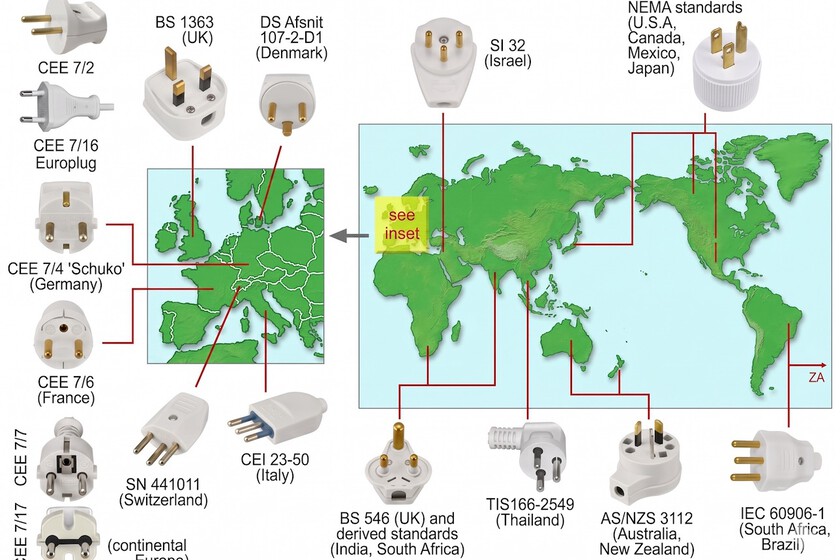
The digital realm is home to an unexpected and peculiar virtual institution: the “Museum of Plugs and Sockets.” This Dutch-based online repository has taken on the ambitious task of cataloging, photographing, and explaining the vast array of domestic electrical plugs that have emerged across the globe. The project meticulously adheres to the technical references provided by the International Electrotechnical Commission (IEC), the very body tasked with bringing order to this historical electrical disarray.
The museum’s collection serves as a stark visual testament to a period between 1880 and 1930, during which countries independently decided on their electrical plug standards. This decentralized approach, while seemingly practical at the time, led to an intricate and often incompatible web of connectors. The consequence, over a century later, is the ubiquitous need for travel adapters when journeying internationally—a small but persistent reminder of this early technological divergence.
Historical Context of Electrical Divergence
The early 20th century saw nations grappling with the fundamental challenge of electrifying their infrastructure. In the absence of global coordination, each country proceeded with its own design choices for plugs and sockets. This resulted in a fragmented landscape of electrical connectors, each with its own unique dimensions, voltage compatibilities, pin configurations, and safety regulations. The museum’s comprehensive catalog visualizes this divergence, offering a detailed look at the historical decisions that shaped our modern electrical interactions.
The IEC’s Classification System
The International Electrotechnical Commission (IEC) has attempted to bring some semblance of order to this “chaos” by employing a letter-based classification system. Currently, the IEC designates plug types with letters ranging from A to N, with an acknowledgment that the “O” designation for Thailand was introduced later. The “Museum of Plugs and Sockets” effectively maps these IEC classifications to their corresponding regional or national standards. For instance, North America utilizes the NEMA standards for types A and B plugs. Continental Europe commonly uses type C, though countries like Switzerland have their own distinct standards, such as SN 441011 and the unique plug type J. Similarly, the United Kingdom adheres to the BS 1363 standard (type G), and Australia uses AS 3112 (type I).
The museum’s detailed entries for each plug type provide insights into their specific technical characteristics, including physical dimensions, voltage ratings, pin sizes and spacing, and safety features. This level of detail is invaluable for understanding the subtle yet critical differences that render plugs incompatible across borders.
Failed Attempts at Universal Standardization
Recognizing the practical difficulties posed by this lack of standardization, the IEC embarked on a mission in the 1930s to establish an international standard for domestic plugs and sockets. This ambitious endeavor culminated in the publication of the IEC 60906 standard in 1986. However, the plan to create a truly universal plug largely failed to gain widespread adoption. To date, only Brazil (in 2002) and South Africa (in 2013) have adopted the IEC 60906-1 standard, and even in these countries, multiple plug types remain in use.
The European Union, for its part, has acknowledged the immense logistical and economic challenges associated with harmonizing plug standards across its member states. A 2017 report from the European Commission estimated that such an undertaking would require transition periods exceeding 75 years, an investment of approximately 100 billion euros, and would generate around 700,000 tons of electrical waste. This pragmatic assessment effectively signaled the EU’s decision against pursuing a continent-wide plug standardization.
Switzerland’s Unique Electrical Identity
Switzerland stands out as a particularly interesting case in the history of electrical plug design. True to its independent spirit, Switzerland is not a member of the European Union and does not use the Euro. This autonomy extends to its electrical infrastructure, where it maintains its own plug standard, defined by the SN 441011 norm (previously SEV 1011 until 2019). The Swiss plug type J is almost exclusively used within Switzerland and the Principality of Liechtenstein.
Beyond its limited global usage, the Swiss plug type J is notable for its distinctive hexagonal geometry. Paradoxically, when the IEC designed its proposed universal plug in 1986, it drew inspiration from the Swiss T12 plug. However, the IEC’s design incorporated differences in pin diameter and the positioning of the earth pin, ultimately failing to achieve universal adoption despite its Swiss roots.
Discontinued and Obsolete Plugs
The “Museum of Plugs and Sockets” also dedicates a section to plugs that were developed as alternatives to prevailing standards but have since been discontinued or are now nearly extinct. These include historical British types like Wylex and Dorman & Smith, the impractical hook-shaped “Hakenstecker,” and the Greek “Tripoliki” with its triangular arrangement of three pins. These retired connectors, now residing in both physical and digital museums, represent a rich archive of the failed attempts at global electrical standardization.
The existence of such a comprehensive digital museum underscores the ongoing practical impact of historical engineering decisions. For travelers, developers working with international hardware, and anyone seeking to understand the global technological landscape, the “Museum of Plugs and Sockets” offers a fascinating and educational deep dive into a seemingly mundane yet surprisingly complex aspect of our interconnected world.
Key facts
- Museum Focus: Cataloging and explaining global domestic electrical plugs and sockets.
- Standardization Attempts: IEC’s IEC 60906 standard, largely unsuccessful.
- Notable Exceptions: Switzerland’s unique plug type J (SN 441011).
- Practical Implication: Continued need for travel adapters due to diverse global standards.
Source: El museo más raro de internet tiene una colección de enchufes del mundo entero que reflejan el caos eléctrico – Xataka (https://www.xataka.com/historia-tecnologica/museo-raro-internet-tiene-coleccion-enchufes-mundo-entero-que-reflejan-caos-electrico)
Source
Xataka IA Publicacion original: 2026-05-24T15:31:33+00:00
Related articles

Nepal’s “Flood-Proof” Google Maps Landmark Is Not a Verified Safety Rating
A house that survived a destructive Himalayan flood reportedly appeared on Google Maps as a “flood-proof” attraction. The viral label should not…
Read article
Perplexity Deploys GPT-6 Astra for End-to-End Production and Communication Systems
Perplexity has integrated OpenAI’s GPT-6 Astra to handle communications, software changes, and production monitoring, reducing the need for frequent human check-ins compared…
Read article
Privacy Reports Put AI Smart Glasses Under Scrutiny in France
French association e-Enfance says it has received more than 20 reports involving women allegedly recorded without their knowledge by connected glasses, bringing…
Read article
Snowflake Publishes GTM Blueprint for Closing the AI-to-Revenue Gap
Snowflake’s sales and marketing teams share a repeatable RAMP framework and four revenue leaks they fixed to turn AI pilots into measurable…
Read articleWiki relacionada

AI Model API Pricing and Context Window Comparison: Current Rates and Limits
Compare the latest API pricing, context windows, and capabilities of leading AI model providers including OpenAI, Anthropic, Google, and Mistral. Practical guidance…
Read article
AI Agent Evaluation Frameworks: How to Benchmark Agentic Systems
A practical guide to evaluating AI agents — from task completion metrics to safety, cost, and robustness. Covers major frameworks, primary sources,…
Read article
LLM Benchmarks Decoded: What MMLU, HumanEval, and GSM8K Actually Measure for Developers
A developer-focused breakdown of the most-cited LLM benchmarks — MMLU, HumanEval, GSM8K, MATH, Chatbot Arena — including what they test, their hidden…
Read article
What Is RAG? A Practical Guide to Retrieval-Augmented Generation in 2025
Retrieval-Augmented Generation (RAG) grounds LLM outputs in external data, reducing hallucinations and enabling enterprise use cases. This guide covers how RAG works,…
Read article