
NVIDIA Opens Nemotron 3.5 Parse Training Data and Reports Faster Inference
NVIDIA has released three synthetic datasets and a fine-tuning recipe for its document-parsing model, alongside benchmarks for a new speculative-decoding method. The results are vendor-reported and depend on the tested hardware and workload.
NVIDIA has published three synthetic datasets and a fine-tuning recipe for Nemotron 3.5 Parse, its model for extracting structured information from document images. The release also describes a DFlash2 speculative-decoding method and reports higher throughput on a single H200 GPU than Parse 3.5 running without speculation. For developers building document-processing systems, the package offers training materials as well as performance claims to evaluate against their own data and infrastructure.
The model is designed to identify content such as text, tables and charts, preserve reading order, and attach bounding boxes to extracted regions. NVIDIA says the latest version improves at interpreting difficult charts and tables, including charts without printed values and tables where misplaced rows or columns can change meaning.
Key facts
| Item | Details |
|---|---|
| Synthetic Charts V1 | 98 million examples |
| Synthetic Tables V1 | 1 million examples |
| OCR Synthetic Multilingual v2 | 9 million examples |
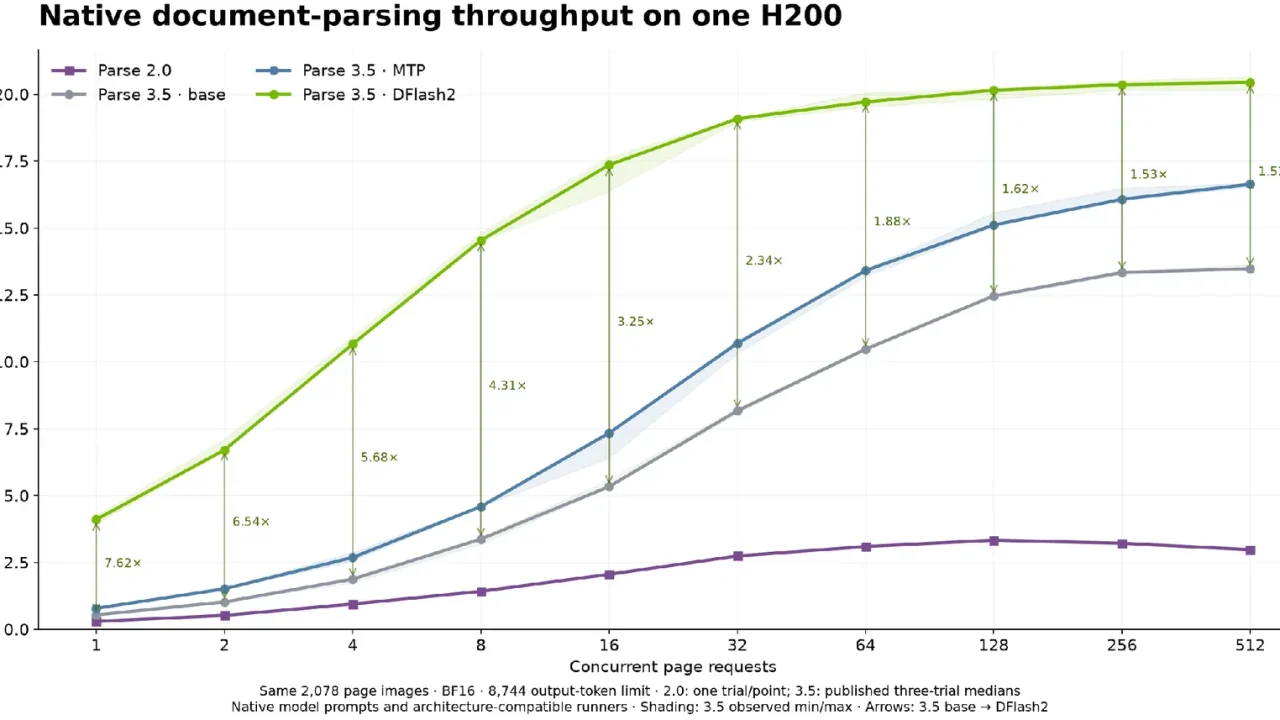
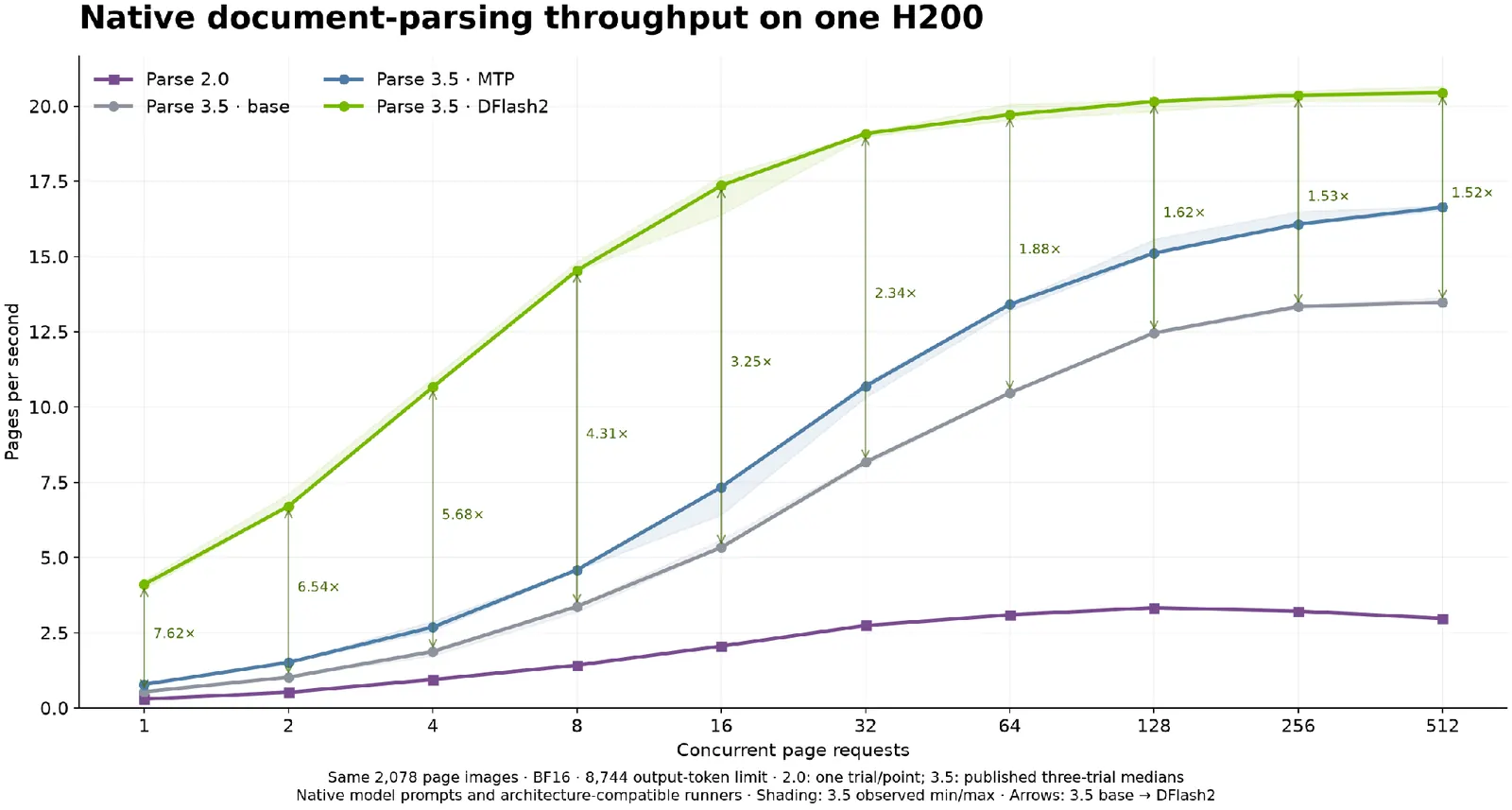
| DFlash2 benchmark | Up to 7.62× throughput at concurrency 1 versus Parse 3.5 without speculative decoding |
What NVIDIA released
The three datasets pair rendered document images with structured annotations. Synthetic Charts V1 covers chart categories, series and numerical values. Synthetic Tables V1 is intended to retain relationships among rows, columns, headers and cells. OCR Synthetic Multilingual v2 contains synthetic pages with targets in Parse’s format, aimed at multilingual text recognition and structured page reading.
NVIDIA says each release includes images, annotations, generation documentation and a training format. That could give teams a starting point for adapting document models or generating variations for particular layouts and languages. But synthetic examples are not a substitute for checking performance on real documents: the supplied material does not establish how well the datasets represent any particular organization’s scans, languages or document conventions.
The company also outlines a training recipe using supervised fine-tuning, followed by reinforcement learning with verifiable rewards. In its description, the reward process assesses whether outputs recover useful structures and values, and whether the model completes without repetition or truncation. The recipe refers to NeMo Automodel for supervised fine-tuning, NeMo RL for GRPO training, and vLLM for generating candidate answers.
Reported training and speed results
NVIDIA’s matched development-checkpoint comparison reports that reinforcement learning reduced outputs flagged for looping from 126 pages to 29, and outputs reaching a 9,000-token limit from 185 to 35. The overall score rose from 66.24 to 71.38, with reported gains of 5.18 points for tables and 4.15 for charts. The company specifies that these are development checkpoints, not the final released model; the supplied account does not provide enough detail to independently assess the evaluation set or scoring method.
For inference, NVIDIA reports tests on one H200 in BF16 using the same 2,078 pages. At concurrency 1, DFlash2 delivered 7.62 times the throughput of Parse 3.5 with speculative decoding disabled. At concurrency 512, throughput was 20.44 pages per second with DFlash2, compared with 13.48 without it. NVIDIA says the 32-token draft configuration accepted about 14 proposed tokens on average, yielding roughly 15 tokens of progress per verification step, including the target token.
Those figures describe a specific hardware and benchmark setup, not a guaranteed speedup for other GPUs, document mixes or serving configurations. Developers should compare end-to-end latency and extraction quality on their own workloads, including any extra cost from retries or downstream validation.
Accuracy can require extra passes
The release also describes single-, double- and triple-pass strategies. A single pass processes the page once. The more involved options revisit selected regions—such as dense tables or small chart details—at higher detail, with the triple-pass approach adding a detection step to check for missed regions. NVIDIA reports that double and triple passes improved its reference ParseBench score by 2.18 and 2.46 points, respectively, over a single pass.
That trade-off matters in production: reprocessing may improve extraction on difficult pages, but additional crops and model calls can consume more compute and increase processing time. The useful comparison is therefore not just pages per second, but the balance among accuracy, latency and cost for the documents an application actually handles.
What developers should check next
Teams considering the release should inspect the dataset documentation and licensing terms before reuse; the provided source context does not specify those terms. They should also test representative documents for table structure, chart-value recovery, multilingual OCR and failure behavior, then compare single- and multi-pass processing with and without speculative decoding.
The benchmarks and training results are NVIDIA’s own reported measurements. Independent results on other hardware and real-world document collections are not included in the supplied material, so the figures are best treated as a starting point for evaluation rather than a general performance guarantee.
Source: Hugging Face Blog, “Building on Nemotron 3.5 Parse: Open Data, Fine-Tuning, and Faster Inference” — https://huggingface.co/blog/nvidia/building-on-nemotron-35-parse-open-data-fine-tunin
Source
Hugging Face Blog Publicacion original: 2026-11-26T05:05:36+00:00
Related articles
Supabase Launches an Open Knowledge Base for Developers and Coding Agents
Supabase has introduced a dedicated library for applied guidance, including migration help and troubleshooting. Its pages are available in Markdown for coding…
Read article
Gallup Report Finds One-Third of Gen Z Uses AI for Companionship
A Gallup and Digital Wellness Lab survey of 15,925 people aged 15 to 22 links AI companionship and online-only friendships with higher…
Read article
Anthropic reportedly splits Claude Fable and Mythos access by risk level
Xataka reports that Anthropic has introduced two Claude 5.2 variants with different safeguards and access rules. The claims, pricing and benchmark figures…
Read article
AI Companions Become Daily Tools for Conversation and Emotional Support
A documentary follows people who use AI companions in daily routines, showing how chatbot interactions can feel meaningful even when users understand…
Read articleWiki relacionada

AI Model API Pricing and Context Window Comparison: Current Rates and Limits
Compare the latest API pricing, context windows, and capabilities of leading AI model providers including OpenAI, Anthropic, Google, and Mistral. Practical guidance…
Read article
AI Agent Evaluation Frameworks: How to Benchmark Agentic Systems
A practical guide to evaluating AI agents — from task completion metrics to safety, cost, and robustness. Covers major frameworks, primary sources,…
Read article
LLM Benchmarks Decoded: What MMLU, HumanEval, and GSM8K Actually Measure for Developers
A developer-focused breakdown of the most-cited LLM benchmarks — MMLU, HumanEval, GSM8K, MATH, Chatbot Arena — including what they test, their hidden…
Read article
What Is RAG? A Practical Guide to Retrieval-Augmented Generation in 2025
Retrieval-Augmented Generation (RAG) grounds LLM outputs in external data, reducing hallucinations and enabling enterprise use cases. This guide covers how RAG works,…
Read article