
Tunguska Event: The 1908 Blast That Revealed Space’s Dangers
A massive explosion in Siberia over a century ago, equivalent to 12 megatons, serves as a stark reminder of the potential threats from outer space and the ongoing efforts to protect Earth.
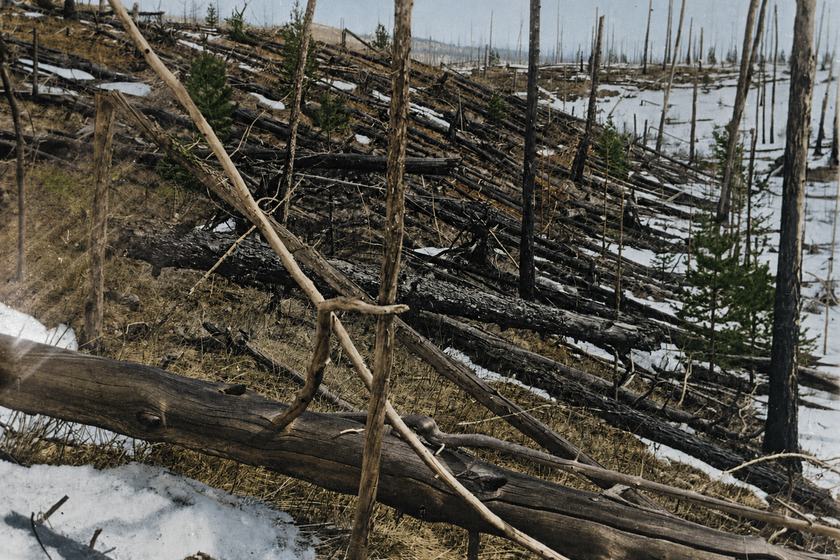
The Tunguska event, a catastrophic explosion that occurred in Siberia on June 30, 1908, remains one of history’s most perplexing and powerful cosmic incidents. The blast, estimated to be equivalent to 12 megatons of TNT, flattened an estimated 80 million trees over an area of 2,150 square kilometers. This event, occurring in a remote region, served as a dramatic introduction to the potential dangers lurking in space.
Colossal Dimensions
The sheer scale of the Tunguska explosion led to a variety of speculative theories in its aftermath, ranging from antimatter to a mini black hole, and even a crashed UFO or a test of Nikola Tesla’s “death ray.” However, scientific consensus points towards a more prosaic explanation: the atmospheric explosion of a small asteroid or a comet fragment. Crucially, no impact crater has ever been found, despite multiple expeditions to the site since 1921.
Understanding the Event
Despite the lack of a physical crater, evidence of the Tunguska event is undeniable. Seismographs across Asia and Europe recorded the explosion, while the Greenwich Observatory detected atmospheric pressure variations. Furthermore, the dust suspended in the atmosphere caused unusually bright nights across Northern Eurasia, making it appear as if it were daytime. The most accepted theory posits that a meteoroid exploded at an altitude of approximately 8 kilometers, releasing its immense energy.
Could It Happen Again?
The possibility of a repeat event is a serious consideration. Similar, though less powerful, incidents like the Eastern Mediterranean, Vitim, and Chelyabinsk events demonstrate that such occurrences are not confined to history. While the probability of another Tunguska-scale event is low due to their rarity, the consequences could be devastating if one were to strike a populated area. The vast majority of Earth’s surface is uninhabited, which has historically mitigated the impact of such events.
Cultural Impact and Awareness
The Tunguska event, and the potential for similar future impacts, has had a significant cultural footprint. Arthur C. Clarke’s fictional depiction in “Rendezvous with Rama” vividly illustrated the catastrophic consequences if such an event were to occur in a densely populated area like Europe, resulting in millions of deaths and trillions of dollars in damage. This fictional scenario underscores the real-world threat posed by near-Earth objects.
Recognizing this ongoing risk, June 30th is now celebrated annually as Asteroid Day, an initiative endorsed by the United Nations. Asteroid Day aims to raise global awareness about asteroid impacts and the critical need for planetary defense strategies. It serves as an annual reminder that while space is a source of wonder, it also harbors potential dangers that require our vigilance and preparedness.
Datos clave
| Aspecto | Detalle |
|———————-|——————————————|
| Fecha del evento | 30 de junio de 1908 |
| Ubicación | Región de Tunguska, Siberia |
| Potencia estimada | 12 megatones |
| Causa más aceptada | Explosión atmosférica de un meteorito/cometa |
| Consecuencias | Devastación de 2,150 km², 80 millones de árboles talados |
Fuente: Xataka – El bólido de Tunguska: la brutal explosión de 12 megatones que en 1908 nos puso frente a los horrores del espacio – https://www.xataka.com/espacio/bolido-tunguska-brutal-explosion-12-megatones-que-1908-nos-puso-frente-a-horrores-espacio
Datos clave
| Punto | Detalle |
|---|---|
| Fuente | Xataka IA |
| Fecha | 2026-05-30T07:01:47+00:00 |
| Tema | El bólido de Tunguska: la brutal explosión de 12 megatones que en 1908 nos puso frente a los horrores del espacio |
Source
Xataka IA Publicacion original: 2026-05-30T07:01:47+00:00
Related articles

OCU Finds Spanish Homeowner Communities Overpaying Up to €1,500 on Electricity and €3,515 on Gas—Can AI Tools Optimize Shared Energy Bills?
A new OCU analysis of Spanish homeowner community bills reveals widespread overpayment due to non-competitive tariffs and excess contracted power. Could AI-driven…
Read article
Mayotte fiber dispute does not meet ReviewArticle’s AI news brief
Le Monde reports that France’s competition authority has ordered Orange to suspend part of its fiber-optic rollout in Mayotte. The dispute is…
Read article
DiffEEG Model Uses Diffusion Pre-Training to Improve Seizure Detection from Minimal Labeled Data
Researchers have introduced DiffEEG, a 9.6-million-parameter foundation model that combines denoising diffusion pre-training with reinforcement learning fine-tuning to detect seizure events from…
Read article
The Technology Trap: Why AI Cannot Escape the Unchanging Fundamentals of War
A new Foreign Affairs essay by former Pentagon official Mara Karlin warns that over-reliance on AI and advanced tech in military planning…
Read articleWiki relacionada

AI Model API Pricing and Context Window Comparison: Current Rates and Limits
Compare the latest API pricing, context windows, and capabilities of leading AI model providers including OpenAI, Anthropic, Google, and Mistral. Practical guidance…
Read article
AI Agent Evaluation Frameworks: How to Benchmark Agentic Systems
A practical guide to evaluating AI agents — from task completion metrics to safety, cost, and robustness. Covers major frameworks, primary sources,…
Read article
LLM Benchmarks Decoded: What MMLU, HumanEval, and GSM8K Actually Measure for Developers
A developer-focused breakdown of the most-cited LLM benchmarks — MMLU, HumanEval, GSM8K, MATH, Chatbot Arena — including what they test, their hidden…
Read article
What Is RAG? A Practical Guide to Retrieval-Augmented Generation in 2025
Retrieval-Augmented Generation (RAG) grounds LLM outputs in external data, reducing hallucinations and enabling enterprise use cases. This guide covers how RAG works,…
Read article