
Farage Accused of Hijacking Tragic Killings for ‘Woke’ Culture War
Columnist Gaby Hinsliff argues that Nigel Farage and the right are using the tragic deaths of Henry Nowak and Barnaby Webber to fuel a culture war, overshadowing critical discussions about mental health care and public safety.
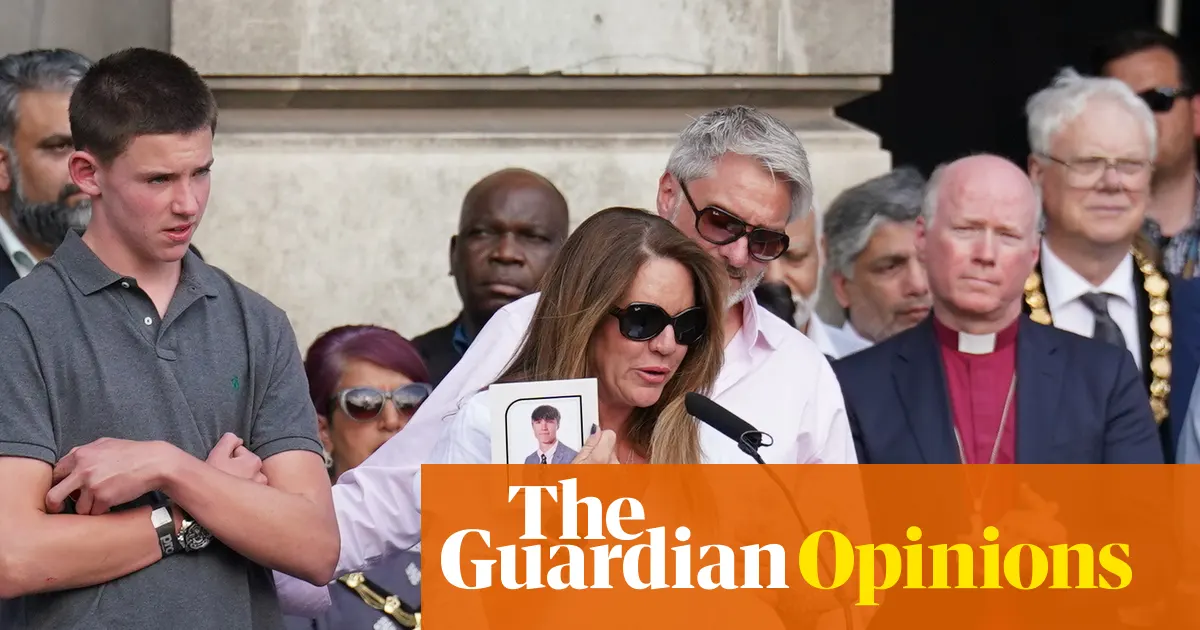
Reckless political rhetoric risks derailing crucial inquiries into recent tragic killings by exploiting them for culture war battles, according to Guardian columnist Gaby Hinsliff. The argument, amplified by figures like Nigel Farage, suggests that a focus on anti-racism and diversity has directly led to the deaths of innocent individuals, a claim Hinsliff contends distracts from the real, complex issues at play.
The column highlights the cases of Henry Nowak in Southampton and Barnaby Webber in Nottingham, both young students who were fatally stabbed. The perpetrator in Nottingham, Valdo Calocane, a paranoid schizophrenic who was not taking his medication, also killed a caretaker and injured others. The initial reports and subsequent handling of these cases have become entangled with broader political debates.
Lessons from Tragedy
Emma Webber, Barnaby’s mother, has been a vocal advocate for a public inquiry into the circumstances surrounding her son’s death. The inquiry has heard evidence on systemic issues within mental health services, including bed shortages and the dismantling of specialist teams. Warnings from experts about a shift away from public safety towards patient autonomy have also been presented. However, Hinsliff points out that these sober lessons are at risk of being lost amidst what she describes as “political grandstanding” by the right.
Shadow home secretary Chris Philp has suggested that doctors’ hesitation to section Calocane, who is black, was influenced by concerns over disproportionately high section rates for black men, directly contributing to the murders. Similar arguments have been made regarding the Southampton case, where a headteacher’s concerns about a student were questioned for racial stereotyping. Claire Coutinho, shadow equalities secretary, has linked these events, along with the Manchester Arena attack, to racism being “weaponised in public services” and costing lives. This narrative aligns with Nigel Farage’s “woke kills” message and his proposals to repeal anti-discrimination laws.
Navigating Complex Truths
Hinsliff argues that such claims oversimplify complex situations. While Calocane was sectioned and discharged multiple times, two doctors stated race did not influence these decisions. However, another doctor, who saw Calocane months before the killings, testified that he was repeatedly told psychiatry was “institutionally racist” and too coercive, especially with young black men. This doctor admitted he was “viscerally” aware of these arguments and believed they “had no bearing on VC’s care.” The upcoming inquiry is tasked with reconciling these differing accounts.
The columnist emphasizes that professionals in demanding fields like policing and medicine are increasingly being asked to navigate a complex landscape of considerations, including the principle that fairness doesn’t always mean treating everyone the same. This requires skilled management and enhanced diversity training, not the “collective hysteria” of politicians. The argument that anti-racism is more dangerous than racism itself is characterized as an anglicized version of a US rightwing talking point that ignores the historical impact of racism.
The article concludes by stating that the true lesson from these tragedies is that kneejerk assumptions, in any direction, are dangerous and must be confronted. The legacy of reports on racism in policing, such as the Macpherson report, should not be dismantled. Instead, lessons must be learned from all tragic events, including those highlighted by the Stephen Lawrence inquiry, to prevent further loss and ensure families are not left with only memories.
Datos clave
| Aspect | Detail |
| :————————- | :——————————————————————- |
| Tragic Events | Murders of Henry Nowak and Barnaby Webber, plus Ian Coates. |
| Perpetrator | Valdo Calocane, diagnosed with paranoid schizophrenia. |
| Political Narrative | Accusations that “woke” ideology led to the deaths. |
| Columnist’s Argument | This narrative distracts from critical discussions on mental health. |
| Recommended Action | Confront kneejerk assumptions, learn from all tragedies. |
This news analysis is relevant to ReviewArticle readers by examining how political discourse can distort and derail important societal conversations, particularly concerning mental health, public safety, and the complex challenges of addressing systemic issues like racism. It highlights the importance of evidence-based journalism that avoids sensationalism and focuses on the substance of critical policy debates.
Fuente: theguardian.com – https://www.theguardian.com/commentisfree/2026/jun/05/nigel-farage-woke-kills-culture-war-henry-nowak-southampton
Datos clave
| Punto | Detalle |
|---|---|
| Fuente | theguardian.com |
| Fecha | 2026-06-05T05:00:27+00:00 |
| Tema | Farage says woke kills – and the real, hard questions we could be asking are swamped by the culture war |
Source
theguardian.com Publicacion original: 2026-06-05T05:00:27+00:00
Related articles

Nepal’s “Flood-Proof” Google Maps Landmark Is Not a Verified Safety Rating
A house that survived a destructive Himalayan flood reportedly appeared on Google Maps as a “flood-proof” attraction. The viral label should not…
Read article
Perplexity Deploys GPT-6 Astra for End-to-End Production and Communication Systems
Perplexity has integrated OpenAI’s GPT-6 Astra to handle communications, software changes, and production monitoring, reducing the need for frequent human check-ins compared…
Read article
Privacy Reports Put AI Smart Glasses Under Scrutiny in France
French association e-Enfance says it has received more than 20 reports involving women allegedly recorded without their knowledge by connected glasses, bringing…
Read article
Snowflake Publishes GTM Blueprint for Closing the AI-to-Revenue Gap
Snowflake’s sales and marketing teams share a repeatable RAMP framework and four revenue leaks they fixed to turn AI pilots into measurable…
Read articleWiki relacionada

AI Model API Pricing and Context Window Comparison: Current Rates and Limits
Compare the latest API pricing, context windows, and capabilities of leading AI model providers including OpenAI, Anthropic, Google, and Mistral. Practical guidance…
Read article
AI Agent Evaluation Frameworks: How to Benchmark Agentic Systems
A practical guide to evaluating AI agents — from task completion metrics to safety, cost, and robustness. Covers major frameworks, primary sources,…
Read article
LLM Benchmarks Decoded: What MMLU, HumanEval, and GSM8K Actually Measure for Developers
A developer-focused breakdown of the most-cited LLM benchmarks — MMLU, HumanEval, GSM8K, MATH, Chatbot Arena — including what they test, their hidden…
Read article
What Is RAG? A Practical Guide to Retrieval-Augmented Generation in 2025
Retrieval-Augmented Generation (RAG) grounds LLM outputs in external data, reducing hallucinations and enabling enterprise use cases. This guide covers how RAG works,…
Read article