
China Begins Mass Production of Domestic Lithography Machines, Threatening AI Chip Supply Chain
A Chinese government-backed company has started manufacturing immersion DUV lithography machines, potentially reducing dependence on ASML and reshaping the AI hardware supply chain. The first units are slated for SMIC and other fabs this year.
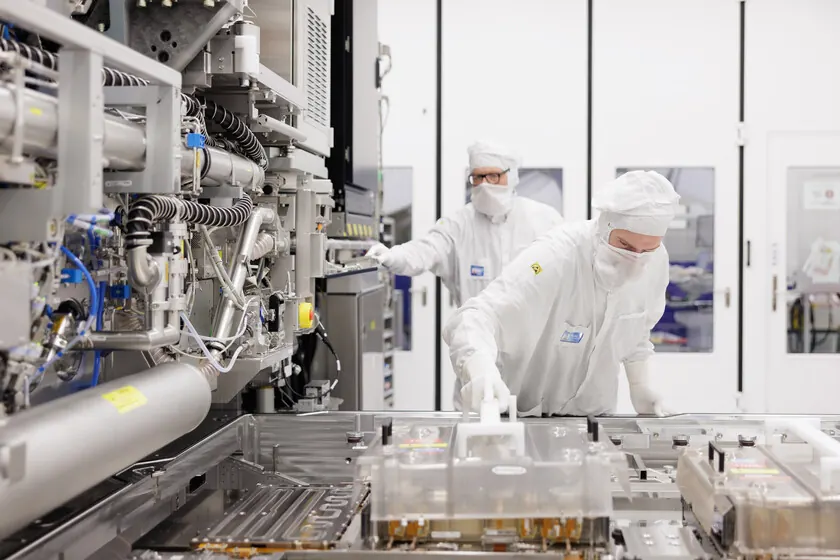
China has taken a significant step toward self-sufficiency in semiconductor manufacturing by beginning mass production of its own immersion deep ultraviolet (DUV) lithography machines. According to a report by The Information, an unnamed Chinese company backed by the government of Xi Jinping has started serial production of the tools that etch circuit patterns onto silicon wafers. The breakthrough could eventually reduce China’s reliance on Dutch giant ASML and weaken the impact of US-led export controls on advanced AI chips.
The company, widely believed to be Shanghai Yuliangsheng Technology, a startup linked to Huawei and SiCarrier, aims to deliver five units this year to Chinese foundries SMIC, Hua Hong Semiconductor, and CXMT (ChangXin Memory Technologies). A further 20 machines are planned for 2027. SMIC has been testing a Yuliangsheng tool since September 2025, according to the report.
Key facts
| Metric | Current status |
|---|---|
| Chinese lithography production target | 5 units in 2026, 20 units in 2027 |
| ASML immersion DUV deliveries (2026 projection) | ~130 units |
| ASML market share in immersion DUV | 7% |
| Chinese machine node capability | 28 nm natively, 7 nm with multipatterning |
The machines are designed for 28 nm process technology, but with advanced multipatterning techniques they could reach 7 nm nodes or potentially finer geometries. That would be sufficient for many AI accelerator chips, edge AI processors, and memory components. However, the Chinese equipment is expected to lag behind ASML in performance, yield, and reliability. Independent analysis from AI Futures Project, published in June, estimates that commercial-scale Chinese immersion DUV production will not arrive until the mid-2030s.
Market and geopolitical impact
The news triggered an immediate sell-off in semiconductor equipment stocks. ASML shares fell as much as 6.5% in Amsterdam, while Applied Materials, Lam Research, and KLA Corp dropped between 4% and 7%. The reaction reflects investor concern that China’s progress could eventually erode ASML’s dominant position in the Chinese market, which remains a significant revenue source despite US and Dutch export restrictions.
The US government is considering additional curbs under the proposed MATCH Act, which could extend restrictions to servicing and maintaining existing lithography equipment already installed in Chinese factories. China’s domestic manufacturing push is a direct response to these tightening controls. The country is also developing extreme ultraviolet (EUV) lithography, but analysts say that project remains in early prototype stages and is years away from commercial chips.
Hardware implications for AI development
For AI developers and cloud providers, the availability of advanced chips is a critical constraint. If Chinese foundries can produce more advanced chips using domestic lithography, the impact of US export controls on AI accelerators and memory could be blunted. However, the current machines still rely on some Japanese components, and qualification testing will take months before large-scale production begins. SMIC has set 2027 as its target for mass production of chips using these tools.
Even if successful, the volume of Chinese machines is tiny compared to ASML’s output. ASML’s CFO Roger Dassen stated in the company’s July earnings call that it expects to deliver around 130 immersion DUV units in 2026, roughly the same as 2025. China’s planned 20 units in 2027 would be equivalent to less than two months of ASML’s production.
Limits and uncertainties
The identity of the manufacturing company has not been officially confirmed. International media have not yet independently verified the production claims. The performance and reliability of the Chinese machines compared to ASML’s tools remain unknown. The AI Futures Project analysis suggests a longer timeline, and the gap between prototype and volume production is wide. Additionally, the effectiveness of multipatterning to reach 7 nm depends on the specific design rules and yields, which have not been disclosed.
Source: Laura López, “China prepara su primera gran victoria en chips: ya fabrica en masa sus propias máquinas de litografía UVP, según The Information,” Xataka, July 28, 2026. https://www.xataka.com/empresas-y-economia/china-prepara-su-primera-gran-victoria-chips-fabrica-masa-sus-propias-maquinas-litografia-uvp-the-information
Source
Xataka IA Publicacion original: 2026-07-28T07:29:00+00:00
Related articles
OCU Finds Spanish Homeowner Communities Overpaying Up to €1,500 on Electricity and €3,515 on Gas—Can AI Tools Optimize Shared Energy Bills?
A new OCU analysis of Spanish homeowner community bills reveals widespread overpayment due to non-competitive tariffs and excess contracted power. Could AI-driven…
Read article
Mayotte fiber dispute does not meet ReviewArticle’s AI news brief
Le Monde reports that France’s competition authority has ordered Orange to suspend part of its fiber-optic rollout in Mayotte. The dispute is…
Read article
DiffEEG Model Uses Diffusion Pre-Training to Improve Seizure Detection from Minimal Labeled Data
Researchers have introduced DiffEEG, a 9.6-million-parameter foundation model that combines denoising diffusion pre-training with reinforcement learning fine-tuning to detect seizure events from…
Read article
The Technology Trap: Why AI Cannot Escape the Unchanging Fundamentals of War
A new Foreign Affairs essay by former Pentagon official Mara Karlin warns that over-reliance on AI and advanced tech in military planning…
Read articleWiki relacionada

AI Model API Pricing and Context Window Comparison: Current Rates and Limits
Compare the latest API pricing, context windows, and capabilities of leading AI model providers including OpenAI, Anthropic, Google, and Mistral. Practical guidance…
Read article
AI Agent Evaluation Frameworks: How to Benchmark Agentic Systems
A practical guide to evaluating AI agents — from task completion metrics to safety, cost, and robustness. Covers major frameworks, primary sources,…
Read article
LLM Benchmarks Decoded: What MMLU, HumanEval, and GSM8K Actually Measure for Developers
A developer-focused breakdown of the most-cited LLM benchmarks — MMLU, HumanEval, GSM8K, MATH, Chatbot Arena — including what they test, their hidden…
Read article
What Is RAG? A Practical Guide to Retrieval-Augmented Generation in 2025
Retrieval-Augmented Generation (RAG) grounds LLM outputs in external data, reducing hallucinations and enabling enterprise use cases. This guide covers how RAG works,…
Read article