
Eric Schmidt Booed by University Graduates Over AI’s Future Impact
Former Google CEO Eric Schmidt faced boos from university graduates when discussing AI's societal transformation, highlighting a growing skepticism among younger generations regarding the technology's promised benefits and its potential disruption to the job market.
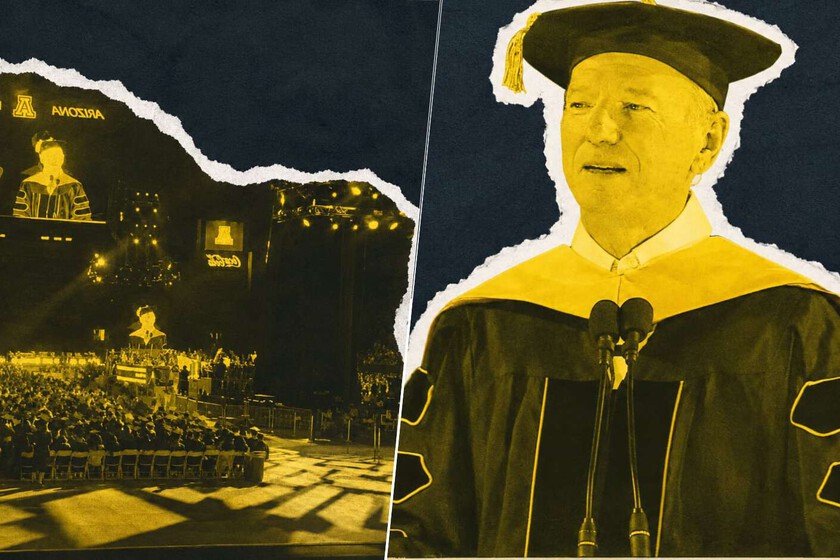
Former Google CEO Eric Schmidt encountered significant pushback from university graduates during a recent commencement speech where he discussed the pervasive impact of artificial intelligence. His assertion that AI would fundamentally change every profession, classroom, hospital, and human relationship was met with boos from the audience, signaling a deep-seated apprehension among younger generations about the future shaped by AI. This reaction underscores a growing divide between AI evangelists and those who perceive the technology as a threat to their economic prospects and societal stability.
Schmidt’s address at a U.S. university, where he spoke to approximately 10,000 students, acknowledged the palpable fear among graduates regarding a future where jobs evaporate and machines dominate. While he framed this anxiety as a rational response amplified by social media algorithms, he urged the graduates to reject the notion of a predetermined future, emphasizing their agency in building it. “The future doesn’t just arrive. It’s built in laboratories, in university dorms, in startups, in classrooms, in legislatures. And the people who will build it will be you and people like you,” Schmidt stated. However, this message of empowerment did not resonate universally, leading to audible dissent from the graduating class.
The incident highlights a broader sentiment among young people concerning the promises and perils of AI, often contrasting sharply with the optimistic outlook presented by many technology leaders.
The Core of the Discontent
The graduates’ reaction, as reported by Xataka IA, was not merely a rejection of AI itself but a complex response to several underlying issues. Many students appear to be wary of being told about a world they are inheriting, one where technology, still imperfect, is poised to impact every aspect of society. A significant point of contention for some was the perceived hypocrisy of an ex-Google CEO, given Google’s extensive use of algorithms and its role in shaping the very digital landscape Schmidt criticized for amplifying fear. The question of whether graduates will be part of shaping AI, or merely subject to its changes, remains a central concern.
This event is not isolated. Similar reactions have been observed at other institutions. Gloria Caulfield, Vice President of Strategic Alliances for Tavistock, faced comparable boos at the University of Central Florida when she compared the current AI revolution to the Industrial Revolution. Caulfield, unlike Schmidt, reportedly paused her speech multiple times due to the intensity of the student response, acknowledging the clear division of opinions. She attempted to draw parallels to the insecurity her own generation felt with the advent of the internet, but this did little to assuage the students’ concerns.
The Job Market and Generational Anxiety
A significant factor contributing to this student skepticism is the current state of the job market, particularly in the United States. Reports from various social media platforms, including TikTok, Reddit, and YouTube, detail instances of university graduates being rejected from jobs for which they are academically overqualified, often entry-level positions at companies like Target, Walmart, or McDonald’s. This disconnect between the promise of a thriving job market fueled by technological advancements and the reality of limited opportunities creates a climate of frustration and anger among the graduating cohort.
The narrative from tech leaders often suggests that AI will create numerous new jobs and industries. Jensen Huang, CEO of Nvidia, for example, recently stated at Carnegie Mellon University that there has never been a better time to embark on one’s life’s work, asserting that AI is a net positive for humanity, creating opportunities, particularly for young people. He famously remarked, “It’s not likely that AI will replace you, but someone using AI better than you will.” However, for many graduates, particularly those not directly involved in AI development, this optimism feels detached from their immediate employment struggles.
Key Incidents of AI Skepticism Among Graduates
- University of Arizona Commencement: Eric Schmidt (ex-Google CEO) | AI will transform everything; graduates must shape the future. | Boos and skepticism about job displacement and tech’s influence.
- University of Central Florida Commencement: Gloria Caulfield (Tavistock VP) | AI era compared to Industrial Revolution. | Strong boos, forcing speaker to pause and acknowledge division.
- CalArts Graduation: Institution President | Praising AI’s potential. | “Monumental anger” over AI’s impact on creative fields.
The “Climate of Unease”
Beyond the job market, there is a general “climate of unease” regarding AI’s societal implications. A study cited by The Guardian indicates that roughly half of young Americans are more concerned than excited about the increasing presence of AI in daily life. This concern is particularly acute in sectors like the arts, as evidenced by the “monumental anger” expressed by graduates at CalArts when the institution’s president lauded artificial intelligence. For these students, the promise of AI often comes with the threat of automation impacting creative professions and devaluing human artistry.
While figures like Jensen Huang emphasize the opportunities AI presents, especially for those entering AI-related fields, the sentiment is that this benefit is not universally distributed. Many graduates feel that the technological shift disproportionately favors a select few, leaving the majority to contend with an uncertain future. This divergence in perspective between the tech elite and the incoming workforce underscores a critical tension in the ongoing development and adoption of AI technologies.
What remains unclear
While the reports clearly indicate widespread student discontent, the specific nuances of their objections are less defined. It is not fully clear if the boos represent a wholesale rejection of AI as a technology, or if they are more targeted at the perceived economic injustices, the role of tech giants in shaping the future, or the perceived hypocrisy of the speakers themselves. Further research into student surveys or more detailed accounts from attendees would be needed to fully disentangle these motivations.
Source: Xataka IA – https://www.xataka.com/empresas-y-economia/eric-schmidt-advirtio-a-jovenes-universitarios-que-ia-cambiara-todo-respuesta-universitarios-abuchearle
Source
Xataka IA Publicacion original: 2026-05-21T11:01:35+00:00
Related articles
OCU Finds Spanish Homeowner Communities Overpaying Up to €1,500 on Electricity and €3,515 on Gas—Can AI Tools Optimize Shared Energy Bills?
A new OCU analysis of Spanish homeowner community bills reveals widespread overpayment due to non-competitive tariffs and excess contracted power. Could AI-driven…
Read article
Mayotte fiber dispute does not meet ReviewArticle’s AI news brief
Le Monde reports that France’s competition authority has ordered Orange to suspend part of its fiber-optic rollout in Mayotte. The dispute is…
Read article
DiffEEG Model Uses Diffusion Pre-Training to Improve Seizure Detection from Minimal Labeled Data
Researchers have introduced DiffEEG, a 9.6-million-parameter foundation model that combines denoising diffusion pre-training with reinforcement learning fine-tuning to detect seizure events from…
Read article
The Technology Trap: Why AI Cannot Escape the Unchanging Fundamentals of War
A new Foreign Affairs essay by former Pentagon official Mara Karlin warns that over-reliance on AI and advanced tech in military planning…
Read articleWiki relacionada

AI Model API Pricing and Context Window Comparison: Current Rates and Limits
Compare the latest API pricing, context windows, and capabilities of leading AI model providers including OpenAI, Anthropic, Google, and Mistral. Practical guidance…
Read article
AI Agent Evaluation Frameworks: How to Benchmark Agentic Systems
A practical guide to evaluating AI agents — from task completion metrics to safety, cost, and robustness. Covers major frameworks, primary sources,…
Read article
LLM Benchmarks Decoded: What MMLU, HumanEval, and GSM8K Actually Measure for Developers
A developer-focused breakdown of the most-cited LLM benchmarks — MMLU, HumanEval, GSM8K, MATH, Chatbot Arena — including what they test, their hidden…
Read article
What Is RAG? A Practical Guide to Retrieval-Augmented Generation in 2025
Retrieval-Augmented Generation (RAG) grounds LLM outputs in external data, reducing hallucinations and enabling enterprise use cases. This guide covers how RAG works,…
Read article