
European Electric Vehicle Sales Show Stark Regional Divide in 2025
A new map reveals significant disparities in electric vehicle adoption across Europe, with Nordic countries leading and Eastern European nations lagging far behind.
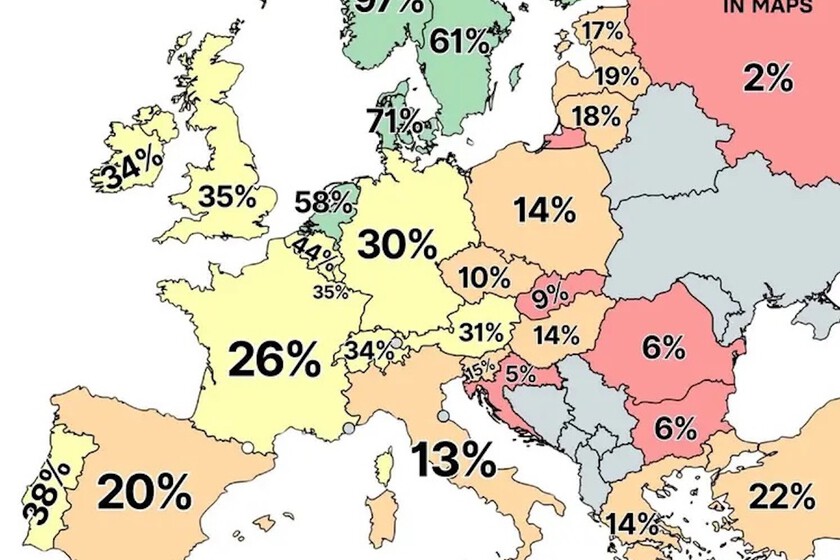
A recent visualization of European electric vehicle (EV) sales for 2025 highlights a deeply divided continent, with the Nordic region far outpacing other areas in adoption. The data, compiled by The World in Maps and drawing from the International Energy Agency’s (IEA) Global EV Outlook 2026, illustrates a significant gap between EV-friendly nations and those still heavily reliant on traditional combustion engines.
This analysis focuses specifically on new vehicle registrations, including both pure electric vehicles (EVs) and plug-in hybrid electric vehicles (PHEVs). It excludes the existing car parc, where electric vehicles currently represent a more modest 5% of the total.
Europe’s EV Market Growth
Across the continent, sales of electric and plug-in hybrid vehicles saw a substantial 30% increase in 2025. This growth rate outpaced the global average, which stood at 20%, pushing total global EV sales past 20 million units. Notably, Europe has now surpassed China as the fastest-growing market for electric vehicles, with Germany, Spain, and Italy showing particularly strong performance.
Despite this overall positive trend, the detailed map reveals a highly heterogeneous picture. State policies, including direct subsidies, tax incentives, and tariff exemptions, play a crucial role in shaping EV adoption rates. While many European countries have seen a progressive decrease in direct public support as sales have climbed, nations like Denmark, Norway, and Turkey continue to offer favorable conditions due to their robust fiscal incentives.
The Nordic Success Story
The map clearly demarcates “Electric Europe,” primarily comprising the Nordic countries and the Netherlands, where EV market share is highest. Norway leads the pack with a remarkable 97% of new car sales being electric or plug-in hybrid. Denmark follows with 71%, Sweden with 61%, and Iceland with 62%.
This success is attributed to a combination of factors: high per capita income, significant taxation on fossil fuel vehicles, long-standing historical incentives for EVs, and a well-developed charging infrastructure. However, even in Norway, fiscal advantages for EVs began to be reduced starting in 2026, signaling a potential shift in market dynamics.
The “Combustion Europe” Divide
In stark contrast, “Combustion Europe” is largely concentrated in the East. Countries like Russia (2% EV sales), Bosnia (5%), Romania, and Bulgaria (6%) show minimal penetration of electric vehicles. These markets are characterized by lower purchasing power, limited charging infrastructure, and a lack of substantial fiscal incentives. Croatia, Greece, and much of the Balkan region fall into a similar category, with EV sales ranging between 5% and 15%. This slower transition occurs despite increasingly stringent EU emissions regulations.
Implications for Climate and Industry
The speed of electrification in Europe is directly linked to the continent’s ability to meet its climate objectives, as road transport is a major source of carbon emissions. Beyond environmental concerns, the shift towards electric mobility has profound implications for the automotive industry. Europe’s historically strong automotive sector is undergoing a significant adaptation, with production and planning increasingly aligned with electric demand. Furthermore, the global EV market also has economic and geopolitical dimensions, with China currently playing a leading role.
Key Facts
| Metric | Value/Region |
|---|---|
| 2025 European EV+PHEV Sales Growth | 30% |
| Leading Region | Nordic countries and Netherlands |
| Norway’s 2025 EV+PHEV Market Share | 97% |
| Lagging Regions | Eastern Europe (e.g., Russia, Bosnia, Romania) |
| Data Source | IEA Global EV Outlook 2026 |
This development matters for ReviewArticle readers by illustrating the uneven adoption of a key sustainable technology. It highlights how policy, economic factors, and infrastructure development influence technological transition, providing context for future AI-driven advancements in automotive and energy sectors.
Source: Las ventas de coches eléctricos en Europa, en un revelador mapa con una península que arrasa. Spoiler: no es la Ibérica by Eva R. de Luis on Xataka: https://www.xataka.com/movilidad/ventas-coches-electricos-europa-revelador-mapa-peninsula-que-arrasa-spoiler-no-iberica
Source
Xataka IA Publicacion original: 2026-07-12T08:01:57+00:00
Related articles
OCU Finds Spanish Homeowner Communities Overpaying Up to €1,500 on Electricity and €3,515 on Gas—Can AI Tools Optimize Shared Energy Bills?
A new OCU analysis of Spanish homeowner community bills reveals widespread overpayment due to non-competitive tariffs and excess contracted power. Could AI-driven…
Read article
Mayotte fiber dispute does not meet ReviewArticle’s AI news brief
Le Monde reports that France’s competition authority has ordered Orange to suspend part of its fiber-optic rollout in Mayotte. The dispute is…
Read article
DiffEEG Model Uses Diffusion Pre-Training to Improve Seizure Detection from Minimal Labeled Data
Researchers have introduced DiffEEG, a 9.6-million-parameter foundation model that combines denoising diffusion pre-training with reinforcement learning fine-tuning to detect seizure events from…
Read article
The Technology Trap: Why AI Cannot Escape the Unchanging Fundamentals of War
A new Foreign Affairs essay by former Pentagon official Mara Karlin warns that over-reliance on AI and advanced tech in military planning…
Read articleWiki relacionada

AI Model API Pricing and Context Window Comparison: Current Rates and Limits
Compare the latest API pricing, context windows, and capabilities of leading AI model providers including OpenAI, Anthropic, Google, and Mistral. Practical guidance…
Read article
AI Agent Evaluation Frameworks: How to Benchmark Agentic Systems
A practical guide to evaluating AI agents — from task completion metrics to safety, cost, and robustness. Covers major frameworks, primary sources,…
Read article
LLM Benchmarks Decoded: What MMLU, HumanEval, and GSM8K Actually Measure for Developers
A developer-focused breakdown of the most-cited LLM benchmarks — MMLU, HumanEval, GSM8K, MATH, Chatbot Arena — including what they test, their hidden…
Read article
What Is RAG? A Practical Guide to Retrieval-Augmented Generation in 2025
Retrieval-Augmented Generation (RAG) grounds LLM outputs in external data, reducing hallucinations and enabling enterprise use cases. This guide covers how RAG works,…
Read article