
Microsoft CEO Satya Nadella Warns of “Inverse Information Paradox” in AI Era
Microsoft CEO Satya Nadella has voiced concerns that companies using AI services risk surrendering valuable institutional knowledge, a phenomenon he terms the "Inverse Information Paradox.

Microsoft CEO Satya Nadella has articulated a significant concern for businesses navigating the burgeoning AI landscape: the “Inverse Information Paradox.” Nadella suggests that companies utilizing AI services may be inadvertently surrendering critical institutional knowledge, a valuable asset that could disproportionately benefit AI providers.
Nadella’s argument draws upon the principles of Kenneth Arrow, a Nobel laureate economist, and his paradox of the information market. Arrow noted that a buyer cannot fully ascertain the value of information until they possess it, at which point it may have been acquired at little to no cost. For Nadella, the AI era presents a reversed challenge.
The Inverse Information Paradox
In Nadella’s view, when companies engage with AI tools, they risk ceding proprietary and confidential knowledge to the AI model’s owner. This occurs because the more a company wishes to refine the AI’s performance, the more data and context it must provide. This process creates an asymmetry where the AI provider gains increasingly deep insights into the client’s operations, while the client learns little about what the provider is learning in return.
Nadella posits that this dynamic could lead to a concentration of economic value towards AI infrastructure owners rather than knowledge creators, especially if learning flows predominantly in one direction. He advocates for distributing learning infrastructure to ensure companies can better control their own learning loops.
Implications for Businesses
Nadella proposes that a company’s competitive edge in AI may lie not just in selecting the best models, but in owning the learning cycle itself. His vision suggests that if Microsoft facilitates access to third-party models like Claude or ChatGPT, the knowledge generated through user interactions and refinements on Microsoft’s platform should ideally remain within Microsoft’s ecosystem, rather than flowing freely to external providers like Anthropic and OpenAI. This data, particularly user corrections and feedback, is seen as a crucial component for continuous AI improvement.
Microsoft’s Strategy: Azure as a Hub
This strategy appears to align with Microsoft’s cloud ambitions, particularly Azure. By encouraging clients to access AI models through its cloud services, Microsoft aims to capture the valuable learning data generated by these interactions. This positions Azure not just as a computing platform, but as a central hub for accumulating proprietary AI learning.
Nadella outlines five key principles for businesses to safeguard their benefits in the AI era:
Control: Establish private evaluations and retain ownership of institutional memory, feedback, and context.
Capacity: Develop proprietary learning environments within secure servers to train or fine-tune models without exposing company knowledge.
Choice: Decouple learning processes from specific models to allow adaptability to various AI systems.
Cost: Achieve efficiency and cost-effectiveness by consolidating context, models, and tasks without compromising quality.
Capitalization: Integrate these elements to create a continuous learning loop that enhances company value for investors.
Nadella suggests that instead of competing on model selection, companies should focus on securing this learning loop knowledge, potentially through platforms like Azure. While major cloud providers like Microsoft, Amazon, and Google offer the necessary server infrastructure, other companies possess the advanced models.
Industry Reactions and Caveats
Not all industry players fully agree with Nadella’s framing. OpenAI and Anthropic, for instance, have indicated that their model advancements rely on factors beyond solely these learning loops, particularly for evolving frontier models for a diverse client base.
The practical implementation of Nadella’s vision may also depend on a company’s computing capabilities. While Azure can provide the necessary services, not all businesses possess the infrastructure to manage such extensive learning loops independently.
Nonetheless, Nadella’s concerns highlight
Datos clave
| Punto | Detalle |
|---|---|
| Fuente | Xataka IA |
| Fecha | 2026-07-14T10:30:07+00:00 |
| Tema | La información es poder y Microsoft ha llegado a una conclusión: se ha cansado de regalarla a las Big Tech de la IA |
Source
Xataka IA Publicacion original: 2026-07-14T10:30:07+00:00
Related articles
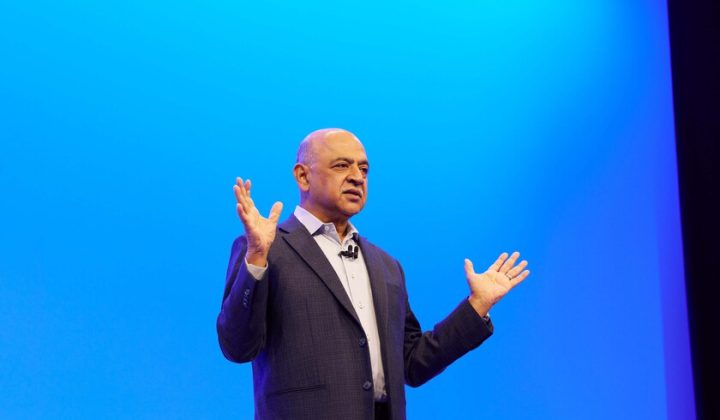
IBM CEO Puts a Number on the Open-Weight AI Value Proposition: 90% of the Performance at 10% of the Token Cost
IBM CEO Arvind Krishna told analysts that open-weight models now deliver about 90% of frontier-model effectiveness while costing between 10% and 25%…
Read article
OCU Finds Spanish Homeowner Communities Overpaying Up to €1,500 on Electricity and €3,515 on Gas—Can AI Tools Optimize Shared Energy Bills?
A new OCU analysis of Spanish homeowner community bills reveals widespread overpayment due to non-competitive tariffs and excess contracted power. Could AI-driven…
Read article
Mayotte fiber dispute does not meet ReviewArticle’s AI news brief
Le Monde reports that France’s competition authority has ordered Orange to suspend part of its fiber-optic rollout in Mayotte. The dispute is…
Read article
DiffEEG Model Uses Diffusion Pre-Training to Improve Seizure Detection from Minimal Labeled Data
Researchers have introduced DiffEEG, a 9.6-million-parameter foundation model that combines denoising diffusion pre-training with reinforcement learning fine-tuning to detect seizure events from…
Read articleWiki relacionada

AI Model API Pricing and Context Window Comparison: Current Rates and Limits
Compare the latest API pricing, context windows, and capabilities of leading AI model providers including OpenAI, Anthropic, Google, and Mistral. Practical guidance…
Read article
AI Agent Evaluation Frameworks: How to Benchmark Agentic Systems
A practical guide to evaluating AI agents — from task completion metrics to safety, cost, and robustness. Covers major frameworks, primary sources,…
Read article
LLM Benchmarks Decoded: What MMLU, HumanEval, and GSM8K Actually Measure for Developers
A developer-focused breakdown of the most-cited LLM benchmarks — MMLU, HumanEval, GSM8K, MATH, Chatbot Arena — including what they test, their hidden…
Read article
What Is RAG? A Practical Guide to Retrieval-Augmented Generation in 2025
Retrieval-Augmented Generation (RAG) grounds LLM outputs in external data, reducing hallucinations and enabling enterprise use cases. This guide covers how RAG works,…
Read article