
Volkswagen’s Poznań Factory Embraces Sheep for Solar Farm Maintenance, Advancing Agrivoltaics
Volkswagen's factory in Poznań, Poland, has integrated a flock of sheep into its solar farm operations, a novel approach that merges renewable energy production with sustainable land management and research into agrivoltaics.
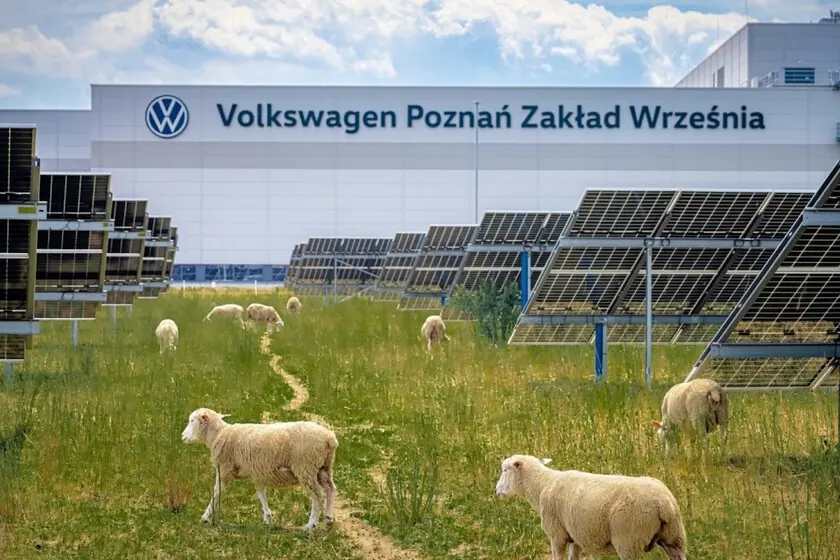
Volkswagen’s manufacturing plant in Poznań, Poland, is implementing an unconventional yet effective strategy for managing its extensive solar farm: a flock of approximately 100 sheep. This initiative replaces traditional, often costly, mechanical maintenance with a time-honored practice, demonstrating a unique application of agrivoltaics—the integration of solar energy generation with agricultural activities.
The solar installation at the Poznań facility is substantial, designed to meet the factory’s full energy demand on days with optimal sunlight and contributing around 25% to its annual energy consumption. A common challenge for large solar farms is the control of vegetation growth, which can impede operations, escalate maintenance expenses, and introduce safety hazards. Conventional solutions typically involve the use of heavy machinery or manual labor, both of which incur significant economic and energy costs.
An Ancient Solution for a Modern Challenge
Volkswagen’s approach bypasses high-tech machinery in favor of a well-established method. The sheep act as natural grazers, effectively managing grass and weeds without the need for mechanical mowers. This not only reduces the risk of damage to the solar infrastructure from equipment but also lowers operational emissions. The flock moves freely across the grounds, maintaining the vegetation in a manner that is both cost-efficient and environmentally conscious.
This project is part of the growing field of agrivoltaics, which explores the synergistic potential of generating solar power and engaging in agricultural or livestock activities on the same land. In collaboration with researchers from the University of Life Sciences in Poznań, the solar farm has been transformed into an open-air laboratory. The research aims to assess the impact of this integrated system on biodiversity, soil quality, microclimate conditions, and animal welfare. A particular focus is on how the shade provided by solar panels may offer thermal relief to the sheep during warmer months.
Nature’s Optimization in Practice
Initial observations indicate a rapid adaptation by the sheep to their new environment. They have naturally dispersed throughout the installation, forming smaller groups in the shaded areas beneath the solar panels. This behavior suggests the animals are comfortable and secure, contributing to a consistent coverage of vegetation. This, in turn, can support the proliferation of insects and other small species, potentially fostering a more biodiverse ecosystem within the solar farm compared to conventionally maintained areas.
The integration of sheep into solar farm management is not entirely novel and has seen increasing adoption in countries such as the United Kingdom and the United States. The fundamental concept of agrivoltaics is to derive multiple benefits from a single land parcel: producing electricity from solar panels while simultaneously supporting agricultural or livestock activities. This strategy can lead to reduced operational costs and an improved environmental profile for solar installations, all without creating competition for land use.
Innovation Beyond Technological Sophistication
The Volkswagen initiative highlights a notable paradox: a company committed to electrification and decarbonization finding a highly effective solution in a practice with millennia of history. In an era where innovation is frequently associated with artificial intelligence, automation, and robotics, Volkswagen’s success with sheep underscores that innovation can also stem from embracing natural processes. The company has demonstrated that, at times, the most efficient and effective solutions are those that leverage natural systems to perform tasks that machines may not replicate with the same efficiency or ecological benefit.
Key Facts
Aspect | Detail
——- | ——–
Location | Volkswagen Poznań factory, Poland
Solar Installation Size | 31,000 panels
Maintenance Method | Flock of approximately 100 sheep
Project Framework | Agrivoltaics (combining solar energy and agriculture)
Research Focus | Biodiversity, soil health, microclimate, animal welfare, vegetation
This development is particularly relevant to ReviewArticle readers as it exemplifies a practical and innovative application of sustainable practices within an industrial context. It illustrates how established renewable energy technologies like solar power can be enhanced by integrating natural systems, offering a model for more efficient and environmentally responsible energy production. The use of sheep for maintenance represents a step towards solutions that are both economically viable and ecologically beneficial, pushing the boundaries of industrial operational strategies.
Source: Volkswagen took a flock of sheep to graze under 31,000 solar panels. It turns out it started to change the way energy is produced, Xataka, https://www.xataka.com/energia/volkswagen-puso-a-pastar-a-ejercito-ovejas-31-000-placas-solares-resulta-que-hacen-algo-que-mantener-cesped-corto
Datos clave
| Punto | Detalle |
|---|---|
| Fuente | Xataka IA |
| Fecha | 2026-07-13T13:00:08+00:00 |
| Tema | Volkswagen llevó a pastar a un ejército de ovejas bajo 31.000 placas solares. Resulta que empezó a cambiar la forma de p |
Source
Xataka IA Publicacion original: 2026-07-13T13:00:08+00:00
Related articles

IBM CEO Puts a Number on the Open-Weight AI Value Proposition: 90% of the Performance at 10% of the Token Cost
IBM CEO Arvind Krishna told analysts that open-weight models now deliver about 90% of frontier-model effectiveness while costing between 10% and 25%…
Read article
OCU Finds Spanish Homeowner Communities Overpaying Up to €1,500 on Electricity and €3,515 on Gas—Can AI Tools Optimize Shared Energy Bills?
A new OCU analysis of Spanish homeowner community bills reveals widespread overpayment due to non-competitive tariffs and excess contracted power. Could AI-driven…
Read article
Mayotte fiber dispute does not meet ReviewArticle’s AI news brief
Le Monde reports that France’s competition authority has ordered Orange to suspend part of its fiber-optic rollout in Mayotte. The dispute is…
Read article
DiffEEG Model Uses Diffusion Pre-Training to Improve Seizure Detection from Minimal Labeled Data
Researchers have introduced DiffEEG, a 9.6-million-parameter foundation model that combines denoising diffusion pre-training with reinforcement learning fine-tuning to detect seizure events from…
Read articleWiki relacionada

AI Model API Pricing and Context Window Comparison: Current Rates and Limits
Compare the latest API pricing, context windows, and capabilities of leading AI model providers including OpenAI, Anthropic, Google, and Mistral. Practical guidance…
Read article
AI Agent Evaluation Frameworks: How to Benchmark Agentic Systems
A practical guide to evaluating AI agents — from task completion metrics to safety, cost, and robustness. Covers major frameworks, primary sources,…
Read article
LLM Benchmarks Decoded: What MMLU, HumanEval, and GSM8K Actually Measure for Developers
A developer-focused breakdown of the most-cited LLM benchmarks — MMLU, HumanEval, GSM8K, MATH, Chatbot Arena — including what they test, their hidden…
Read article
What Is RAG? A Practical Guide to Retrieval-Augmented Generation in 2025
Retrieval-Augmented Generation (RAG) grounds LLM outputs in external data, reducing hallucinations and enabling enterprise use cases. This guide covers how RAG works,…
Read article