
Dubai Company Turns Desert Sand into Sustainable Building Blocks
ARDH Collective is developing DuneCrete and DuneBlocks using local desert sand and date seeds, aiming to reduce cement usage by 50% and address the environmental impact of traditional construction materials.
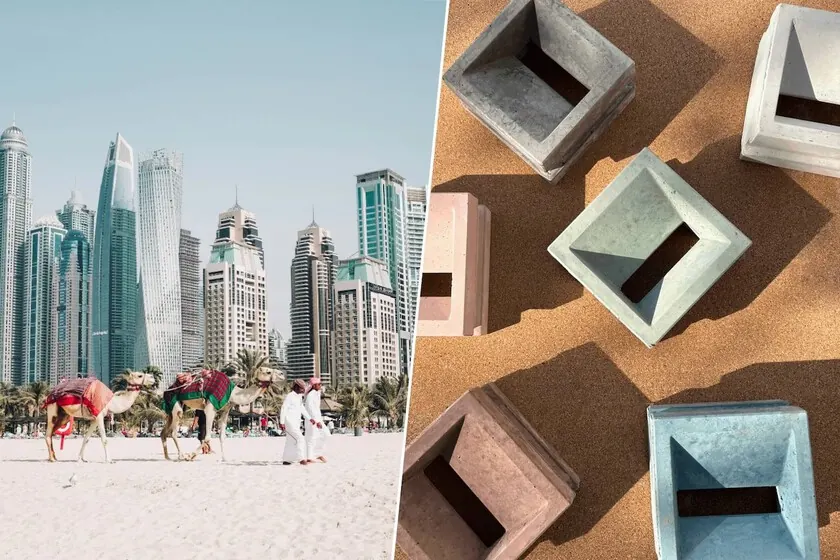
A Dubai-based company, ARDH Collective, is pioneering a new approach to construction materials by utilizing abundant desert sand and date seeds to create sustainable alternatives to conventional concrete and bricks. This innovation, branded as DuneCrete and DuneBlocks, aims to significantly reduce the environmental footprint of the construction industry, a sector responsible for a substantial portion of global CO2 emissions.
The problem with traditional construction materials, particularly cement, lies in their high carbon dioxide output. The production of one ton of Portland cement releases between 0.6 and 0.8 tons of CO2, attributed to both the energy consumed in the manufacturing process and a chemical reaction inherent to its creation. The International Energy Agency reports that the construction industry accounts for 34% of global CO2 emissions. ARDH Collective’s initiative seeks to mitigate this impact by developing materials that rely less on traditional cement.
Introducing DuneCrete and DuneBlocks
ARDH Collective, founded by Alhaan Ahmed, Alyina Ahmed, and Máximo Tettamanzi, has developed DuneCrete as a concrete alternative. This material reduces cement content by 50% by incorporating locally sourced desert sand. The company further produces DuneBlocks from this mixture. Their product line also includes Dateform, a material that repurposes date seeds, with 1,000 seeds used per square meter.
The significance of this development stems from the global consumption of sand. The UN Environment Programme estimates that up to 50 billion tons of sand and gravel are consumed annually worldwide. The extraction of sand from rivers and coastal ecosystems leads to erosion, harms water supplies, damages biodiversity, and diminishes natural storm protection. By shifting to underutilized desert sand, ARDH Collective offers a more sustainable sourcing solution.
Reducing the carbon footprint is a key objective. DuneCrete’s 50% reduction in cement content is projected to halve the CO2 emissions compared to conventional concrete. This is particularly relevant as Portland cement alone contributes to 8% of global emissions, an impact not entirely offset by renewable energy due to the chemical reaction involved in its production.
Overcoming Challenges with Desert Sand
Paradoxically, the United Arab Emirates, despite its vast deserts, has historically imported sand for construction. The primary challenge with desert sand is its particle shape. Wind erosion results in rounded particles, which do not adhere as well in conventional concrete mixtures. River sand, in contrast, has more angular particles that facilitate better compaction and strength. ARDH Collective’s breakthrough lies in developing a formula to stabilize desert sand for use in construction.
The project originated during a master’s program at the Architectural Association School of Architecture in London. With initial funding of $8,000, the team established a laboratory in a Dubai garage during the pandemic. Their research led to the stabilization formula for desert sand. Laboratory tests have reportedly confirmed that the material meets the necessary resistance standards for commercial development, with production commencing in 2021.
Potential and Limitations
While the company has addressed the issue of desert sand particle morphology, scaling the project faces further hurdles. The composition of desert sand varies significantly by region, lacking homogeneity. ARDH Collective claims DuneCrete offers comparable resistance to conventional concrete, but independent academic publications or third-party testing reports validating its mechanical properties are not yet available. Therefore, the full transformative potential of DuneCrete remains to be demonstrated.
Key facts
| Feature | Description |
|---|---|
| Company | ARDH Collective |
| Products | DuneCrete, DuneBlocks, Dateform |
| Primary Material | Desert sand, date seeds |
| Cement Reduction | 50% |
| Location | Dubai, UAE |
| Production Start | 2021 |
| Reported Benefits | Reduced CO2 emissions, sustainable material sourcing, waste repurposing |
| Unconfirmed Claims | Independent validation of mechanical properties and long-term durability |
This development is significant for the AI and technology sector as it highlights innovative applications of material science, often driven by research and development that can be accelerated or informed by AI-driven analysis and simulation. Companies like ARDH Collective demonstrate how technological advancements can address critical global challenges like climate change through novel material solutions.
Source: Emiratos Árabes tiene petróleo y desierto a raudales. Ahora han descubierto cómo aprovechar la arena: convirtiéndola en ladrillo – Xataka (https://www.xataka.com/materiales/emiratos-arabes-tiene-petroleo-desierto-a-raudales-ahora-han-descubierto-como-aprovechar-arena-convirtiendola-ladrillo)
Source
Xataka IA Publicacion original: 2026-06-20T09:30:17+00:00
Related articles

Mexico Reclassifies Sargassum as a Resource, Spurring AI-Optimized Circular Economy Startups
Mexico has reclassified sargassum from waste to a resource, enabling startups to turn the algae into sandals, cosmetics, and bioplastics. The move…
Read article
AI Error Near Strait of Hormuz Raises Questions About Military Automation Risks
A reported AI mistake that nearly triggered an attack on a Chinese vessel near the Strait of Hormuz has brought new scrutiny…
Read article
Google Rebuilds Experimental AI Agent CC to Manage Family Life, Up to Six Users per Household
Google is rebuilding its experimental AI agent CC to coordinate schedules, tasks and communications for up to six family members in the…
Read article
HierSTT Reports 32% Lower Forecast Error Across Portugal’s Emergency Departments
The HierSTT research model generates linked hospital, regional and national demand forecasts. Its authors report 32% lower average WAPE than the strongest…
Read articleWiki relacionada

AI Model API Pricing and Context Window Comparison: Current Rates and Limits
Compare the latest API pricing, context windows, and capabilities of leading AI model providers including OpenAI, Anthropic, Google, and Mistral. Practical guidance…
Read article
AI Agent Evaluation Frameworks: How to Benchmark Agentic Systems
A practical guide to evaluating AI agents — from task completion metrics to safety, cost, and robustness. Covers major frameworks, primary sources,…
Read article
LLM Benchmarks Decoded: What MMLU, HumanEval, and GSM8K Actually Measure for Developers
A developer-focused breakdown of the most-cited LLM benchmarks — MMLU, HumanEval, GSM8K, MATH, Chatbot Arena — including what they test, their hidden…
Read article
What Is RAG? A Practical Guide to Retrieval-Augmented Generation in 2025
Retrieval-Augmented Generation (RAG) grounds LLM outputs in external data, reducing hallucinations and enabling enterprise use cases. This guide covers how RAG works,…
Read article