
Russia’s “Drone Cage” Becomes Russian Roulette as Ukraine Deploys Long-Range Missiles
Satellite imagery revealed Russia's extensive anti-drone measures on a key factory, only for Ukraine to demonstrate their vulnerability with new long-range cruise missiles.
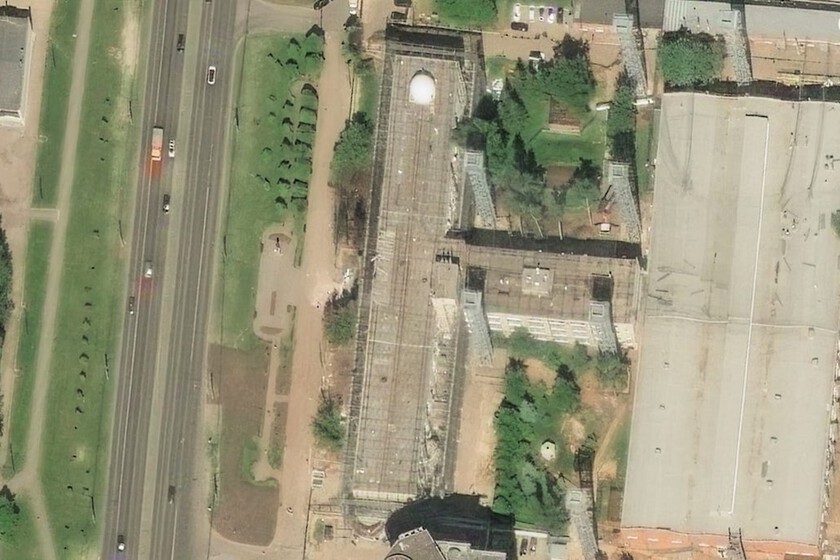
Russia’s attempt to shield a strategic manufacturing plant with a massive “drone cage” has been met with a stark demonstration of vulnerability from Ukraine, highlighting the rapid escalation in the industrial war. Satellite imagery confirmed that Russia had encased a significant portion of the VNIIR Progress plant in Cheboksary, located over 900 kilometers from the front lines, with a formidable metal structure. This measure, intended to defend against drones, has now been rendered potentially obsolete by Ukraine’s deployment of new, long-range cruise missiles.
The VNIIR Progress facility is a critical node in Russia’s military production, manufacturing components essential for a range of weaponry including Shahed-136 drones, Kalibr cruise missiles, Iskander ballistic missiles, and glide bombs. The decision to protect such a deep-rear facility underscores Russia’s assessment of Ukraine’s growing strike capabilities and the erosion of its strategic depth. The “cope cage,” as such structures are informally known, had become a common sight on military hardware, but its application to an entire factory signaled a new phase in hardening industrial assets.
Por que importa
Ukraine’s response, however, has shifted the paradigm. In a recent strike, Kyiv reportedly utilized its domestically produced FP-5 Flamingo cruise missiles, boasting a range exceeding 2,800 kilometers and a warhead exceeding one ton. This development directly challenges the efficacy of the anti-drone cage, which was conceived to counter smaller, lighter drone munitions. Against a missile of the Flamingo’s scale, the elaborate structure appears to function more as a symbolic backdrop than a genuine defensive barrier, suggesting Russia’s defensive measures were designed for a previous iteration of the conflict.
The visible presence of these defensive structures across Russian industrial sites signals a broader psychological and operational impact of Ukraine’s deep-strike campaign. The fortification of previously secure production centers indicates Russia’s ongoing need to redistribute protective resources and absorb additional costs, a clear symptom of the campaign’s success in pressuring Moscow’s rear. This ongoing adaptation reflects a constant technological race, where defensive innovations are quickly countered by offensive advancements.
Contexto
Key facts
| Fact | Detail |
|---|---|
| Russian Facility | VNIIR Progress plant, Cheboksary |
| Protective Measure | Large anti-drone cage structure |
| Ukrainian Weaponry | FP-5 Flamingo cruise missiles (over 2,800 km range) |
| Significance | Demonstrates vulnerability of hardened industrial targets to long-range strikes |
This development is crucial for understanding the evolving nature of AI-influenced warfare, where industrial capacity and technological adaptation are becoming decisive factors. The cat-and-mouse game between defensive infrastructure and offensive weaponry, amplified by AI-driven targeting and autonomous systems, suggests that the front lines of industrial conflict are increasingly blurred.
Source: Imágenes satelitales revelaron que Rusia cubrió un edificio con una jaula antidrón. Ucrania la convirtió en decorado de cine de acción, Xataka, https://www.xataka.com/magnet/imagenes-satelitales-revelaron-que-rusia-cubrio-edificio-jaula-antidron-ucrania-convirtio-decorado-cine-accion
Source
Xataka IA Publicacion original: 2026-06-20T15:01:08+00:00
Related articles

IBM CEO Puts a Number on the Open-Weight AI Value Proposition: 90% of the Performance at 10% of the Token Cost
IBM CEO Arvind Krishna told analysts that open-weight models now deliver about 90% of frontier-model effectiveness while costing between 10% and 25%…
Read article
OCU Finds Spanish Homeowner Communities Overpaying Up to €1,500 on Electricity and €3,515 on Gas—Can AI Tools Optimize Shared Energy Bills?
A new OCU analysis of Spanish homeowner community bills reveals widespread overpayment due to non-competitive tariffs and excess contracted power. Could AI-driven…
Read article
Mayotte fiber dispute does not meet ReviewArticle’s AI news brief
Le Monde reports that France’s competition authority has ordered Orange to suspend part of its fiber-optic rollout in Mayotte. The dispute is…
Read article
DiffEEG Model Uses Diffusion Pre-Training to Improve Seizure Detection from Minimal Labeled Data
Researchers have introduced DiffEEG, a 9.6-million-parameter foundation model that combines denoising diffusion pre-training with reinforcement learning fine-tuning to detect seizure events from…
Read articleWiki relacionada

AI Model API Pricing and Context Window Comparison: Current Rates and Limits
Compare the latest API pricing, context windows, and capabilities of leading AI model providers including OpenAI, Anthropic, Google, and Mistral. Practical guidance…
Read article
AI Agent Evaluation Frameworks: How to Benchmark Agentic Systems
A practical guide to evaluating AI agents — from task completion metrics to safety, cost, and robustness. Covers major frameworks, primary sources,…
Read article
LLM Benchmarks Decoded: What MMLU, HumanEval, and GSM8K Actually Measure for Developers
A developer-focused breakdown of the most-cited LLM benchmarks — MMLU, HumanEval, GSM8K, MATH, Chatbot Arena — including what they test, their hidden…
Read article
What Is RAG? A Practical Guide to Retrieval-Augmented Generation in 2025
Retrieval-Augmented Generation (RAG) grounds LLM outputs in external data, reducing hallucinations and enabling enterprise use cases. This guide covers how RAG works,…
Read article