
China’s Gradual Isolation Strategy Around Taiwan: A New Era of Maritime Pressure
Beijing is transforming routine naval patrols into a daily practice, aiming to isolate Taiwan through sustained presence and control of maritime traffic without firing a shot.
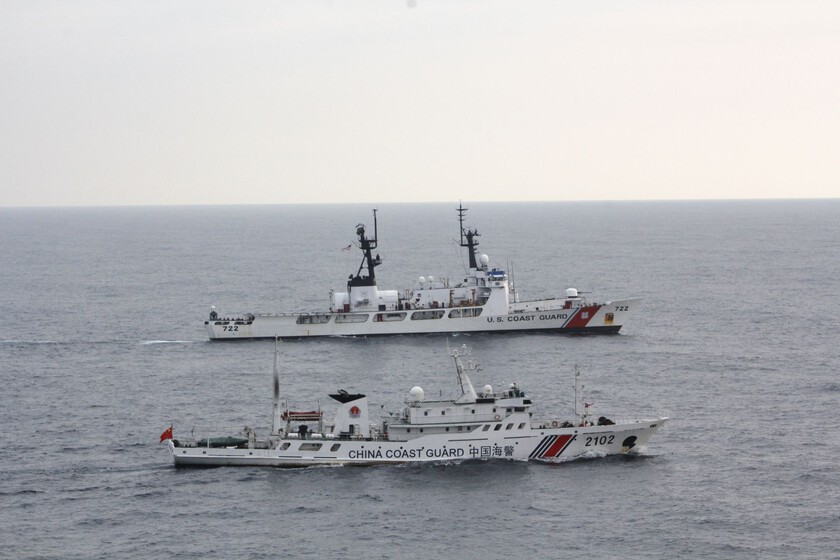
China has developed a sophisticated strategy to gradually isolate Taiwan, employing a continuous daily presence of naval and coast guard vessels. This approach shifts from occasional displays of force to a routine operational posture, aiming to exert pressure and control over maritime traffic without initiating direct military confrontation. The objective is to normalize a heightened state of encirclement, making it a de facto reality before any formal escalation.
Routine Patrols as Training
What was once considered a diplomatic crisis or extraordinary military maneuver—the presence of Chinese warships around Taiwan—has become a daily occurrence. The Wall Street Journal reports that the Chinese navy maintains a consistent presence of five to six warships encircling Taiwan, with numbers increasing during specific operations. These vessels typically remain in the area for approximately two weeks before being relieved by new crews. This continuous rotation allows a growing number of personnel to gain experience in a potential future conflict zone, effectively turning daily patrols into ongoing training for a blockade or invasion.
desgaste y recopilación de información
The constant presence of these ships compels Taiwan to repeatedly deploy its own naval and coast guard units in response. Each Chinese incursion requires Taiwan to dedicate resources to tracking, fuel, maintenance, and maintaining crews on constant alert. While Taiwan expends these resources, China gathers critical intelligence on Taiwanese vessel movements, response times, communication methods, and potential actions during a conflict. This strategy serves a dual purpose: to wear down Taiwan’s operational capacity and to systematically collect intelligence.
Expanding Maritime Control
China is extending its pressure beyond the Taiwan Strait, with its Coast Guard conducting patrols east of Taiwan. This region is a critical hub for international maritime traffic and would be strategically vital in any hypothetical blockade. Beijing’s actions signal an intent to project authority into the western Pacific, asserting its jurisdiction over these waters, not just the immediate strait.
Beyond Surveillance: Enforcing Authority
Chinese Coast Guard vessels are reportedly moving beyond simple surveillance. Reports indicate they have recently begun demanding information from merchant ships regarding their destination, crew, and cargo. Taiwan rejects this assertion of authority. These actions allow Beijing to rehearse maritime traffic control mechanisms using armed civilian agencies, a tactic that presents a more complex challenge for military responses compared to exclusively naval deployments.
The Goal: Normalizing Isolation
China’s ultimate aim is not necessarily an immediate, complete closure of Taiwan’s access. Instead, it focuses on incrementally increasing the intensity and scope of its patrols, familiarizing shipping companies, fishermen, governments, and armed forces with this constant presence. If this situation becomes perceived as the new normal, Beijing will have significantly advanced its isolation strategy without formally initiating a blockade.
The Gradual Blockade
The current operations suggest that a blockade may no longer involve a sudden closure of all access points to Taiwan. Instead, it can be constructed gradually through sustained patrols, inspections, military exercises, coast guard presence, and psychological pressure on maritime traffic. China appears to have recognized that the isolation of Taiwan begins long before any declaration of war, evolving into a daily reality that becomes less surprising with each successive step.
Key facts
| Aspect | Details |
|---|---|
| Strategy | Gradual isolation of Taiwan without direct military conflict. |
| Method | Daily routine patrols by naval and coast guard vessels. |
| Objectives | Maritime traffic control, intelligence gathering, wearing down Taiwan’s resources, normalizing presence. |
| Areas of Operation | Taiwan Strait and eastward into the western Pacific. |
| Source | Xataka |
This development is significant for AI and technology audiences as it highlights the application of strategic, data-driven planning in geopolitical contexts. The continuous maritime operations generate vast amounts of data, potentially involving advanced surveillance and communication technologies. Understanding these evolving geopolitical pressures is crucial for companies and researchers operating in or with interests in the Asia-Pacific region, as it impacts supply chains, technological development, and international collaboration in AI and related fields.
Source: China ha descifrado cómo aislar a Taiwán sin disparar un solo tiro: cinco destructores al día están cada día más cerca, Xataka, https://www.xataka.com/magnet/china-ha-descifrado-como-aislar-a-taiwan-disparar-solo-tiro-cinco-destructores-al-dia-estan-cada-dia-cerca
Source
Xataka IA Publicacion original: 2026-07-10T15:01:57+00:00
Related articles

IBM CEO Puts a Number on the Open-Weight AI Value Proposition: 90% of the Performance at 10% of the Token Cost
IBM CEO Arvind Krishna told analysts that open-weight models now deliver about 90% of frontier-model effectiveness while costing between 10% and 25%…
Read article
OCU Finds Spanish Homeowner Communities Overpaying Up to €1,500 on Electricity and €3,515 on Gas—Can AI Tools Optimize Shared Energy Bills?
A new OCU analysis of Spanish homeowner community bills reveals widespread overpayment due to non-competitive tariffs and excess contracted power. Could AI-driven…
Read article
Mayotte fiber dispute does not meet ReviewArticle’s AI news brief
Le Monde reports that France’s competition authority has ordered Orange to suspend part of its fiber-optic rollout in Mayotte. The dispute is…
Read article
DiffEEG Model Uses Diffusion Pre-Training to Improve Seizure Detection from Minimal Labeled Data
Researchers have introduced DiffEEG, a 9.6-million-parameter foundation model that combines denoising diffusion pre-training with reinforcement learning fine-tuning to detect seizure events from…
Read articleWiki relacionada

AI Model API Pricing and Context Window Comparison: Current Rates and Limits
Compare the latest API pricing, context windows, and capabilities of leading AI model providers including OpenAI, Anthropic, Google, and Mistral. Practical guidance…
Read article
AI Agent Evaluation Frameworks: How to Benchmark Agentic Systems
A practical guide to evaluating AI agents — from task completion metrics to safety, cost, and robustness. Covers major frameworks, primary sources,…
Read article
LLM Benchmarks Decoded: What MMLU, HumanEval, and GSM8K Actually Measure for Developers
A developer-focused breakdown of the most-cited LLM benchmarks — MMLU, HumanEval, GSM8K, MATH, Chatbot Arena — including what they test, their hidden…
Read article
What Is RAG? A Practical Guide to Retrieval-Augmented Generation in 2025
Retrieval-Augmented Generation (RAG) grounds LLM outputs in external data, reducing hallucinations and enabling enterprise use cases. This guide covers how RAG works,…
Read article