
Fried Pizza’s Unexpected Role in Post-War Naples
A deep-fried delicacy, often mistaken for a modern American invention, played a crucial role in feeding Naples during its post-WWII recovery.
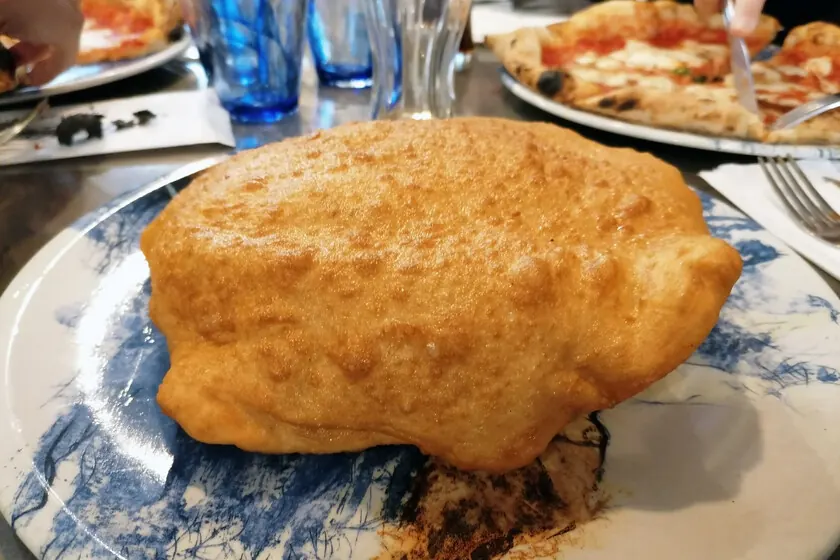
While often perceived as a greasy American fast-food item, fried pizza holds a significant and historically vital place in Neapolitan cuisine, dating back to the desperate years following World War II. This culinary creation emerged not from a desire for novelty, but out of necessity, playing a critical role in sustaining the city of Naples when traditional ovens were destroyed and resources were scarce.
The origins of fried pizza are deeply rooted in Naples’ long tradition of fried dough. Historical texts from the 13th century, such as the “Liber de coquina,” describe fried dough preparations. A direct precursor to modern fried pizza is the “zeppole,” a type of fritter that gained popularity between the late 18th and early 19th centuries. While some zeppole variations are sweet, filled with pastry cream, savory versions incorporating ingredients like anchovies also existed. Initially enjoyed across various Italian cities, zeppole became particularly ingrained in Neapolitan culture. As baked pizza gained prominence, a distinction emerged between the “pizzaiuolo” (pizza maker) and the “zeppolaiolo” (maker of fried doughs).
Por que importa
By the 19th century, fried calzoncini, often filled and fried, were recognized as a more substantial alternative to their sweet counterparts. Recipes began explicitly differentiating between “pizza al forno” (baked pizza) and “pizza fritta di cicoli” (fried pizza with pork cracklings). Fried pizza was solidifying its place as a Neapolitan street food, often utilizing leftover ingredients. However, the true pivot point for its widespread adoption came with the devastation of World War II.
The aftermath of the war left Naples in a state of extreme poverty. Bombings had destroyed many of the city’s essential ovens, and a lack of wood made their repair or replacement impossible. The priority shifted from baking to rebuilding and feeding the populace. With ingredients scarce and expensive, Neapolitan families turned to the familiar concept of zeppole. They adapted by creating larger discs of pizza dough, filling them with affordable ingredients like ricotta, vegetables, or any available scraps of meat, and then frying them. This resourceful adaptation provided a filling and economical meal.
Contexto
This “pizza del popolo” (pizza of the people) became a symbol of resilience and survival. It offered a much-needed source of sustenance for workers during their breaks, embodying the spirit of a city striving to recover. The phrase “a ogge a otto,” meaning “eat today, pay in eight days,” reportedly emerged during this period, underscoring the economic hardship and the role of this accessible food. It represented a form of credit and community support in dire times, helping to fuel the city’s reconstruction.
The popular explosion of fried pizza in the post-war era solidified its cultural significance, even as its roots lay in earlier fried dough traditions. It stands as a testament to Neapolitan ingenuity and culinary heritage, a food born from necessity that continues to be celebrated. This history offers a fascinating contrast to the modern perception of fried pizza, much like the story of the Americano coffee, which many believe originated in the US but was actually an Italian barista’s adaptation for American soldiers during WWII.
Key facts
| Fact | Detail |
|———————–|————————————————————————–|
| Historical Context | Naples, Italy, post-World War II |
| Precursor | Zeppole (Neapolitan fried dough) |
| Driving Factor | Destruction of ovens and scarcity of resources |
| Significance | Provided affordable sustenance and symbolized city’s resilience |
| Modern Perception | Often mistaken for a contemporary American fast-food item |
The story of fried pizza highlights how necessity can drive culinary innovation and preserve cultural traditions in the face of adversity. For readers interested in the intersection of history, culture, and food, this unexpected origin story provides a rich context.
Source: La pizza frita parece una guarrada procedente de EEUU. En realidad se “inventó” para salvar Nápoles tras la Segunda Guerra Mundial, https://www.xataka.com/magnet/pizza-frita-parece-guarrada-procedente-eeuu-realidad-se-invento-para-salvar-napoles-segunda-guerra-mundial
Datos clave
| Punto | Detalle |
|---|---|
| Fuente | Xataka IA |
| Fecha | 2026-07-12T10:01:57+00:00 |
| Tema | La pizza frita parece una guarrada procedente de EEUU. En realidad se "inventó" para salvar Nápoles tras la Segunda Guer |
Source
Xataka IA Publicacion original: 2026-07-12T10:01:57+00:00
Related articles

Nepal’s “Flood-Proof” Google Maps Landmark Is Not a Verified Safety Rating
A house that survived a destructive Himalayan flood reportedly appeared on Google Maps as a “flood-proof” attraction. The viral label should not…
Read article
Perplexity Deploys GPT-6 Astra for End-to-End Production and Communication Systems
Perplexity has integrated OpenAI’s GPT-6 Astra to handle communications, software changes, and production monitoring, reducing the need for frequent human check-ins compared…
Read article
Privacy Reports Put AI Smart Glasses Under Scrutiny in France
French association e-Enfance says it has received more than 20 reports involving women allegedly recorded without their knowledge by connected glasses, bringing…
Read article
Snowflake Publishes GTM Blueprint for Closing the AI-to-Revenue Gap
Snowflake’s sales and marketing teams share a repeatable RAMP framework and four revenue leaks they fixed to turn AI pilots into measurable…
Read articleWiki relacionada

AI Model API Pricing and Context Window Comparison: Current Rates and Limits
Compare the latest API pricing, context windows, and capabilities of leading AI model providers including OpenAI, Anthropic, Google, and Mistral. Practical guidance…
Read article
AI Agent Evaluation Frameworks: How to Benchmark Agentic Systems
A practical guide to evaluating AI agents — from task completion metrics to safety, cost, and robustness. Covers major frameworks, primary sources,…
Read article
LLM Benchmarks Decoded: What MMLU, HumanEval, and GSM8K Actually Measure for Developers
A developer-focused breakdown of the most-cited LLM benchmarks — MMLU, HumanEval, GSM8K, MATH, Chatbot Arena — including what they test, their hidden…
Read article
What Is RAG? A Practical Guide to Retrieval-Augmented Generation in 2025
Retrieval-Augmented Generation (RAG) grounds LLM outputs in external data, reducing hallucinations and enabling enterprise use cases. This guide covers how RAG works,…
Read article