
Professor Spends Seven Years Hand-Copying ‘Don Quixote’ in Gothic Script, Seeks Million-Euro Valuation
A Spanish art teacher has dedicated over six years to meticulously re-writing Miguel de Cervantes' masterpiece, 'Don Quixote,' in Gothic calligraphy, now valuing his unique manuscript at one million euros.
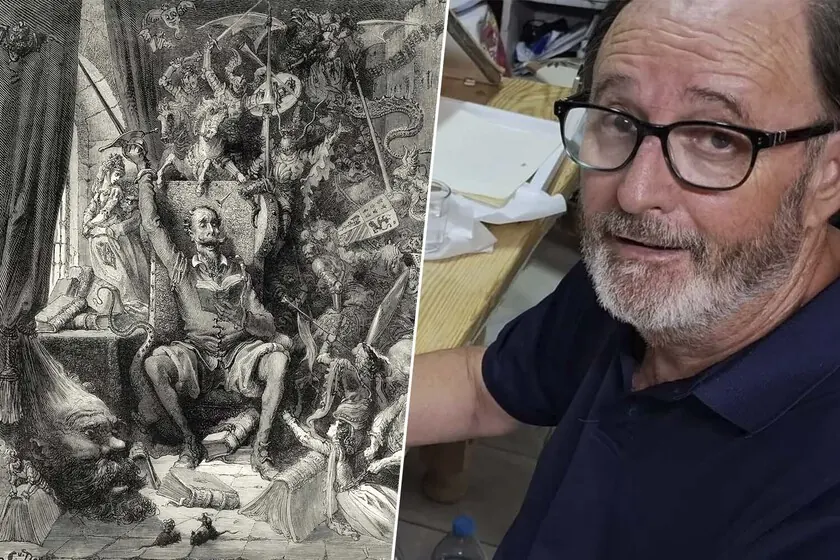
A professor of artistic drawing from Vélez-Málaga, Spain, has embarked on an extraordinary seven-year project: to hand-write Miguel de Cervantes’ epic novel, ‘Don Quixote,’ entirely in Gothic calligraphy. Manuel Marín Navarro has dedicated an estimated seven to eight hours daily to this endeavor, painstakingly recreating the 344,000-word masterpiece. The resulting manuscript, titled ‘El Quixote Axárquico,’ is now nearing completion and is valued by its creator at one million euros.
The Genesis of a Monumental Task
Navarro describes his project as a “madness,” yet one driven by a profound commitment to the literary world. The sheer scale of the undertaking is immense; the final book is expected to weigh around 20 kilograms and will span over 1,300 A3-sized pages. This monumental work is not merely a transcription but a deep dive into the text, with Navarro immersing himself in the era and characters by listening to 17th-century music and reading chapters before beginning each section. His personal library boasts over 4,000 volumes, with 300 dedicated to various editions of ‘Don Quixote,’ underscoring his lifelong passion for the novel.
Artistic and Historical Significance
The choice of Gothic script, specifically the Textura style, is deliberate. Navarro notes its historical association with knowledge and its dramatic weight, requiring significant manual dexterity. He has even crafted his own quills from cane and metal to achieve the precise strokes, eschewing modern correction fluid for a blade to meticulously remove any errors. This commitment to historical accuracy and artisanal craftsmanship sets his work apart from contemporary digital creations. The project’s name, ‘El Quixote Axárquico,’ is a nod to the original 1605 edition and a tribute to his native Andalusian region.
A Labor of Love and Calculation
The one-million-euro valuation is not arbitrary but stems from a calculation of the immense labor involved. Navarro has meticulously tracked his hours, days, and years of work, equating his efforts to that of a medieval scribe in today’s market. He has already penned an estimated 2.1 million characters, each stroke a testament to his dedication. The sheer size of the manuscript necessitates a unique binding, and Navarro is reportedly seeking an artisan capable of creating a cover using an entire cowhide.
Connecting to Cervantes’ History
Navarro’s choice of Vélez-Málaga as the creative hub for his ‘Don Quixote’ project also carries historical resonance. Cervantes himself spent time in the region in 1594 as a tax collector, a period that eventually led to his imprisonment and is believed to have influenced the creation of ‘Don Quixote.’ By dedicating this work to the city’s museum, Navarro aims to bring the manuscript’s origin full circle, ensuring it remains accessible to the public and protected from private acquisition or mass reproduction.
Facing Challenges and Inspirations
The project has not been without its hurdles. Navarro contracted COVID-19 during the confinement period, but his determination to complete the manuscript led him to continue working even while ill. He has also drawn inspiration from the numerous artists who have illustrated ‘Don Quixote’ throughout history, from Gustave Doré and Pablo Picasso to Salvador Dalí, though his own project focuses purely on the textual transcription.
The Value of the Tangible
In an era dominated by digital media and AI-generated content, Navarro’s project stands out as a powerful assertion of the value of tangible, handcrafted art. The million-euro price tag, while seemingly astronomical, serves a dual purpose: to reflect the immense time and skill invested and to deter potential buyers from commodifying a work intended for preservation and public appreciation. It represents the “useless and beautiful immortality” of a text that continues to inspire dedication across centuries.
Key facts
| Detail | Information |
|---|---|
| Creator | Manuel Marín Navarro |
| Project | Hand-copying ‘Don Quixote’ in Gothic calligraphy |
| Duration | 6 years, 7 months, 26 days (and ongoing) |
| Estimated Weight | 20 kg |
| Valuation | €1 million |
| Location | Vélez-Málaga, Spain |
This unique fusion of literature, art, and historical dedication offers a counterpoint to the rapid, often ephemeral nature of digital content creation. Navarro’s endeavor highlights the enduring human impulse to engage deeply with classic works through painstaking manual craft, a process starkly different from the automated or AI-assisted content generation prevalent today.
Source: Un profesor de Málaga decidió reescribir el ‘Quijote’ en caligrafía gótica. Ahora dice que vale un millón de euros – Xataka: https://www.xataka.com/magnet/profesor-malaga-decidio-reescribir-quijote-caligrafia-gotica-ahora-dice-que-vale-millon-euros
Source
Xataka IA Publicacion original: 2026-07-17T09:00:08+00:00
Related articles

Nepal’s “Flood-Proof” Google Maps Landmark Is Not a Verified Safety Rating
A house that survived a destructive Himalayan flood reportedly appeared on Google Maps as a “flood-proof” attraction. The viral label should not…
Read article
Perplexity Deploys GPT-6 Astra for End-to-End Production and Communication Systems
Perplexity has integrated OpenAI’s GPT-6 Astra to handle communications, software changes, and production monitoring, reducing the need for frequent human check-ins compared…
Read article
Privacy Reports Put AI Smart Glasses Under Scrutiny in France
French association e-Enfance says it has received more than 20 reports involving women allegedly recorded without their knowledge by connected glasses, bringing…
Read article
Snowflake Publishes GTM Blueprint for Closing the AI-to-Revenue Gap
Snowflake’s sales and marketing teams share a repeatable RAMP framework and four revenue leaks they fixed to turn AI pilots into measurable…
Read articleWiki relacionada

AI Model API Pricing and Context Window Comparison: Current Rates and Limits
Compare the latest API pricing, context windows, and capabilities of leading AI model providers including OpenAI, Anthropic, Google, and Mistral. Practical guidance…
Read article
AI Agent Evaluation Frameworks: How to Benchmark Agentic Systems
A practical guide to evaluating AI agents — from task completion metrics to safety, cost, and robustness. Covers major frameworks, primary sources,…
Read article
LLM Benchmarks Decoded: What MMLU, HumanEval, and GSM8K Actually Measure for Developers
A developer-focused breakdown of the most-cited LLM benchmarks — MMLU, HumanEval, GSM8K, MATH, Chatbot Arena — including what they test, their hidden…
Read article
What Is RAG? A Practical Guide to Retrieval-Augmented Generation in 2025
Retrieval-Augmented Generation (RAG) grounds LLM outputs in external data, reducing hallucinations and enabling enterprise use cases. This guide covers how RAG works,…
Read article