
AI-Driven 3D Imaging Reveals New Secret of Roman Concrete Durability from Hadrian’s Toilet
A new study uses advanced 3D imaging to uncover a carbonation mechanism that helped Roman concrete last millennia. The sample came from a sewer beneath Hadrian’s villa latrine, and the findings could feed AI models for designing modern durable cements.
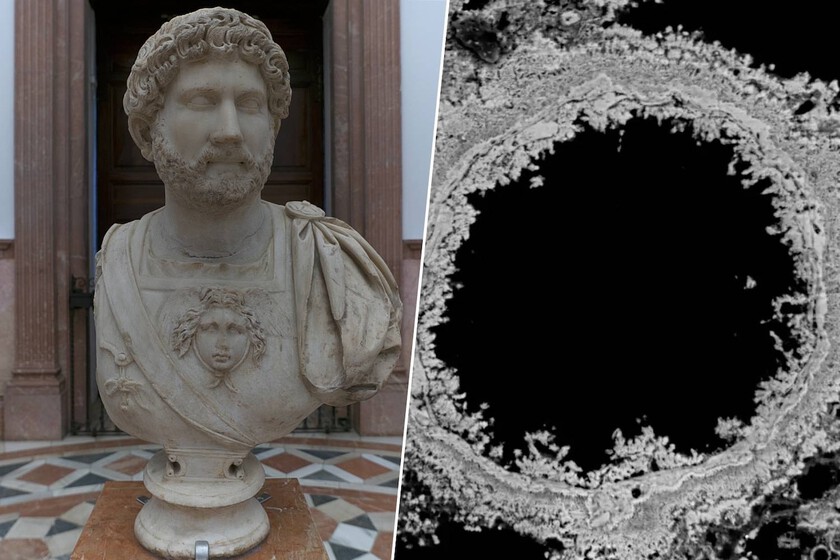
The durability of Roman concrete has puzzled engineers for centuries. While the Pantheon’s dome still stands after 2,000 years, modern concrete often crumbles within decades. Now a team of researchers has used advanced 3D imaging—a technique increasingly powered by AI—to identify a second mechanism behind the material’s longevity. The sample came from a surprising place: the sewer beneath a communal latrine in Hadrian’s villa at Tivoli, Italy.
The study, published in *Science Advances* on July 24, 2026, confirms that the well-known pozzolanic reaction (lime and volcanic ash) is not the whole story. The researchers found that a slow, natural carbonation process also contributed significantly, forming calcite crystals that gradually filled cracks and pores, making the concrete denser and more resistant to water and chemical attack.
The 3D reconstruction was performed using high-resolution X-ray microtomography, a method that can be enhanced by AI-based segmentation and image analysis. The team created detailed maps of the internal structure, showing how calcite deposits accumulated over centuries. This level of detail would be difficult to achieve without automated algorithms that classify mineral phases and pore geometries.
Why this matters for AI and materials science
The discovery opens a new avenue for designing modern cements that mimic Roman concrete’s self-repairing properties. AI models trained on microstructural data from thousands of samples could predict how different compositions and curing conditions affect long-term carbonation. Companies like CarbonCure and Solidia already use AI to optimize CO2 injection in concrete, and this study provides a new natural process to emulate.
Machine learning could also help identify other ancient construction sites where similar carbonation mechanisms may have occurred, using satellite imagery and ground-penetrating radar. The Vatican’s archaeological office has already expressed interest in non-destructive testing methods for historic structures.
The toilet sample: why it was chosen
The sample was taken from the concrete lining of a sewer channel under one of the seats in the western Canopus complex of Hadrian’s Villa. The location was ideal because it had been protected from rain and direct sunlight, allowing a slow, steady carbonation process. The researchers noted that the calcite formation was more pronounced in this interior environment than in outdoor Roman concrete, which may explain why previous studies underestimated the role of carbonation.
Key facts from the study
| Aspect | Detail |
|---|---|
| Source | Sewer under a latrine seat in Hadrian’s Villa, Tivoli, Italy |
| Main finding | Slow carbonation formed calcite, reinforcing concrete over centuries |
| Method | 3D X-ray microtomography with digital image analysis |
| Publication | Science Advances*, July 2026 |
| Potential AI use | Training models to predict carbonation rates in modern cement mixes |
Limitations and open questions
The study is based on a single sample from an indoor environment. The authors caution that the results may not apply to Roman concrete used in marine settings, where different self-repair mechanisms (e.g., reaction with seawater) have been observed. Further research on multiple samples from various sites is needed, and AI could help correlate microstructural features across large datasets.
What is still unclear is whether the carbonation effect can be accelerated in modern concrete without compromising its strength. The team is already working with a materials AI startup to design experiments that test different lime-to-aggregate ratios and humidity levels.
How this fits with other Roman concrete research
In 2023, MIT researchers showed that Roman concrete contained white lime clasts that allowed self-healing via hot mixing. The new study adds a complementary mechanism: even after the initial hot mix, the concrete continues to slowly strengthen through carbonation. Both processes could be incorporated into AI-driven generative design tools for next-generation building materials.
The Vatican’s chief archaeologist, Dr. Maria Pia Donato, commented that the findings “could help preserve ancient monuments without invasive restoration, by using climate-controlled environments that encourage natural carbonation.”
Reader value and next steps
For engineers and materials scientists, this study provides a concrete (pun intended) target for computational modeling. The 3D image data is publicly available, and researchers can use it to train segmentation algorithms. For the general reader, the lesson is that nature’s slow chemistry can outperform modern quick-setting cements—and that AI is helping us understand how.
Before adopting these methods for commercial use, however, the research community needs to replicate the findings on a wider set of samples. The Vatican, the University of Rome, and the MIT Concrete Sustainability Hub are planning a joint study using AI to scan Roman concrete from the Colosseum and the Baths of Caracalla.
Source: Original report at Xataka (https://www.xataka.com/magnet/vater-adriano-revela-nuevo-secreto-durabilidad-hormigon-romano) and the study “Mineralized carbonates contribute to the millennial durability of Roman concrete” in *Science Advances* (2026).
Source
Xataka IA Publicacion original: 2026-07-25T16:00:27+00:00
Related articles

A Simple Traffic-Light Protocol: How a 1966 Incident Shaped Modern AI Communication Design
A communication breakdown between a referee and a player during the 1966 World Cup led to the invention of yellow and red…
Read article
AI data center energy hunger gives wave power a second chance as CorPower prototype passes certification
A Swedish wave energy converter has received the first independent prototype certification for wave power, as AI data centers’ growing electricity demand…
Read article
Balcony Washing Machines in Spain: AI Noise Monitoring Tools Could Trigger Fines Up to €3,000
Spanish homeowners installing washing machines on balconies risk fines up to €3,000 under noise regulations. New AI-powered sound monitoring systems used by…
Read article
The Galician Mathematician Who Helped Define the Meter: A Historical AI-Free Profile
Pedro Xosé Rodríguez González, a self-taught mathematician from rural Galicia, played a key role in the expedition that fixed the length of…
Read articleWiki relacionada

What Is a Context Window in AI Models? A Practical Guide
Understand how context windows define the memory and reasoning scope of large language models, with real limits, comparisons, and practical implications for…
Read article
AI Model Evaluation Benchmarks: A Practical Guide for Developers
Compare AI models with confidence. This guide explains the most common benchmarks—MMLU, HumanEval, GPQA, and others—what they measure, their limits, and how…
Read article
AI Agent Evaluation Benchmarks: What They Measure and How to Use Them
A practical guide to the major benchmarks for evaluating AI agent performance, including GAIA, AgentBench, and WebArena, with source-backed comparisons and limitations.
Read articleUnderstanding Retrieval-Augmented Generation (RAG) in AI
Retrieval-Augmented Generation (RAG) combines large language models with external knowledge bases, allowing AI systems to generate more informed and accurate responses by…
Read article