
Beyond the Hype: Navigating the Labyrinth of AI Information
In an era saturated with AI claims, expert analysis and rigorous source evaluation are paramount. This column delves into the critical skills needed to discern fact from fiction in the ever-evolving AI landscape, offering a framework for readers to test and verify information.


The artificial intelligence landscape is a whirlwind of innovation, promising revolutionary advancements and disruptive technologies at an unprecedented pace. Yet, this rapid evolution is often accompanied by a deluge of claims, analyses, and pronouncements that can be difficult to navigate. For professionals, founders, and creators in the AI space, the ability to discern credible information from hype is not just a useful skill—it’s a strategic imperative. This column argues that adopting a rigorous, source-led approach to evaluating AI information, akin to journalistic best practices, is essential for making informed decisions and avoiding costly missteps.
Why this signal matters now
We are witnessing an explosion of AI news, tool releases, and research papers, each vying for attention. From claims of AGI breakthroughs to the latest “game-changing” AI tool, the sheer volume can overwhelm even seasoned practitioners. Without a robust framework for evaluating sources and claims, it’s easy to fall prey to marketing hyperbole, misinterpret research findings, or invest in technologies based on flimsy evidence. The consequences can range from wasted development cycles and misallocated resources to reputational damage and missed opportunities. As AI becomes more integrated into critical infrastructure and business operations, the need for reliable, verifiable information has never been greater.
What the strongest sources show
Evaluating information, particularly in rapidly evolving fields like AI, requires a multi-pronged approach. Academic and journalistic guides offer valuable frameworks. The SIFT method, for instance, encourages readers to Stop, Investigate the Source, Find Better Coverage, and Trace Claims to the Original Context (University of Portland Library). This systematic approach helps move beyond initial impressions and delve into the credibility and potential biases of information.
Cornell University Library’s critical appraisal guides emphasize examining the publication history of a source. Are there multiple editions, suggesting revision and updates? Is the publisher reputable, such as a university press for scholarly work? For web sources, are revision dates present? Distinguishing between scholarly and popular sources is also crucial, as they cater to different audiences and levels of technical depth. Popular sources, while accessible, require careful evaluation of author expertise, publisher agenda, and evidence presented (Cornell University Library).
Purdue OWL’s guidance on citing periodicals, while focused on academic citation, highlights the importance of identifying authors, titles, and publication details for magazines, newspapers, and journals. This attention to metadata is a proxy for the underlying need to verify the origin and context of any piece of information (Purdue OWL).
Similarly, publications like CIO Review and Statista, while often aggregating content or presenting data, serve as examples of platforms that can provide industry trends or statistical insights. However, their individual articles or data points still require scrutiny regarding their own sources, methodologies, and potential biases. For instance, Statista provides market data, but understanding how that data was collected and its specific context is vital for accurate interpretation. CIO Review features articles often authored by industry leaders, which can offer valuable perspectives but should be cross-referenced with other sources to ensure a balanced view.
Where it helps in a real workflow
Applying these evaluation principles directly impacts several AI-related workflows:
- Tool Selection: When evaluating a new AI tool, instead of relying solely on a product launch announcement or a glowing review from a less reputable source, one would investigate the publisher’s history, the author’s credentials, and look for independent analyses or comparisons. This means checking if the tool’s claims about performance, pricing, or features are supported by official documentation, pricing pages, or verifiable benchmarks, rather than just marketing copy.
- Research Interpretation: When encountering a new AI research paper or a claim about a model’s capabilities, the SIFT method becomes invaluable. Instead of accepting a headline at face value, one would trace the claim back to the original paper or model card. Are the authors transparent about limitations and potential failure modes? Are there other research groups that have replicated or commented on the findings?
- Investment and Strategy Decisions: For founders and executives, evaluating market signals requires a deep dive into the sources of information. Is a trend being reported by a broad range of credible, diverse sources, or by a few outlets with a clear agenda? Understanding the publisher’s audience and potential biases can reveal whether a reported market shift is a genuine signal or a manufactured narrative.
Where it can fail or mislead
The primary pitfall is succumbing to the “convenience” of popular or easily accessible information without critical examination. This can lead to several issues:
- “Fake News” and Misinformation: As highlighted by the University of Portland, satire can be mistaken for genuine news, and media bias charts, while useful, are not definitive pronouncements. In the AI space, this can manifest as exaggerated claims about AI capabilities (e.g., sentience, perfect accuracy) or the deliberate spread of misinformation for commercial or ideological gain.
- Oversimplification: Popular sources may lack the technical depth to accurately represent complex AI concepts, leading to misunderstandings about how models work, their limitations, or their true costs. For example, a blog post might discuss a new AI model’s impressive output without detailing the massive computational resources or specific fine-tuning required.
- Unverified Claims: Many AI tools and platforms are marketed with bold claims that lack verifiable evidence. Without checking official documentation, pricing pages, or independent reviews, users might assume features are available, perform at a certain level, or come at a specific cost that isn’t accurate. This is particularly problematic for enterprise-grade features or security assurances.
- “Churnalism”: The practice of repackaging existing information without adding new insight or verification can create the illusion of comprehensive coverage. This is common in news aggregators or even some industry publications that may not have deep technical expertise.
What readers should test next
To navigate this complex information environment, consider these practical steps:
- Source Credibility: Identify the author and publisher of any AI-related claim. | Research author’s expertise, publisher’s reputation, and potential biases. Look for “About Us” or “Editorial Policy” pages. | Assuming authority based on title alone.
- Evidence Trail: Trace claims back to their original source (e.g., research paper, official documentation, dataset). | Use footnotes, citations, or direct links. If none exist, treat claims with skepticism. | Relying on secondary reporting without checking primary sources.
- Scope and Limitations: Look for explicit mentions of the AI model’s or tool’s limitations, failure modes, or out-of-scope capabilities. | Scan research papers for “Limitations” sections, official docs for caveats, or reviews discussing drawbacks. | Accepting broad capability claims without qualification.
- Timeliness and Updates: Note publication dates and check for revisions or updates. | Look for revision dates on web pages, or publication dates for articles/papers. | Assuming old information is still relevant in a fast-moving field.
- Independent Verification: Seek out analyses from multiple, diverse sources, including those with potentially different perspectives. | Compare reporting from technical journals, industry analysts, and academic researchers. | Consuming information from sources with similar biases.
- Practical Application Check: For tool reviews or feature announcements, try to find evidence of real-world application or user workflows. | Look for case studies, user testimonials (with caution), or technical deep-dives into implementation. | Mistaking demos or theoretical use cases for proven, scalable applications.
Sources and limits
The information presented here is synthesized from established academic and journalistic best practices for evaluating information. These methods are broadly applicable but require adaptation to the specific context of AI. The rapid pace of AI development means that sources themselves can become outdated quickly, and new evaluation challenges will emerge. While frameworks like SIFT provide a strong foundation, the ultimate responsibility for critical assessment lies with the reader. The sources provided offer guidance on *how* to evaluate, but the *what*—the specific AI claims and their veracity—requires ongoing, diligent investigation. There is no single, definitive “AI bias chart” or universally agreed-upon scorecard for AI information, necessitating a personalized application of these critical thinking tools.
Update log
- [Date of publication]: Initial publication of the column.
This column aims to equip readers with the tools to navigate the AI information landscape critically. By prioritizing source evaluation, seeking independent verification, and understanding potential biases, we can move beyond the hype and make more informed, effective decisions in the world of artificial intelligence.
Related articles

Context Bombing Turns AI Refusal Mechanisms Against Attackers in New Anti-Prompt Injection Defense
Tracebit’s “context bombing” technique places prohibited text next to fake credentials, causing attacking AI agents to trigger their own safety refusal and…
Read article
How AI Editing Tools and Reddit IP Discovery Are Reshaping Content Creation
The superhero era is fading. YouTube‑born creators are producing hit content using AI‑powered editing tools, audience analytics, and Reddit as a real‑time…
Read article
Samsung Galaxy Watch Ultra2 and Apple Watch Ultra 3 Bring AI Assistants and Health Sensors to Premium Wearables
Samsung’s Galaxy Watch Ultra2 and Apple’s Watch Ultra 3 both pack AI-powered health sensors and voice assistants, but the Samsung model adds…
Read article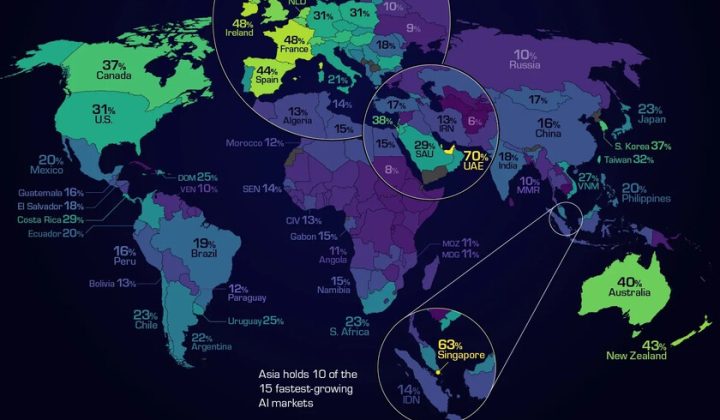
Microsoft AI Diffusion Report Reveals 70% Adoption in UAE, 31% in US, and a Deepening Digital Divide
The Microsoft AI Diffusion Report for Q1 2026 shows 17.8% of global working-age adults use AI, with UAE at 70% and Singapore…
Read articleWiki relacionada

What Is a Context Window in AI Models? A Practical Guide
Understand how context windows define the memory and reasoning scope of large language models, with real limits, comparisons, and practical implications for…
Read article
AI Model Evaluation Benchmarks: A Practical Guide for Developers
Compare AI models with confidence. This guide explains the most common benchmarks—MMLU, HumanEval, GPQA, and others—what they measure, their limits, and how…
Read article
AI Agent Evaluation Benchmarks: What They Measure and How to Use Them
A practical guide to the major benchmarks for evaluating AI agent performance, including GAIA, AgentBench, and WebArena, with source-backed comparisons and limitations.
Read articleUnderstanding Retrieval-Augmented Generation (RAG) in AI
Retrieval-Augmented Generation (RAG) combines large language models with external knowledge bases, allowing AI systems to generate more informed and accurate responses by…
Read article