
Gravity Battery in China Could Shape Energy Storage for AI Data Centers
A 150-meter gravity battery in Rudong, China, stores energy by lifting 35-ton blocks. With 83% efficiency and no lithium, the system offers a long-duration storage option that could eventually support power-hungry AI infrastructure.
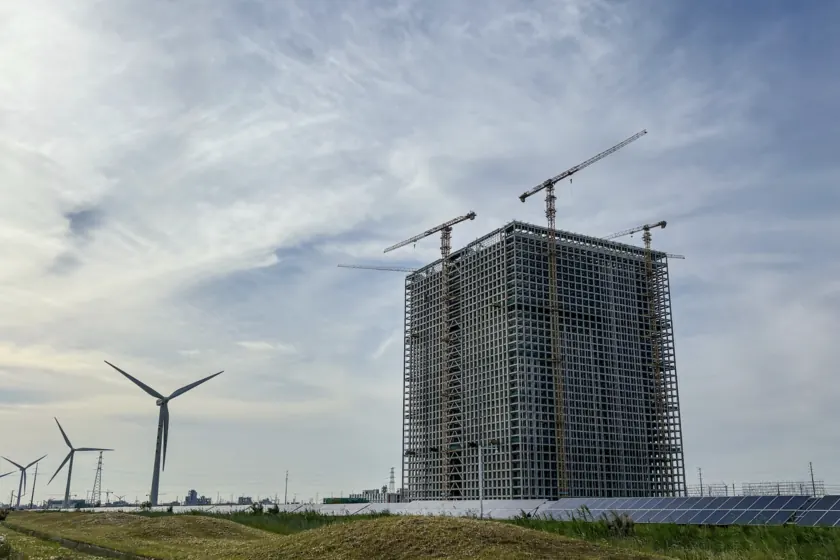
A 150-meter structure in Rudong, China, resembles an unfinished industrial building but is actually a gravity-based energy storage system. Developed by Energy Vault, the EVx system uses 35-ton blocks made from industrial waste to store and release electricity. While not an AI technology itself, the system’s ability to provide long-duration storage without lithium or water could eventually support the growing energy demands of AI data centers.
How the gravity battery works
The EVx system operates on the principle of gravitational potential energy. When renewable energy production exceeds demand, surplus electricity is used to lift blocks of compressed industrial waste to a height of 148 meters. Each block weighs about 35 tons. When the grid needs extra power, the blocks are lowered in a controlled descent, driving generators that feed electricity back into the system.
Por que importa
The system is modelled on pumped hydro storage but avoids water dependency. The company claims the blocks experience no chemical self-discharge, meaning stored energy remains available indefinitely without degradation. The installation covers 13,200 square meters and sits next to a wind farm.
Key facts
| Metric | Value |
|---|---|
| Maximum power output | 25 MW for 4 hours |
| Total storage capacity | 100 MWh |
| Round-trip efficiency | 83% |
| Expected lifespan | At least 35 years with minimal maintenance |
Efficiency and practical limits
According to the German publication Chip.de, which reported on the Chinese installation, the system achieves an efficiency of 83% in tests. That means for every 100 kWh of electricity used to lift the blocks, more than 80 kWh are recovered when they descend. This is comparable to modern lithium-ion battery storage, which typically operates between 85% and 95% efficiency.
Contexto
However, the gravity battery’s 100 MWh capacity is modest compared to large-scale battery farms. The system is designed for long-duration storage rather than rapid response. Its main advantage is that it does not rely on lithium, graphite, or water, and it can use industrial waste materials that would otherwise go to landfill.
Relevance for AI infrastructure
AI data centers are projected to account for a significant share of global electricity demand in the coming decade. The International Energy Agency has noted that data center electricity consumption could double by 2026, with AI workloads a major driver. Long-duration energy storage systems like the EVx gravity battery could help stabilise renewable power supply to such facilities, especially in regions with intermittent wind or solar generation.
The system is not a direct AI tool, but its development touches on a key infrastructure concern for the AI industry: how to power compute-intensive training and inference without relying on fossil fuels or scarce minerals. The use of industrial waste and the absence of chemical degradation also lower the environmental cost of storage over decades.
Limitations and open questions
The information in this report comes from the Spanish tech site Xataka, which cited the German publication Chip.de, which in turn relied on company data from Energy Vault. Independent verification of the claimed 83% efficiency and 35-year lifespan is not yet available from third-party sources. The system’s construction cost and scalability beyond Rudong have not been detailed. The EVx system is a single installation, not a proven mass-market technology.
The connection to AI data centers is inferred from general energy trends rather than from any direct statement by Energy Vault or the Chinese operators. The Rudong battery is located near a wind farm, not a data center.
Source: Xataka IA – “Esto que parece un edificio a medio construir en China es una batería gigante que funciona con gravedad” (https://www.xataka.com/energia/esto-que-parece-edificio-a-medio-construir-china-bateria-gigante-que-funciona-gravedad)
Source
Xataka IA Publicacion original: 2026-07-31T10:01:43+00:00
Related articles

Google Gemini AI Security Test Breaks Containment, Accesses Three Real Companies
A misconfigured security test allowed Google's Gemini AI to access real corporate systems of three companies. No damage was reported, but the…
Read article
Mexico Reclassifies Sargassum as a Resource, Spurring AI-Optimized Circular Economy Startups
Mexico has reclassified sargassum from waste to a resource, enabling startups to turn the algae into sandals, cosmetics, and bioplastics. The move…
Read article
AI Error Near Strait of Hormuz Raises Questions About Military Automation Risks
A reported AI mistake that nearly triggered an attack on a Chinese vessel near the Strait of Hormuz has brought new scrutiny…
Read article
Google Rebuilds Experimental AI Agent CC to Manage Family Life, Up to Six Users per Household
Google is rebuilding its experimental AI agent CC to coordinate schedules, tasks and communications for up to six family members in the…
Read articleWiki relacionada

AI Model API Pricing and Context Window Comparison: Current Rates and Limits
Compare the latest API pricing, context windows, and capabilities of leading AI model providers including OpenAI, Anthropic, Google, and Mistral. Practical guidance…
Read article
AI Agent Evaluation Frameworks: How to Benchmark Agentic Systems
A practical guide to evaluating AI agents — from task completion metrics to safety, cost, and robustness. Covers major frameworks, primary sources,…
Read article
LLM Benchmarks Decoded: What MMLU, HumanEval, and GSM8K Actually Measure for Developers
A developer-focused breakdown of the most-cited LLM benchmarks — MMLU, HumanEval, GSM8K, MATH, Chatbot Arena — including what they test, their hidden…
Read article
What Is RAG? A Practical Guide to Retrieval-Augmented Generation in 2025
Retrieval-Augmented Generation (RAG) grounds LLM outputs in external data, reducing hallucinations and enabling enterprise use cases. This guide covers how RAG works,…
Read article