
Neon Functions puts Node.js compute on Postgres branches for AI agent backends
Neon announced Functions, a Node.js 24 runtime deployed directly onto a Postgres branch with automatic DATABASE_URL injection, aimed at AI agent loops, WebSockets and SSE. Free during beta.
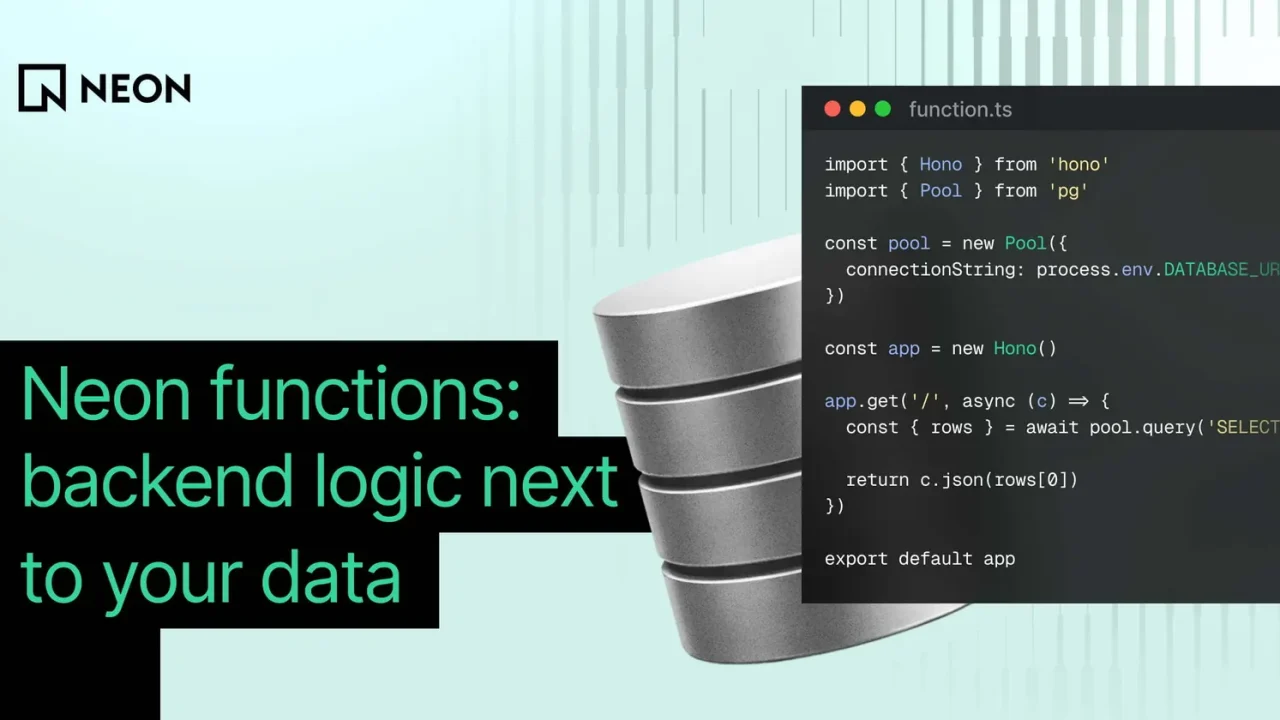
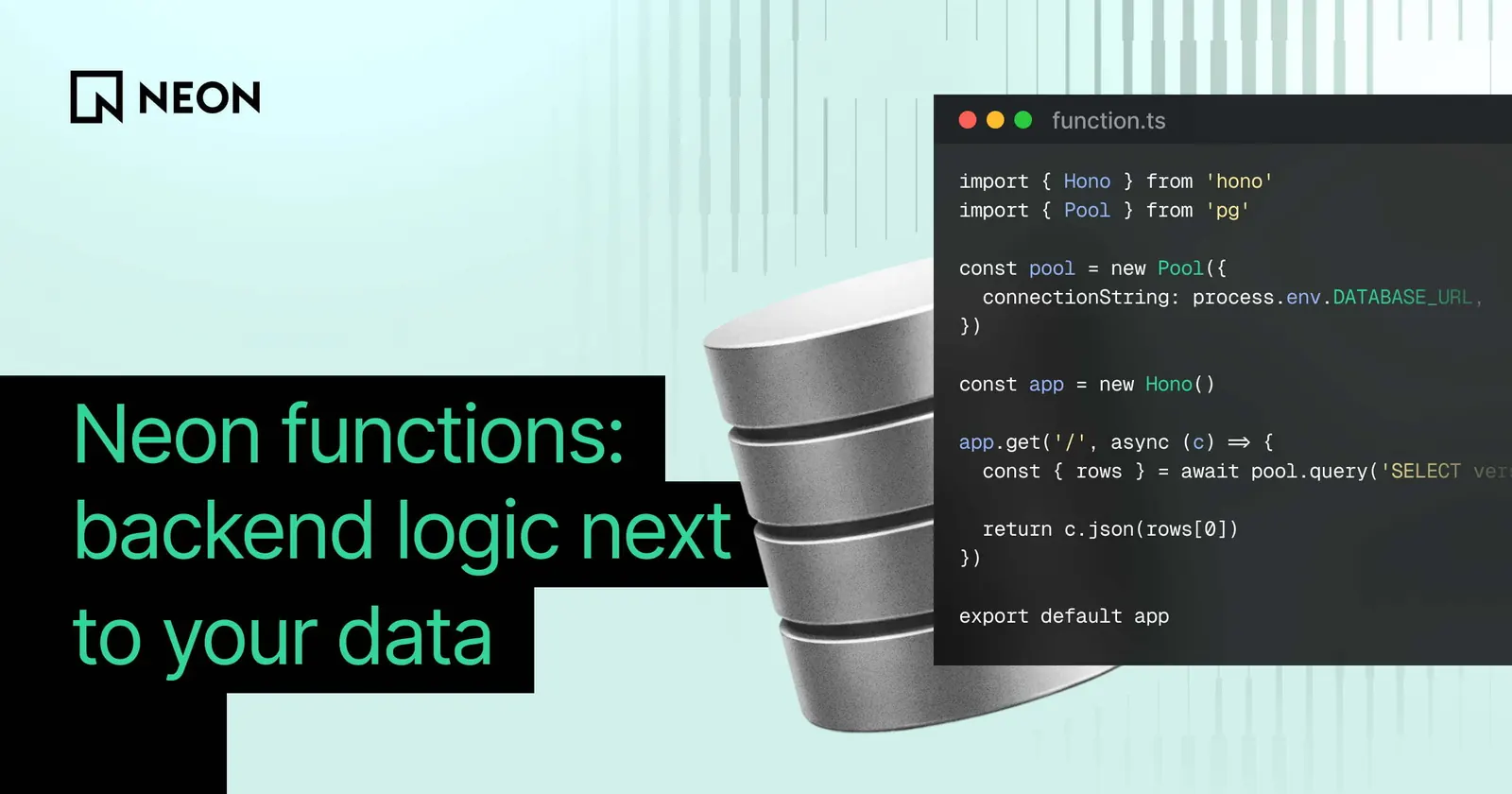
Neon has launched Neon Functions, a compute service that runs Node.js 24 workloads directly on a Neon branch, in the same region as its Lakebase Postgres database. The database connection string is injected automatically at runtime. The company announced the product on August 17, 2026, presenting it as an early piece of a broader “Neon backend” that combines Postgres with Object Storage, Functions, Auth and an AI Gateway.
For developers building AI agent backends on Postgres, the main promise is removing the cross-region hops and short runtime caps that usually push long-lived workloads onto separate infrastructure.
What Neon announced
Neon’s argument is that a database alone is not enough for applications built today, especially when a coding agent ships an entire app. According to the company, Functions targets three frustrations in typical serverless setups: every query pays a cross-network round trip, developers wire secrets themselves, and runtimes often cap at a few seconds.
Functions run on the same infrastructure as Postgres and read the branch’s DATABASE_URL from process.env. If the project also uses Neon’s AI Gateway or Object Storage, those credentials are injected as well, so developers do not need to assemble separate accounts. Because the runtime stays up across requests, a function can keep a long-lived pg Pool open instead of opening a fresh connection on every invocation the way edge-style handlers often do.
Designed for agents and real-time connections
The longer runtime is aimed squarely at AI agent workloads. One agent request can remain active for minutes while the agent calls models and tools, and Neon says Functions is long-running enough for those loops, as well as for WebSockets and SSE connections that stay open while data flows.
A function can export an upgrade handler for WebSockets or return text/event-stream for SSE, and fan out across isolates using Postgres LISTEN/NOTIFY instead of standing up Redis. Neon draws a clear line at background jobs: a function is always requested and always returns a web response such as JSON, an SSE feed or a WebSocket upgrade. For queued work with its own lifecycle, the company suggests pairing a function with something like Inngest.
Functions follow the branch
Branching is Neon’s flagship feature, and Functions uses the same model. A Neon branch acts as a lightweight copy-on-write environment of the database, and functions deployed to a branch are tied to that branch_id. Since Neon now also offers Object Storage, Managed Better Auth and an AI Gateway, those primitives branch as well. According to the company, creating a branch duplicates the entire backend instantly, including any deployed functions.
That design is meant to make preview environments more useful: a branch with its own functions, storage and auth can stand in for the full backend during development, then be discarded when the work is merged.
Deployment via neon.ts
Deployment is handled through neon.ts, Neon’s backend-as-code config. A single file can declare Postgres databases, Functions, Object Storage buckets, Auth and the AI Gateway for a branch. A function is any module whose default export provides fetch(request) and returns a Response, with Hono recommended as the framework.
Neon recommends a module-scope pg Pool using the standard pg driver over @neondatabase/serverless, which is built for short-lived, edge-style invocations rather than this long-running model. The service is free during beta on any pricing plan. Templates are available through neon bootstrap –template, with runnable examples on the Build on Neon page and source code on GitHub.
Limits, pricing and what remains unclear
Today, Neon Functions are invoked over HTTP only. The company says the next layer is a declarative invocation surface: function triggers that let Neon call functions from schedules and service events without an external scheduler or app-tier glue. That work is still in progress and, like Functions themselves, will be branch-scoped.
The announcement does not specify production runtime limits, concurrency caps or a timeline for leaving beta. Neon also positions Functions as part of a larger backend rather than a standalone compute product, so developers are expected to combine it with the surrounding primitives. Independent benchmarks were not included in the announcement, so performance claims rest on Neon’s own description. For first tests, Neon points to its Functions quickstart and asks for feedback on Discord.
| Fact | Detail |
|---|---|
| Runtime | Node.js 24, long-running HTTP handlers with WebSocket and SSE support |
| Location | Deployed onto a Neon branch, same region as Lakebase Postgres |
| Auth | DATABASE_URL and other Neon credentials injected via process.env |
| Pricing | Free during beta on any pricing plan |
| Invocation | HTTP today; branch-scoped function triggers in development |
Source: Neon Blog — Neon Functions: backend logic next to your data (https://neon.com/blog/neon-functions-backend-logic-next-to-your-data)
Source
Neon Blog Publicacion original: 2026-08-17T12:00:00+00:00
Related articles

OCU Finds Spanish Homeowner Communities Overpaying Up to €1,500 on Electricity and €3,515 on Gas—Can AI Tools Optimize Shared Energy Bills?
A new OCU analysis of Spanish homeowner community bills reveals widespread overpayment due to non-competitive tariffs and excess contracted power. Could AI-driven…
Read article
Mayotte fiber dispute does not meet ReviewArticle’s AI news brief
Le Monde reports that France’s competition authority has ordered Orange to suspend part of its fiber-optic rollout in Mayotte. The dispute is…
Read article
DiffEEG Model Uses Diffusion Pre-Training to Improve Seizure Detection from Minimal Labeled Data
Researchers have introduced DiffEEG, a 9.6-million-parameter foundation model that combines denoising diffusion pre-training with reinforcement learning fine-tuning to detect seizure events from…
Read article
The Technology Trap: Why AI Cannot Escape the Unchanging Fundamentals of War
A new Foreign Affairs essay by former Pentagon official Mara Karlin warns that over-reliance on AI and advanced tech in military planning…
Read articleWiki relacionada

AI Model API Pricing and Context Window Comparison: Current Rates and Limits
Compare the latest API pricing, context windows, and capabilities of leading AI model providers including OpenAI, Anthropic, Google, and Mistral. Practical guidance…
Read article
AI Agent Evaluation Frameworks: How to Benchmark Agentic Systems
A practical guide to evaluating AI agents — from task completion metrics to safety, cost, and robustness. Covers major frameworks, primary sources,…
Read article
LLM Benchmarks Decoded: What MMLU, HumanEval, and GSM8K Actually Measure for Developers
A developer-focused breakdown of the most-cited LLM benchmarks — MMLU, HumanEval, GSM8K, MATH, Chatbot Arena — including what they test, their hidden…
Read article
What Is RAG? A Practical Guide to Retrieval-Augmented Generation in 2025
Retrieval-Augmented Generation (RAG) grounds LLM outputs in external data, reducing hallucinations and enabling enterprise use cases. This guide covers how RAG works,…
Read article