
Mediterranean Beaches Face Early and Abundant Jellyfish Blooms, Signaling Ecosystem Imbalance
Increased jellyfish sightings on Mediterranean shores before summer are linked to rising sea temperatures and overfishing, disrupting marine ecosystems and impacting coastal tourism.
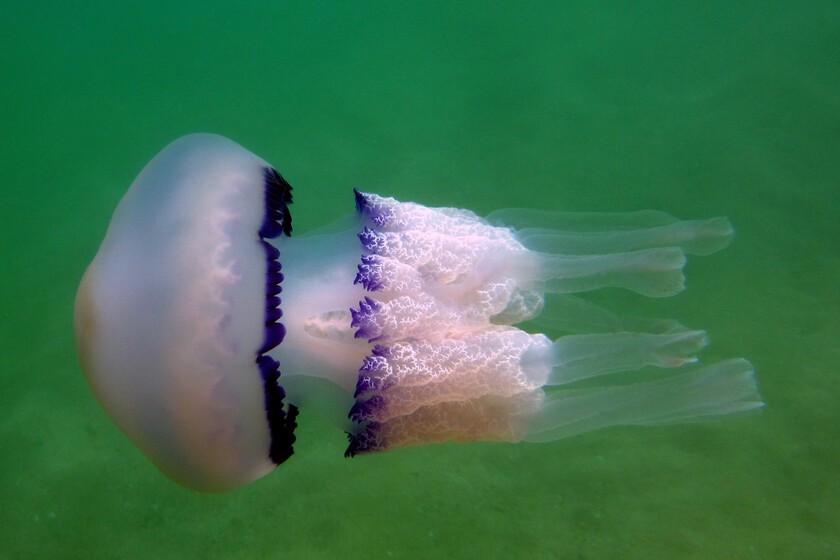
Beaches along the Spanish Mediterranean coast are experiencing an unusually high number of jellyfish sightings earlier in the season, a phenomenon that experts warn signals a broader ecological imbalance. These early and abundant blooms, known as “blooms,” are a growing concern for coastal environments and public enjoyment of seaside areas.
The increased presence of jellyfish, even in May, is becoming a more frequent occurrence, extending beyond traditional warm-water habitats. This trend is prompting a closer look at the underlying causes, which extend beyond simple water temperature increases.
Reproductive Cycles and Warming Waters
The life cycle of most jellyfish involves three stages: larvae, polyps, and finally, adult jellyfish. Polyps attach to the seabed and, under favorable conditions, undergo strobilation to release immature jellyfish, or ephyrae. This process is sensitive to environmental factors, including water temperature.
An increase of just 1.7°C in sea surface temperature has been observed to accelerate asexual reproduction in polyps by up to 20%. This acceleration means that the strobilation, typically occurring in early summer, is happening earlier and potentially leading to more reproductive cycles within a single season. This “dilatation of the reproductive period” results in jellyfish appearing earlier and lingering longer on the coasts.
The Role of Overfishing
While rising sea temperatures contribute to an extended jellyfish season, they are not the sole or primary driver of the massive blooms observed. Scientists point to overfishing as a critical factor in the proliferation of jellyfish.
In a healthy marine ecosystem, various fish species, such as sardines and anchovies, prey on jellyfish larvae (ephyrae). Larger fish like tuna and sea turtles consume adult jellyfish. This natural predation helps keep jellyfish populations in check. However, overfishing has significantly depleted these predator populations, removing a crucial natural control mechanism.
A Vicious Cycle
Adding to the complexity, a 2022 study highlighted a less understood relationship: adult jellyfish can also prey on the eggs of sardines and anchovies. When jellyfish populations surge due to reduced predation, they can decimate fish egg populations, leading to fewer sardines and anchovies. This, in turn, further reduces the number of small fish available to eat jellyfish larvae, creating a feedback loop that favors jellyfish proliferation.
Furthermore, adult jellyfish compete with sardines and anchovies for zooplankton, a common food source. A high density of jellyfish can limit the food available for these smaller fish, impacting their growth and overall health.
Water Quality Degradation
The issue is compounded by a phenomenon known as “gelatinization of water,” where jellyfish contribute to a jelly-like consistency. However, other gelatinous organisms, like ctenophores, are also increasing. More significantly, increased nutrient runoff from agricultural fertilizers leads to eutrophication – an excess of nutrients like phosphorus and nitrogen in the water.
This nutrient overload fuels algal blooms, which make the water turbid and block sunlight from reaching the seabed. Algae that cannot photosynthesize due to lack of light reduce dissolved oxygen levels in the water. The decomposition of large numbers of dead jellyfish further disrupts oxygen levels in seabed sediments, negatively impacting other marine life. The result is murky water, less sand on beaches due to impacts on organisms that stabilize it, and potentially less substantial seafood for consumption.
The Path Forward
Experts emphasize that blaming jellyfish is misguided; they are part of the natural ecosystem. The primary solution lies in addressing the root causes: controlling overfishing to restore natural predator-prey balances and managing nutrient runoff to mitigate eutrophication. While warmer waters may mean jellyfish are present for longer periods, controlling fishing practices is seen as the most effective way to prevent disproportionately large blooms.
Datos clave
| Factor | Impact on Jellyfish Blooms |
|---|---|
| Rising Sea Temperatures | Extends the reproductive season, allowing for more generations of jellyfish per year. |
| Overfishing | Reduces natural predators of jellyfish larvae and adults, allowing populations to grow. |
| Eutrophication | Leads to algal blooms and oxygen depletion, further disrupting the marine ecosystem. |
This situation is particularly relevant to coastal communities and tourists who rely on healthy marine environments for recreation and sustenance. The increasing frequency of jellyfish blooms impacts beach accessibility, tourism revenue, and the overall enjoyment of coastal areas. Understanding the complex interplay of factors driving these blooms is crucial for developing effective conservation and management strategies for the Mediterranean.
Fuente: Cada vez es más habitual encontrarse medusas en las playas del Mediterráneo antes del verano. Y es una mala señal – Xataka: https://www.xataka.com/ecologia-y-naturaleza/medusas-mayo-que-cada-vez-vemos-antes-mayor-cantidad-playas-espanolas
Source
Xataka IA Publicacion original: 2026-06-06T09:15:10+00:00
Related articles

OCU Finds Spanish Homeowner Communities Overpaying Up to €1,500 on Electricity and €3,515 on Gas—Can AI Tools Optimize Shared Energy Bills?
A new OCU analysis of Spanish homeowner community bills reveals widespread overpayment due to non-competitive tariffs and excess contracted power. Could AI-driven…
Read article
Mayotte fiber dispute does not meet ReviewArticle’s AI news brief
Le Monde reports that France’s competition authority has ordered Orange to suspend part of its fiber-optic rollout in Mayotte. The dispute is…
Read article
DiffEEG Model Uses Diffusion Pre-Training to Improve Seizure Detection from Minimal Labeled Data
Researchers have introduced DiffEEG, a 9.6-million-parameter foundation model that combines denoising diffusion pre-training with reinforcement learning fine-tuning to detect seizure events from…
Read article
The Technology Trap: Why AI Cannot Escape the Unchanging Fundamentals of War
A new Foreign Affairs essay by former Pentagon official Mara Karlin warns that over-reliance on AI and advanced tech in military planning…
Read articleWiki relacionada

AI Model API Pricing and Context Window Comparison: Current Rates and Limits
Compare the latest API pricing, context windows, and capabilities of leading AI model providers including OpenAI, Anthropic, Google, and Mistral. Practical guidance…
Read article
AI Agent Evaluation Frameworks: How to Benchmark Agentic Systems
A practical guide to evaluating AI agents — from task completion metrics to safety, cost, and robustness. Covers major frameworks, primary sources,…
Read article
LLM Benchmarks Decoded: What MMLU, HumanEval, and GSM8K Actually Measure for Developers
A developer-focused breakdown of the most-cited LLM benchmarks — MMLU, HumanEval, GSM8K, MATH, Chatbot Arena — including what they test, their hidden…
Read article
What Is RAG? A Practical Guide to Retrieval-Augmented Generation in 2025
Retrieval-Augmented Generation (RAG) grounds LLM outputs in external data, reducing hallucinations and enabling enterprise use cases. This guide covers how RAG works,…
Read article