
African Spur-Thighed Tortoises Reverse Desertification in Sahel Through Burrowing
An innovative ecological approach sees 500 African spur-thighed tortoises successfully restoring degraded land in the Sahel region, demonstrating a novel method for combating desertification.
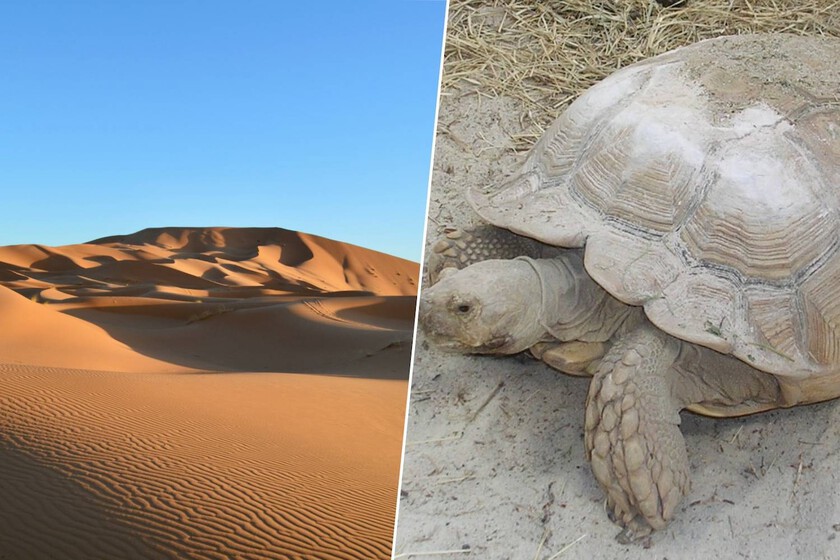
A unique ecological experiment involving the reintroduction of African spur-thighed tortoises has shown remarkable success in reversing desertification in the Sahel, the vast semi-arid region bordering the Sahara Desert. Instead of planting trees, researchers released 500 of these reptiles into the southern Sahara border in 2021. Satellite imagery analyzed five years later reveals significant patches of green vegetation emerging in areas that were previously barren sand.
The initiative, highlighted by Xataka, offers a novel, nature-based solution to a persistent environmental challenge. Desertification in the Sahel, a region identified by the UN Convention to Combat Desertification (UNCCD) as highly vulnerable, leads to hardened soil that prevents water penetration and hinders plant growth, often forcing migration. Traditional reforestation efforts have proven costly and not always effective.
Ecological Engineering at Work
The success of this project hinges on the natural behavior of the African spur-thighed tortoise. These tortoises, native to the Sahel, instinctively dig burrows up to 15 meters long to protect themselves from extreme temperatures. This burrowing activity breaks up the hardened soil crust, allowing rainwater to penetrate deeper into the ground. The increased moisture retention and improved soil structure create more favorable conditions for seeds to germinate and for vegetation to take root.
The significance of this natural process is considerable. The African spur-thighed tortoise acts as an “ecosystem engineer,” modifying its environment in ways that benefit numerous other species. The UNCCD has recognized land restoration as a key solution to desertification, and the tortoises achieve this without the need for heavy machinery or intensive human intervention. For local communities, whose efforts to create water-retaining depressions in the arid land are arduous, the tortoise’s natural burrowing is a crucial, life-sustaining activity.
Challenges and Conservation Concerns
Paradoxically, the very species crucial for this ecological restoration is itself threatened. Habitat loss, exploitation for meat and eggs, the pet trade, and the impacts of climate change, including desertification itself, are contributing to declining populations of the African spur-thighed tortoise. This decline poses a dual threat: the loss of biodiversity and the erosion of a vital natural mechanism for land restoration.
The UNCCD has long acknowledged the severity of desertification in Africa, with approximately two-thirds of the continent classified as desert or arid land, and a similar proportion of its soil already degraded to some degree. The first UN Conference on Desertification was held in Nairobi in 1977, underscoring the enduring nature of this problem.
Conservation efforts for the African spur-thighed tortoise have been ongoing. Since 2000, the species has been under scrutiny by CITES, leading to restrictions and reintroduction programs. In 2017, the African Chelonian Institute documented the release of 20 individuals in Senegal. Captive breeding programs also exist across Africa and internationally. However, the IUCN Red List continues to indicate a decreasing population trend.
Details of the Mechanism
The ecological mechanism involves several key aspects. The tortoise’s digging not only breaks the soil crust but also creates tunnels that enhance water infiltration, preventing rapid evaporation. This process improves soil porosity, reduces surface temperature, and makes nutrients more accessible. Consequently, the land retains moisture for longer periods, enabling seeds that previously could not germinate to sprout. Furthermore, the excavated spaces attract insects and microorganisms, initiating a food chain that can support small vertebrates and birds, thereby fostering greater biodiversity.
Limitations and Future Considerations
While promising, the reintroduction of tortoises is not a panacea for desertification. It serves as a crucial starting point, but the process requires supporting conditions such as adequate rainfall and stable, sustainable land management policies. Protecting the tortoises from hunting and poaching is essential, especially given their threatened status.
There is also ongoing research into whether the tortoises might play a role in seed dispersal across the Sahel, potentially contributing further to the regrowth of vegetation. This aspect, if confirmed, would add another layer to their ecological importance.
Key facts
| Aspect | Detail |
| :————————– | :———————————————————————- |
| Species | African spur-thighed tortoise (Centrochelys sulcata) |
| Location | Southern border of the Sahara Desert (Sahel region) |
| Intervention | Release of 500 tortoises in 2021 |
| Observed Outcome | Emergence of vegetation patches confirmed by satellite imagery |
| Mechanism | Burrowing breaks soil crust, improves water infiltration and retention. |
| Conservation Status | Threatened (IUCN Red List) |
This development is relevant to ReviewArticle’s readership by showcasing an innovative, data-driven approach to environmental restoration. It highlights how understanding and leveraging the natural behaviors of species, supported by observational data like satellite imagery, can provide practical solutions to complex problems like desertification, a critical issue with global implications for climate and ecosystems.
Source: Han encontrado la forma de reverdecer el Sahara y no es plantando árboles: soltando 500 tortugas, Xataka, https://www.xataka.com/ecologia-y-naturaleza/han-encontrado-forma-reverdecer-sahara-no-plantando-arboles-soltar-500-tortugas
Datos clave
| Punto | Detalle |
|---|---|
| Fuente | Xataka IA |
| Fecha | 2026-06-14T13:00:17+00:00 |
| Tema | Han encontrado la forma de reverdecer el Sahara y no es plantando árboles: soltando 500 tortugas |
Source
Xataka IA Publicacion original: 2026-06-14T13:00:17+00:00
Related articles

IBM CEO Puts a Number on the Open-Weight AI Value Proposition: 90% of the Performance at 10% of the Token Cost
IBM CEO Arvind Krishna told analysts that open-weight models now deliver about 90% of frontier-model effectiveness while costing between 10% and 25%…
Read article
OCU Finds Spanish Homeowner Communities Overpaying Up to €1,500 on Electricity and €3,515 on Gas—Can AI Tools Optimize Shared Energy Bills?
A new OCU analysis of Spanish homeowner community bills reveals widespread overpayment due to non-competitive tariffs and excess contracted power. Could AI-driven…
Read article
Mayotte fiber dispute does not meet ReviewArticle’s AI news brief
Le Monde reports that France’s competition authority has ordered Orange to suspend part of its fiber-optic rollout in Mayotte. The dispute is…
Read article
DiffEEG Model Uses Diffusion Pre-Training to Improve Seizure Detection from Minimal Labeled Data
Researchers have introduced DiffEEG, a 9.6-million-parameter foundation model that combines denoising diffusion pre-training with reinforcement learning fine-tuning to detect seizure events from…
Read articleWiki relacionada

AI Model API Pricing and Context Window Comparison: Current Rates and Limits
Compare the latest API pricing, context windows, and capabilities of leading AI model providers including OpenAI, Anthropic, Google, and Mistral. Practical guidance…
Read article
AI Agent Evaluation Frameworks: How to Benchmark Agentic Systems
A practical guide to evaluating AI agents — from task completion metrics to safety, cost, and robustness. Covers major frameworks, primary sources,…
Read article
LLM Benchmarks Decoded: What MMLU, HumanEval, and GSM8K Actually Measure for Developers
A developer-focused breakdown of the most-cited LLM benchmarks — MMLU, HumanEval, GSM8K, MATH, Chatbot Arena — including what they test, their hidden…
Read article
What Is RAG? A Practical Guide to Retrieval-Augmented Generation in 2025
Retrieval-Augmented Generation (RAG) grounds LLM outputs in external data, reducing hallucinations and enabling enterprise use cases. This guide covers how RAG works,…
Read article