
AI data center energy hunger gives wave power a second chance as CorPower prototype passes certification
A Swedish wave energy converter has received the first independent prototype certification for wave power, as AI data centers’ growing electricity demand pushes developers to consider new renewable sources.
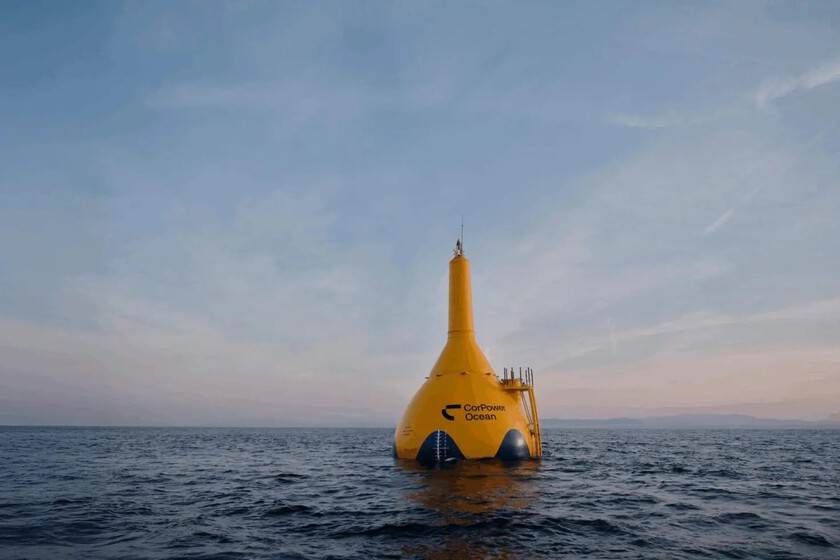
The race to power AI data centers is opening a new door for a renewable technology that has spent decades on the sidelines: wave energy. CorPower Ocean, a Swedish company, has received the first independent prototype certification for its C4 wave energy converter from Det Norske Veritas (DNV), the world’s leading offshore energy certifier. The certification, announced July 2024, marks a technical milestone for wave power, which has historically struggled to move beyond experimental installations.
The C4 device, installed four kilometers off the coast of Aguçadoura in northern Portugal since 2023, measures nine meters in diameter and 18 meters in height, with a mass of 100 tons. It sits at a depth of 45 meters. DNV validated the device’s conceptual development, detailed engineering, structural strength and fatigue analysis, manufacturing, dry testing, and installation. Crucially, the certifier approved its performance in storms with waves up to 18.5 meters high.
Key facts
| Item | Details |
|---|---|
| Device | CorPower Ocean C4 wave energy converter |
| Certification body | Det Norske Veritas (DNV) |
| Location | 4 km off Aguçadoura, Portugal, at 45 m depth |
| Dimensions | 9 m diameter, 18 m height, 100 tonnes |
| Next commercial parks | Portugal and Scotland, planned operation 2027–2029 |
Why this matters for AI infrastructure
Data centers powering AI training and inference are projected to consume roughly 8% of U.S. electricity by 2030, up from about 2% in 2022, according to grid operator estimates. Hyperscalers like Microsoft, Google, and Amazon are actively seeking new renewable sources to meet carbon targets and grid stability requirements. Wave energy, unlike solar and wind, offers higher capacity factors in many coastal regions, especially in places like the Pacific Northwest, the U.K., and Portugal.
CorPower has stated its goal of making wave energy the third major renewable source alongside solar and wind. The company is now preparing two commercial wave farms: one off Portugal and one off Scotland, with operations expected to start between 2027 and 2029. The certification reduces technical risk for investors, a key hurdle for a technology that has spent more than 40 years in prototype limbo.
The history of wave energy setbacks
Wave energy patents date back to 1981, when engineers Laithwaite and Salter filed early designs. Japan, Spain, and Italy have all tested prototypes, but none achieved commercial scale. The primary challenges include the unpredictable nature of waves—variable in height, rhythm, and direction—and the harsh marine environment that complicates maintenance and design.
The existing 296 kW Mutriku wave plant in Spain, operational since 2011, has demonstrated that wave power can produce electricity, but its efficiency is around 11%, far below the capacity factors of modern solar (15–20%) and offshore wind (40–50%). Whether CorPower’s C4 and its successor C5 can improve on that remains unproven.
The AI energy demand link
The growing electricity appetite from AI data centers has shifted the calculus for renewable energy investments. In 2023, Microsoft signed a power purchase agreement for offshore wind in Ireland, and Google has invested in geothermal and battery storage. Wave energy, still in its early commercial phase, could become a niche but valuable addition to the mix, especially for coastal data center locations.
CorPower’s next device, the C5, is already undergoing certification. The company has not disclosed specific power output figures for the commercial farms, but the certification milestone provides a clear timeline for potential offtake agreements with tech companies seeking to secure long-term renewable power.
Caveats and next checks
The C4 remains a prototype, not a mass-produced unit. Scaling up to series production requires additional capital and manufacturing partnerships. The 11% efficiency of existing wave plants raises questions about whether the technology can compete on cost with solar and wind, which have seen dramatic price declines. The 2027–2029 timeline for commercial farms assumes no major delays in permitting, supply chain, or further certification.
Source: Xataka, “La energía de las olas nunca ha logrado despegar a lo grande: dos plantas en Portugal y Escocia están a punto de cambiarlo,” July 25, 2024. https://www.xataka.com/energia/energia-olas-nunca-ha-logrado-despegar-a-grande-dos-plantas-portugal-escocia-estan-a-punto-cambiarlo
Source
Xataka IA Publicacion original: 2026-07-25T12:00:27+00:00
Related articles
OCU Finds Spanish Homeowner Communities Overpaying Up to €1,500 on Electricity and €3,515 on Gas—Can AI Tools Optimize Shared Energy Bills?
A new OCU analysis of Spanish homeowner community bills reveals widespread overpayment due to non-competitive tariffs and excess contracted power. Could AI-driven…
Read article
Mayotte fiber dispute does not meet ReviewArticle’s AI news brief
Le Monde reports that France’s competition authority has ordered Orange to suspend part of its fiber-optic rollout in Mayotte. The dispute is…
Read article
DiffEEG Model Uses Diffusion Pre-Training to Improve Seizure Detection from Minimal Labeled Data
Researchers have introduced DiffEEG, a 9.6-million-parameter foundation model that combines denoising diffusion pre-training with reinforcement learning fine-tuning to detect seizure events from…
Read article
The Technology Trap: Why AI Cannot Escape the Unchanging Fundamentals of War
A new Foreign Affairs essay by former Pentagon official Mara Karlin warns that over-reliance on AI and advanced tech in military planning…
Read articleWiki relacionada

AI Model API Pricing and Context Window Comparison: Current Rates and Limits
Compare the latest API pricing, context windows, and capabilities of leading AI model providers including OpenAI, Anthropic, Google, and Mistral. Practical guidance…
Read article
AI Agent Evaluation Frameworks: How to Benchmark Agentic Systems
A practical guide to evaluating AI agents — from task completion metrics to safety, cost, and robustness. Covers major frameworks, primary sources,…
Read article
LLM Benchmarks Decoded: What MMLU, HumanEval, and GSM8K Actually Measure for Developers
A developer-focused breakdown of the most-cited LLM benchmarks — MMLU, HumanEval, GSM8K, MATH, Chatbot Arena — including what they test, their hidden…
Read article
What Is RAG? A Practical Guide to Retrieval-Augmented Generation in 2025
Retrieval-Augmented Generation (RAG) grounds LLM outputs in external data, reducing hallucinations and enabling enterprise use cases. This guide covers how RAG works,…
Read article