
Arize AI Details Production-Ready LLM-as-a-Judge Evaluation Framework
Arize AI has released a detailed guide on building LLM-as-a-Judge evaluators for production environments, focusing on robust criteria, fixed labels, human agreement, and cost efficiency. The framework emphasizes practical application for AI developers and MLOps teams.
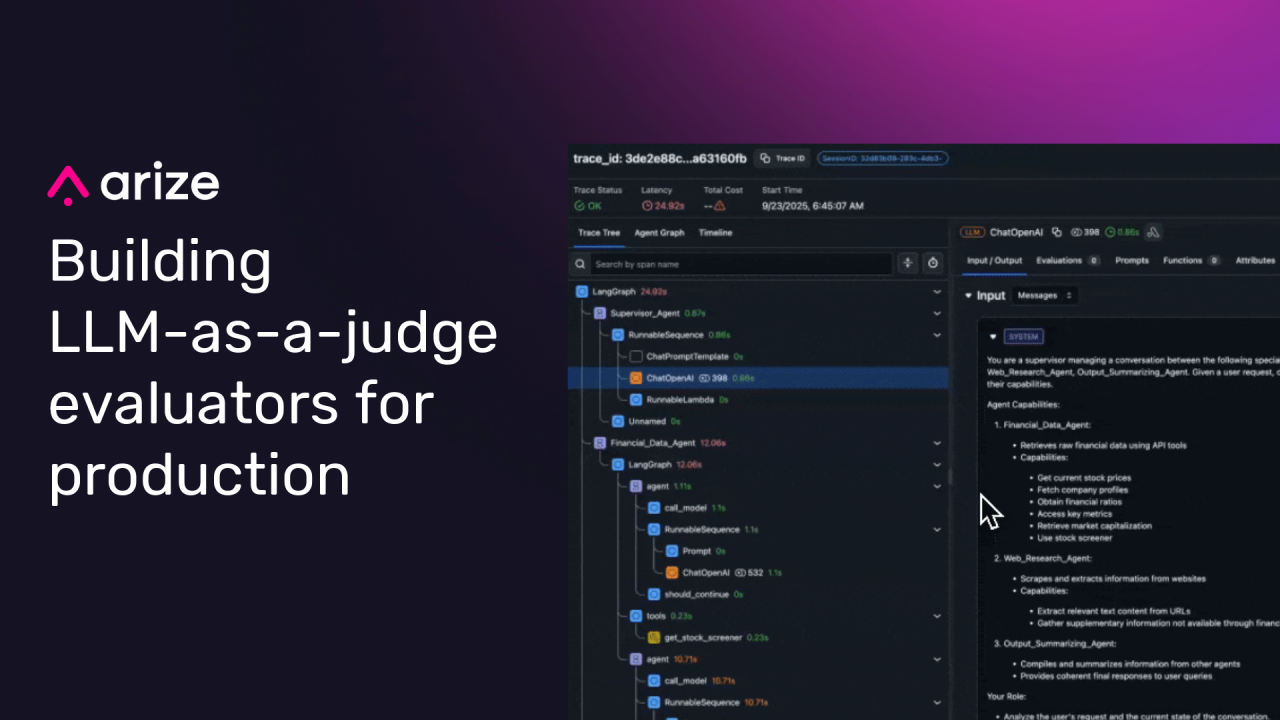
Arize AI has published a comprehensive guide outlining how to construct and implement LLM-as-a-Judge evaluators designed for reliable performance in production environments. The guidance addresses common pitfalls in LLM evaluation, advocating for a structured approach that prioritizes clear criteria, fixed labeling systems, human agreement checks, and efficient resource utilization. This framework is particularly relevant for developers and MLOps teams building and deploying sophisticated LLM-powered applications and agents where scalable, consistent evaluation is critical.
The core premise of the Arize AI guidance is that while LLM-as-a-Judge offers significant scalability over manual review, its effectiveness hinges on the precision and context of the evaluation setup. A key distinction made is between evaluations that can be handled by deterministic code and those requiring semantic interpretation by an LLM judge. Simple checks like JSON validity, tool schema adherence, or latency thresholds are best managed with code, which is faster, cheaper, and more predictable. LLM judges, however, excel when evaluating nuanced aspects like answer correctness, tone, user frustration, or overall task completion, which are difficult to codify with rules.
Key facts:
- Primary Use Case: Semantic evaluation of LLM outputs, traces, and sessions where meaning is critical.
- Evaluation Design: Emphasizes fixed labels, explicit criteria, human agreement, and trace context.
- Cost & Latency Control: Recommends using code for deterministic checks and LLM judges only for semantic interpretation.
- Observability Link: Integrates evaluation results with observability platforms to drive iterative model improvement.
Designing Robust Evaluation Criteria
A central tenet of Arize AI’s approach is the meticulous definition of evaluation criteria. Vague prompts like “rate helpfulness from 1 to 5” or “determine whether the answer is good” lead to meaningless scores because they lack explicit definitions of what constitutes “good” or “helpful.” Instead, the guide proposes a five-part structure for strong evaluation criteria: an evaluation target, allowed labels, decision rules, examples, and edge cases.
For instance, evaluating “task completion” for a customer support agent might involve labels such as `resolved`, `partially_resolved`, `unresolved`, and `insufficient_evidence`. Crucially, specific decision rules would govern when each label applies. For example, an agent’s response is not `resolved` if the user had to repeat the request or if required tool evidence is missing. Similarly, `unresolved` should not be applied simply because an agent escalated a case, as escalation quality might be a separate evaluation concern. This granular approach ensures that each evaluator measures a single, well-defined dimension, preventing ambiguous scores that blend multiple factors.
Balancing LLM Judges with Code-Based Checks
The guide clarifies that LLM judges and code-based evaluators are complementary, not competing, tools. Many production systems will employ both. For example, a customer support agent might use code to verify JSON output, tool-call schemas, and latency, while simultaneously using an LLM judge to assess answer correctness, tone, and user frustration. A Retrieval-Augmented Generation (RAG) system might use code to check citation format, then deploy an LLM judge to determine if the cited source genuinely supports the generated answer.
The practical rule offered is straightforward: if an answer can be checked without semantic interpretation, use code. If it depends on meaning, use an LLM judge. This distinction helps optimize resources, as deterministic code checks are generally more efficient and cheaper to run than LLM inference. Attaching judge outputs to trace context is also recommended to enable inspection and debugging when automated actions are driven by evaluation results.
The Importance of Fixed Labels and Human Calibration
Arize AI advocates for fixed labels over open-ended scores where possible. Fixed labels, such as `resolved` or `unresolved`, provide discrete, unambiguous categories that are easier to calibrate and aggregate consistently. This structured output facilitates comparison over time and across different model versions.
Human agreement checks are presented as a vital step in calibrating LLM judges. By comparing an LLM judge’s assessments against human reviewers for a subset of examples, teams can identify discrepancies, refine prompt instructions, and ensure the judge aligns with human understanding. This calibration process helps build confidence in the automated evaluation system and ensures it measures what humans intend it to measure.
Evaluating Agent Trajectories and Cost Control
For complex AI agents, evaluating entire trajectories or sessions is often more informative than isolated outputs. LLM-as-a-Judge can assess whether an agent followed the correct sequence of actions, used tools appropriately, and ultimately achieved the user’s goal over multiple turns. This is particularly relevant for multi-step tasks where the overall flow and coherence are critical.
Cost and latency are significant considerations in production. The guide advises careful design to minimize unnecessary LLM calls. By offloading deterministic checks to code and limiting the LLM judge’s scope to semantic interpretation, teams can reduce inference costs and accelerate evaluation cycles. The integration with observability platforms like Arize:Observe allows teams to monitor evaluation performance, identify drift, and continuously improve their LLM applications by closing the loop between observation and evaluation.
Source: Arize AI Blog – How to build LLM-as-a-Judge evaluators that hold up in production
Source
Arize AI Blog Publicacion original: 2026-05-21T14:00:45+00:00
Related articles

Mayotte fiber dispute does not meet ReviewArticle’s AI news brief
Le Monde reports that France’s competition authority has ordered Orange to suspend part of its fiber-optic rollout in Mayotte. The dispute is…
Read article
DiffEEG Model Uses Diffusion Pre-Training to Improve Seizure Detection from Minimal Labeled Data
Researchers have introduced DiffEEG, a 9.6-million-parameter foundation model that combines denoising diffusion pre-training with reinforcement learning fine-tuning to detect seizure events from…
Read article
The Technology Trap: Why AI Cannot Escape the Unchanging Fundamentals of War
A new Foreign Affairs essay by former Pentagon official Mara Karlin warns that over-reliance on AI and advanced tech in military planning…
Read article
Supabase Releases .NET SDK for C# Developers Across ASP.NET, Unity, and Mobile
Supabase has launched a .NET SDK for C# developers, extending its backend-as-a-service platform to ASP.NET Core, console apps, desktop, Unity, and mobile…
Read articleWiki relacionada

AI Model API Pricing and Context Window Comparison: Current Rates and Limits
Compare the latest API pricing, context windows, and capabilities of leading AI model providers including OpenAI, Anthropic, Google, and Mistral. Practical guidance…
Read article
AI Agent Evaluation Frameworks: How to Benchmark Agentic Systems
A practical guide to evaluating AI agents — from task completion metrics to safety, cost, and robustness. Covers major frameworks, primary sources,…
Read article
LLM Benchmarks Decoded: What MMLU, HumanEval, and GSM8K Actually Measure for Developers
A developer-focused breakdown of the most-cited LLM benchmarks — MMLU, HumanEval, GSM8K, MATH, Chatbot Arena — including what they test, their hidden…
Read article
What Is RAG? A Practical Guide to Retrieval-Augmented Generation in 2025
Retrieval-Augmented Generation (RAG) grounds LLM outputs in external data, reducing hallucinations and enabling enterprise use cases. This guide covers how RAG works,…
Read article