
China Deploys Evaporative Cooling on Building Roofs to Combat Urban Heat
Chinese communities are experimenting with large-scale rooftop water mists to reduce building temperatures and decrease reliance on air conditioning, offering a novel approach to urban heat island effects.
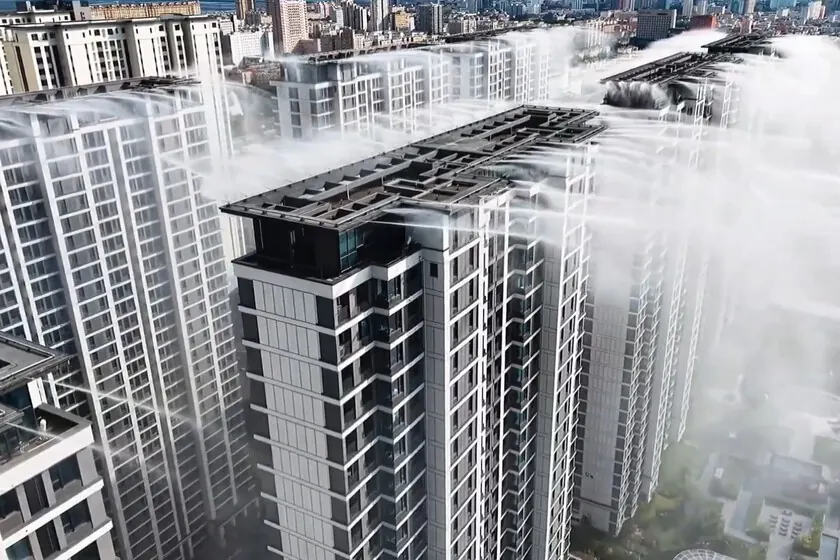
China is pioneering a novel approach to urban cooling by deploying large-scale evaporative cooling systems on the rooftops of residential buildings. This initiative aims to significantly reduce indoor temperatures and, consequently, lower the demand for electricity-intensive air conditioning, addressing the growing challenge of urban heat islands.
The innovation involves misting water from rooftops, a technique that leverages evaporative cooling to lower surface temperatures. In Yuncheng, a city in China’s Shanxi province, a residential zone is utilizing this system, which has reportedly reduced surface temperatures by 5 to 8 degrees Celsius within minutes. Another system, HY-WSWD, has shown similar effectiveness, achieving temperature drops of up to 10 degrees Celsius on rooftops and yielding estimated savings of 20-30% in air conditioning consumption.
Por que importa
While the technology itself is not new, its application at this scale for entire building complexes marks a significant shift. The principle is akin to a large-scale evaporative cooler, a technology that has existed for decades. The HY-WSWD system, for instance, has been commercially available since at least 2025.
The importance of this development is amplified by China’s status as the world’s largest consumer of electricity for air conditioning. According to the International Energy Agency, summer electricity demand peaks in China are directly linked to air conditioning use, a trend expected to worsen as cooling demand in Asia is projected to triple by 2050. Any technology that can pre-cool buildings before air conditioning is engaged offers substantial benefits for the electricity grid. Scientific studies suggest that evaporative cooling systems can reduce energy consumption by 30-40% compared to conventional air conditioners.
Contexto
Historical context shows that evaporative cooling concepts are not exclusive to modern China. The United States saw patents for industrial-scale evaporative cooling systems in the 1970s, with later patents in the late 1980s exploring residential and commercial applications. Urban misting systems are also in use in arid U.S. cities like Phoenix and Tempe, Arizona.
Paradoxically, China has a much older architectural precedent for cooling. Over a thousand years ago, during the Tang Dynasty, the Hanliang Hall of Daming Palace reportedly used a circulating cooling system. This ancient system involved water wheels that propelled cold water to the rooftop, where it cascaded from the eaves as a water curtain, cooling the hall’s exterior.
The striking aspect of China’s current initiative is the scale of deployment. Instead of localized misting for outdoor comfort, as seen in Western bar terraces or some European city street installations, China is covering entire residential rooftops. This approach aims to cool the building as a whole and its immediate surroundings.
This contrasts with conventional split air conditioning units, which do not eliminate heat but rather displace it outdoors. The residual heat expelled by millions of individual units contributes to the urban heat island effect. China’s rooftop misting system, however, targets the building’s thermal environment directly, specifically the sun-exposed rooftop, before heat can significantly impact indoor temperatures. By increasing the surface area for evaporation, these water micro-droplets extract latent heat from the roof and surrounding air, reducing the temperature differential between the interior and exterior without the need for refrigerants.
However, the effectiveness of evaporative cooling is contingent on humidity levels. This system is best suited for dry climates, like the continental semi-arid climate of Shanxi. In humid southern Chinese cities such as Shenzhen, its efficacy would be considerably reduced. High humidity environments can see evaporative coolers perform poorly, potentially exacerbating thermal discomfort by increasing relative humidity. Furthermore, these systems require a continuous water supply, posing a challenge in water-scarce regions and creating a potential trade-off between energy savings and water stress.
Key facts
| Feature | Detail |
|—|—|
| Technology | Rooftop evaporative water misting systems |
| Reported Benefits | Reduced surface temperatures (5-10°C), 20-30% AC energy savings |
| Primary Location | Yuncheng, Shanxi Province, China |
| Historical Precedent | Tang Dynasty Daming Palace cooling system |
| Main Limitation | Effectiveness reduced in high humidity |
Source: La lluvia que no cae del cielo: cómo China está reinventando la climatización de edificios sin usar más electricidad, Xataka, https://www.xataka.com/ecologia-y-naturaleza/lluvia-que-no-cae-cielo-como-china-esta-reinventando-climatizacion-edificios-usar-electricidad
Datos clave
| Punto | Detalle |
|---|---|
| Fuente | Xataka IA |
| Fecha | 2026-07-05T12:31:32+00:00 |
| Tema | La lluvia que no cae del cielo: cómo China está reinventando la climatización de edificios sin usar más electricidad |
Source
Xataka IA Publicacion original: 2026-07-05T12:31:32+00:00
Related articles

IBM CEO Puts a Number on the Open-Weight AI Value Proposition: 90% of the Performance at 10% of the Token Cost
IBM CEO Arvind Krishna told analysts that open-weight models now deliver about 90% of frontier-model effectiveness while costing between 10% and 25%…
Read article
OCU Finds Spanish Homeowner Communities Overpaying Up to €1,500 on Electricity and €3,515 on Gas—Can AI Tools Optimize Shared Energy Bills?
A new OCU analysis of Spanish homeowner community bills reveals widespread overpayment due to non-competitive tariffs and excess contracted power. Could AI-driven…
Read article
Mayotte fiber dispute does not meet ReviewArticle’s AI news brief
Le Monde reports that France’s competition authority has ordered Orange to suspend part of its fiber-optic rollout in Mayotte. The dispute is…
Read article
DiffEEG Model Uses Diffusion Pre-Training to Improve Seizure Detection from Minimal Labeled Data
Researchers have introduced DiffEEG, a 9.6-million-parameter foundation model that combines denoising diffusion pre-training with reinforcement learning fine-tuning to detect seizure events from…
Read articleWiki relacionada

AI Model API Pricing and Context Window Comparison: Current Rates and Limits
Compare the latest API pricing, context windows, and capabilities of leading AI model providers including OpenAI, Anthropic, Google, and Mistral. Practical guidance…
Read article
AI Agent Evaluation Frameworks: How to Benchmark Agentic Systems
A practical guide to evaluating AI agents — from task completion metrics to safety, cost, and robustness. Covers major frameworks, primary sources,…
Read article
LLM Benchmarks Decoded: What MMLU, HumanEval, and GSM8K Actually Measure for Developers
A developer-focused breakdown of the most-cited LLM benchmarks — MMLU, HumanEval, GSM8K, MATH, Chatbot Arena — including what they test, their hidden…
Read article
What Is RAG? A Practical Guide to Retrieval-Augmented Generation in 2025
Retrieval-Augmented Generation (RAG) grounds LLM outputs in external data, reducing hallucinations and enabling enterprise use cases. This guide covers how RAG works,…
Read article