
China’s Massive River Diversion Project Raises Environmental Alarms
A colossal engineering feat to move water from China's south to its arid north is raising questions about ecological impact, despite official explanations for past river disappearances.
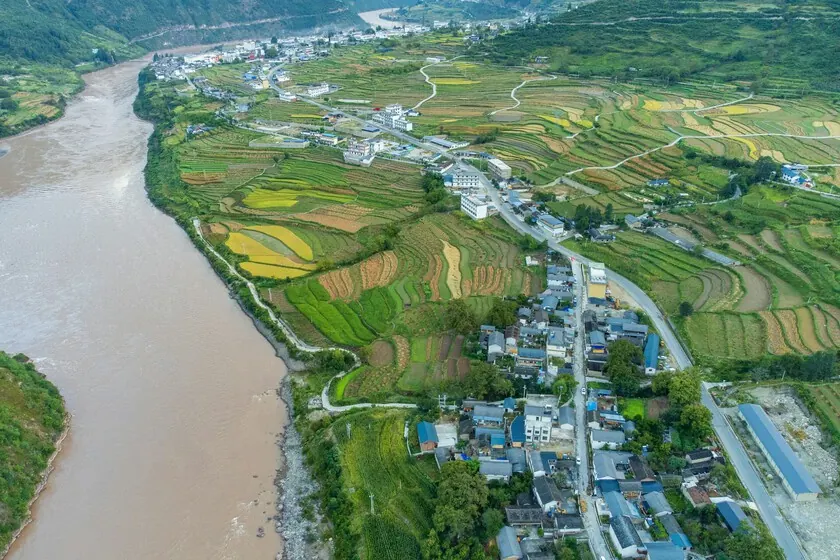
China is undertaking one of the most ambitious hydraulic engineering projects in history: the South-North Water Diversion Project. This massive undertaking aims to address a critical geographic imbalance where the country’s south experiences frequent flooding while the north suffers from chronic drought. The project literally moves water over thousands of kilometers from the water-rich Yangtze River basin in the south to the arid northern plains, where a significant portion of China’s population, agriculture, and industry are concentrated, despite these regions holding only about 20% of the nation’s water resources.
Project Scale and Benefits
The South-North Water Diversion Project involves a colossal network of canals, pipelines, and pumping stations designed to overcome geographical challenges. According to the latest updates from China’s Ministry of Water Resources, the infrastructure is unparalleled globally. To date, the central and eastern routes of the system have successfully transferred over 70 billion cubic meters of water. Hydrologically, this scale of artificial water transfer is equivalent to moving entire rivers.
The project has provided a vital water supply to an estimated 150 million people. This influx of water has reportedly enabled “ecological replenishment,” helping to restore groundwater levels in northern areas that have been depleted for decades. However, such extensive intervention in the natural landscape invariably raises concerns about its “other side.”
Disappearing Rivers and Cartographic Corrections
A striking observation during the project’s implementation was the reported disappearance of tens of thousands of rivers from official Chinese censuses over a few decades. This phenomenon fueled global concern, with many questioning if the water diversion was contributing to an unprecedented drying of the country.
However, an article published in 2019 offered a different explanation. It suggested that the massive reduction in recorded river courses was not due to evaporation from dams or climate change, but rather a methodological issue in cartography. Historically, censuses had included “pseudo-rivers” and used inconsistent counting criteria. With the adoption of a more robust and consolidated hydraulic classification system, the number of “lost” rivers has been drastically reduced.
Ecological Costs and Scientific Warnings
While the cartographic explanation for disappearing rivers has been offered, the environmental cost of modifying major river basins remains a significant concern. Scientific literature has been monitoring the risks associated with such large-scale water diversion for years.
As early as 2009, a review published in Wiley by researcher Zhang Quanfa highlighted the profound environmental implications of the diversion. The study proposed that extracting such massive volumes from the south irrevocably alters the Yangtze River basin, leading to disruptions in its aquatic ecosystem. Furthermore, reduced freshwater flow to the Yangtze’s estuary allows saltwater to penetrate further inland, threatening local water supplies and agriculture in the delta region.
Demographic and Governance Challenges
Beyond the environmental impact, institutional analyses by experts like Mark Wang and Chen Li point to significant governance challenges and socio-political friction. Critical organizations have reported that authorities have compelled the resettlement of hundreds of thousands of people to facilitate the project. Additionally, multi-billion dollar investments have been required for treatment plants to prevent contaminated water from the south from compromising northern reserves.
The long-term ecological consequences of this unprecedented feat of engineering remain a subject of ongoing scientific scrutiny and a significant environmental mystery.
Key Facts
| Aspect | Detail |
|---|---|
| Project Name | South-North Water Diversion Project |
| Goal | Transfer water from southern China to arid northern regions |
| Water Transferred | Over 70 billion cubic meters (central and eastern routes) |
| Beneficiaries | Approximately 150 million people |
| Primary Concerns | Ecological impact on Yangtze basin, saltwater intrusion, resettlement |
| Scientific Warnings | Identified in studies dating back to at least 2009 |
This development matters to ReviewArticle readers as it highlights a monumental engineering project with significant, yet not fully understood, environmental and social implications. It underscores the complex relationship between large-scale infrastructure, resource management, and ecological sustainability, a critical area within AI and technology’s broader impact on society and the planet.
Source: China is diverting its most powerful rivers for thousands of kilometers. The price to pay is a huge environmental mystery – Xataka IA, https://www.xataka.com/ecologia-y-naturaleza/china-esta-desviando-sus-rios-caudalosos-a-miles-kilometros-precio-a-pagar-enorme-misterio-medioambiental
Source
Xataka IA Publicacion original: 2026-06-27T19:00:13+00:00
Related articles

IBM CEO Puts a Number on the Open-Weight AI Value Proposition: 90% of the Performance at 10% of the Token Cost
IBM CEO Arvind Krishna told analysts that open-weight models now deliver about 90% of frontier-model effectiveness while costing between 10% and 25%…
Read article
OCU Finds Spanish Homeowner Communities Overpaying Up to €1,500 on Electricity and €3,515 on Gas—Can AI Tools Optimize Shared Energy Bills?
A new OCU analysis of Spanish homeowner community bills reveals widespread overpayment due to non-competitive tariffs and excess contracted power. Could AI-driven…
Read article
Mayotte fiber dispute does not meet ReviewArticle’s AI news brief
Le Monde reports that France’s competition authority has ordered Orange to suspend part of its fiber-optic rollout in Mayotte. The dispute is…
Read article
DiffEEG Model Uses Diffusion Pre-Training to Improve Seizure Detection from Minimal Labeled Data
Researchers have introduced DiffEEG, a 9.6-million-parameter foundation model that combines denoising diffusion pre-training with reinforcement learning fine-tuning to detect seizure events from…
Read articleWiki relacionada

AI Model API Pricing and Context Window Comparison: Current Rates and Limits
Compare the latest API pricing, context windows, and capabilities of leading AI model providers including OpenAI, Anthropic, Google, and Mistral. Practical guidance…
Read article
AI Agent Evaluation Frameworks: How to Benchmark Agentic Systems
A practical guide to evaluating AI agents — from task completion metrics to safety, cost, and robustness. Covers major frameworks, primary sources,…
Read article
LLM Benchmarks Decoded: What MMLU, HumanEval, and GSM8K Actually Measure for Developers
A developer-focused breakdown of the most-cited LLM benchmarks — MMLU, HumanEval, GSM8K, MATH, Chatbot Arena — including what they test, their hidden…
Read article
What Is RAG? A Practical Guide to Retrieval-Augmented Generation in 2025
Retrieval-Augmented Generation (RAG) grounds LLM outputs in external data, reducing hallucinations and enabling enterprise use cases. This guide covers how RAG works,…
Read article