
China Unveils Satellite Images of Submarine Design Challenging Naval Engineering Norms
Satellite imagery from a Shanghai shipyard reveals a large Chinese submarine lacking a traditional sail, a design choice that could signal a new era in naval engineering by prioritizing hydrodynamics and stealth.
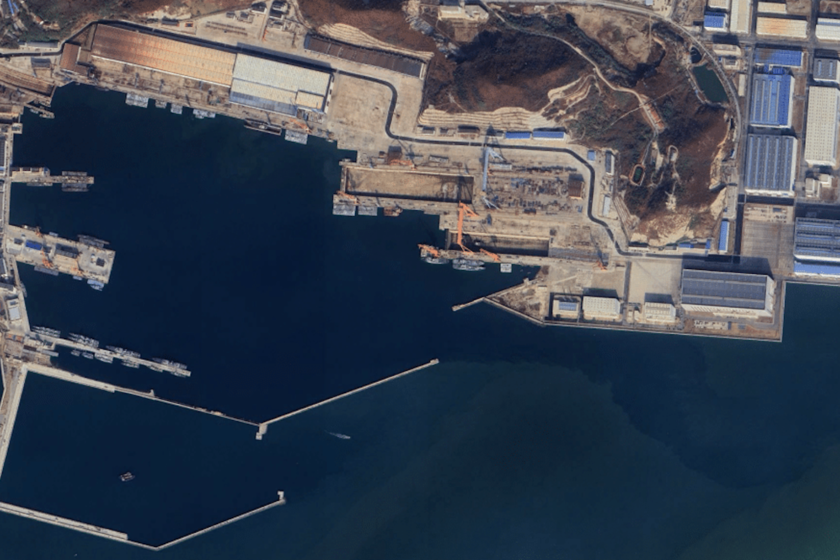
Satellite images captured at a Shanghai shipyard have revealed a substantial Chinese submarine that deviates significantly from conventional naval design by omitting the characteristic sail or command tower. This departure from a fixture of submarine engineering for over a century suggests China is exploring ambitious new concepts aimed at enhancing underwater performance and stealth.
The submarine, estimated to be around 120 meters in length, is considerably larger than many currently active nuclear attack submarines. Its design appears to prioritize hydrodynamic efficiency, a move that could offer notable advantages in speed, maneuverability, and acoustic discretion. The absence of a sail, traditionally housing periscopes, sensors, and communication arrays, raises questions about how these functions are being integrated, or if certain operational capabilities are being redefined.
A Hydrodynamic Revolution
The primary benefit of eliminating the sail is a significant reduction in hydrodynamic drag. This streamlined form allows for improved water flow, potentially leading to increased speed and reduced noise generation. Quieter operation is a critical factor in modern submarine warfare, making detection by sonar more challenging.
Further enhancements may include an X-shaped tail for improved agility and navigation safety, alongside a pump-jet propulsor. This type of enclosed propeller is known for its ability to further reduce underwater noise, a key element for stealth operations.
The Importance of Absence
The traditional sail serves multiple crucial roles, including housing vital equipment like periscopes, sensors, and communication antennas. It also provides an elevated position for surface navigation and enhances situational awareness for the crew. Its removal implies that China has either developed advanced technological solutions to replace these functions or is willing to accept certain operational limitations in exchange for the hydrodynamic and stealth advantages.
Years of Quiet Experimentation
This unveiling is not entirely unexpected. Analysts point to a smaller, sail-less vessel constructed at the same shipyard in 2018, which likely served as a testbed for these design concepts. The progression from that 45-meter prototype to the current 120-meter platform indicates a sustained, multi-year research and development effort by China to perfect this innovative design philosophy.
Future Naval Concepts
The new submarine’s low-profile design aligns with other recent developments in China’s naval industry. In 2024, a state-owned corporation unveiled a concept for a large unmanned underwater vehicle with a similar silhouette, intended for diverse missions including anti-ship attacks, mine-laying, and acting as a mothership for other drones. While the newly spotted submarine appears too large to be fully autonomous, the conceptual overlap suggests a potential family of vessels based on this shared design ethos.
China’s Naval Modernization
This development coincides with a broader, rapid modernization of China’s submarine fleet. Beijing is actively incorporating advanced models, developing new nuclear submarines, and experimenting with hybrid propulsion systems. U.S. officials have acknowledged the increasing quality and capability of Chinese submarines, which are steadily closing the gap with Western counterparts. The People’s Liberation Army Navy continues its expansion at a pace unmatched by any other navy globally, driven by strategic interests in the Pacific and other key maritime regions.
Unanswered Questions
While the exact designation, internal systems, and intended mission of this new submarine remain undisclosed, the satellite imagery presents a compelling case for a significant shift in naval engineering. If this project proves successful, it could herald a new generation of submarines where the traditional sail is no longer an indispensable element, marking a potential evolution in underwater warfare.
Datos clave:
| Característica | Detalles |
| :———————- | :———————————————————- |
| Diseño | Submarino de gran tamaño sin vela (torre de mando) |
| Eslora estimada | Aproximadamente 120 metros |
| Astillero | Astillero en Shanghái |
| Posibles ventajas | Hidrodinámica mejorada, mayor sigilo, menor resistencia al agua |
| Antecedentes | Prototipo más pequeño sin vela construido en 2018 |
The implications of this new submarine design are significant for naval strategists and defense analysts. By potentially overcoming the limitations of traditional submarine architecture, China could be developing a platform with superior stealth and operational capabilities. This innovation challenges established naval doctrines and may necessitate a reevaluation of anti-submarine warfare strategies worldwide.
Fuente: Imágenes por satélite no dejan dudas: China ha lanzado al mar una criatura submarina que desafía la ingeniería naval – Xataka (https://www.xataka.com/magnet/imagenes-satelite-no-dejan-lugar-a-dudas-china-ha-lanzado-al-mar-criatura-submarina-que-desafia-ingenieria-naval)
Datos clave
| Punto | Detalle |
|---|---|
| Fuente | Xataka IA |
| Fecha | 2026-06-04T09:00:55+00:00 |
| Tema | Imágenes por satélite no dejan dudas: China ha lanzado al mar una criatura submarina que desafía la ingeniería naval |
Source
Xataka IA Publicacion original: 2026-06-04T09:00:55+00:00
Related articles

IBM CEO Puts a Number on the Open-Weight AI Value Proposition: 90% of the Performance at 10% of the Token Cost
IBM CEO Arvind Krishna told analysts that open-weight models now deliver about 90% of frontier-model effectiveness while costing between 10% and 25%…
Read article
OCU Finds Spanish Homeowner Communities Overpaying Up to €1,500 on Electricity and €3,515 on Gas—Can AI Tools Optimize Shared Energy Bills?
A new OCU analysis of Spanish homeowner community bills reveals widespread overpayment due to non-competitive tariffs and excess contracted power. Could AI-driven…
Read article
Mayotte fiber dispute does not meet ReviewArticle’s AI news brief
Le Monde reports that France’s competition authority has ordered Orange to suspend part of its fiber-optic rollout in Mayotte. The dispute is…
Read article
DiffEEG Model Uses Diffusion Pre-Training to Improve Seizure Detection from Minimal Labeled Data
Researchers have introduced DiffEEG, a 9.6-million-parameter foundation model that combines denoising diffusion pre-training with reinforcement learning fine-tuning to detect seizure events from…
Read articleWiki relacionada

AI Model API Pricing and Context Window Comparison: Current Rates and Limits
Compare the latest API pricing, context windows, and capabilities of leading AI model providers including OpenAI, Anthropic, Google, and Mistral. Practical guidance…
Read article
AI Agent Evaluation Frameworks: How to Benchmark Agentic Systems
A practical guide to evaluating AI agents — from task completion metrics to safety, cost, and robustness. Covers major frameworks, primary sources,…
Read article
LLM Benchmarks Decoded: What MMLU, HumanEval, and GSM8K Actually Measure for Developers
A developer-focused breakdown of the most-cited LLM benchmarks — MMLU, HumanEval, GSM8K, MATH, Chatbot Arena — including what they test, their hidden…
Read article
What Is RAG? A Practical Guide to Retrieval-Augmented Generation in 2025
Retrieval-Augmented Generation (RAG) grounds LLM outputs in external data, reducing hallucinations and enabling enterprise use cases. This guide covers how RAG works,…
Read article