
Chinese Fishing Fleet Raises Concerns Off Peru’s Coast
Satellite imagery reveals hundreds of Chinese fishing vessels operating near Peru's Exclusive Economic Zone, sparking alarms among environmental groups and local fishermen about potential overfishing and resource depletion.
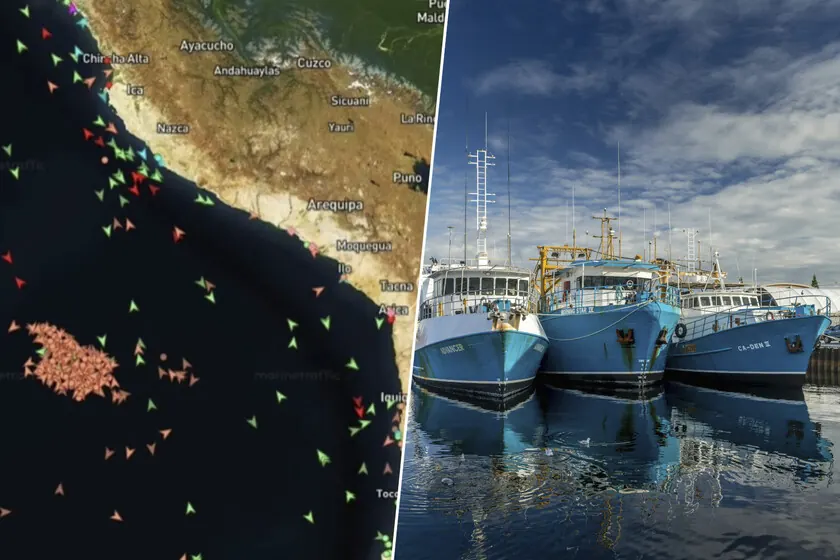
Satellite imagery suggests a significant presence of hundreds of Chinese fishing vessels operating near Peru’s coast, raising alarms among environmental organizations and local fishing communities about the potential for overfishing and depletion of marine resources.
Fleet Concentration and Environmental Warnings
Movimiento Ecologista del Perú (MEP), an environmental advocacy group, has released satellite maps indicating a dense concentration of Chinese fishing vessels in the Pacific Ocean, situated just off the coast of Mollendo, Peru. According to MEP, approximately 300 to 400 vessels were observed around 220 nautical miles from Peru’s coastline between June 1 and June 19, 2026. These vessels are reportedly engaged in fishing activities near the limits of Peru’s Exclusive Economic Zone (ZEE), a region where Peru holds sovereign rights over natural resources.
The MEP highlighted that this fleet’s migration pattern appears to follow the edge of the Peruvian ZEE. The organization expressed concern that these activities could exploit fishing banks, particularly those for squid, located within or near Peru’s jurisdiction.
Impact on Local Fishermen
The presence of this large fleet has reportedly put local Peruvian fishermen on alert. Reports from artisanal fishermen in areas like Paita and Pucusana suggest a decline in their catch quantities. Alberto Sánchez, a fisherman from Paita, told La República that while Peruvian vessels are smaller and operate with fewer resources, the larger Chinese ships possess machinery that allows them to process catches more rapidly. Some Pucusana fishermen have also reported sightings of large vessels within the 200-mile ZEE, despite regulations requiring fishing fleets to transmit their positions via satellite.
The affected area is part of the Humboldt Current ecosystem, recognized by the UN as one of the most productive regions globally. However, the UN has also warned about the serious threats posed by climate change and the overexploitation of its fishery resources.
A Recurring Issue
This is not the first time such concerns have been raised. MEP reported a similar concentration of foreign squid fishing vessels near Peru’s ZEE in 2024. At that time, the organization questioned the number, type, and location of these vessels. Following MEP’s recent reports, the Peruvian Navy (MGP) conducted an aerial reconnaissance flight, which confirmed that the foreign fishing fleet was operating outside Peruvian maritime territory, approximately 230 miles offshore at the time of the flight.
The issue extends beyond Peru’s borders, with similar debates and concerns about the impact of foreign fishing fleets occurring along the South American coast, including in Chile. Studies indicate that in 2024, a significant portion of the 1,359 vessels operating within 500 nautical miles of Peru’s coast were Chinese-flagged, accounting for nearly 40% of the total.
Sustainability and Regulatory Concerns
Sustainable Fisheries Partnership recently issued a statement emphasizing the importance of avoiding overexploitation of the region’s resources and advocating for any legislative changes to be based on scientific evidence. The organization also noted the registration of approximately 2,000 new vessels in Peru, allegedly built outside the legal framework, at a time when the country’s fishery has already reached 83.27% of its annual quota.
The broader context includes China’s extensive global fishing operations, which extend beyond its own waters and Asian-flagged vessels through “flagging” arrangements. This practice involves registering vessels under other countries’ flags to gain access to fishing grounds and operate under different legal frameworks. Despite being a major global fishing power, China aims to bolster its production capacity to meet high domestic demand.
Key facts
| Aspect | Detail |
| :———————- | :———————————————————————— |
| Organization Reporting | Movimiento Ecologista del Perú (MEP) |
| Vessel Nationality | Chinese |
| Location | Approximately 220 nautical miles off the coast of Mollendo, Peru |
| Estimated Number of Vessels | 300-400 |
| Timeframe | June 1-19, 2026 (reported by MEP) |
| Concerns | Overfishing, resource depletion, impact on local artisanal fishermen |
This development is relevant to ReviewArticle readers as it highlights the use of satellite imagery and environmental monitoring in tracking large-scale industrial activities with potential resource implications. It also touches upon international maritime law, concerns about resource sustainability in a key global ecosystem, and the geopolitical implications of major fishing powers’ operations.
Source: Perú se ha encontrado con un viejo conocido frente a sus costas: cientos de barcos chinos depredando bancos de pesca – Xataka – https://www.xataka.com/magnet/peru-se-ha-encontrado-viejo-conocido-frente-a-sus-costas-cientos-barcos-chinos-depredando-bancos-pesca
Datos clave
| Punto | Detalle |
|---|---|
| Fuente | Xataka IA |
| Fecha | 2026-06-30T13:00:57+00:00 |
| Tema | Perú se ha encontrado con un viejo conocido frente a sus costas: cientos de barcos chinos depredando bancos de pesca |
Source
Xataka IA Publicacion original: 2026-06-30T13:00:57+00:00
Related articles

IBM CEO Puts a Number on the Open-Weight AI Value Proposition: 90% of the Performance at 10% of the Token Cost
IBM CEO Arvind Krishna told analysts that open-weight models now deliver about 90% of frontier-model effectiveness while costing between 10% and 25%…
Read article
OCU Finds Spanish Homeowner Communities Overpaying Up to €1,500 on Electricity and €3,515 on Gas—Can AI Tools Optimize Shared Energy Bills?
A new OCU analysis of Spanish homeowner community bills reveals widespread overpayment due to non-competitive tariffs and excess contracted power. Could AI-driven…
Read article
Mayotte fiber dispute does not meet ReviewArticle’s AI news brief
Le Monde reports that France’s competition authority has ordered Orange to suspend part of its fiber-optic rollout in Mayotte. The dispute is…
Read article
DiffEEG Model Uses Diffusion Pre-Training to Improve Seizure Detection from Minimal Labeled Data
Researchers have introduced DiffEEG, a 9.6-million-parameter foundation model that combines denoising diffusion pre-training with reinforcement learning fine-tuning to detect seizure events from…
Read articleWiki relacionada

AI Model API Pricing and Context Window Comparison: Current Rates and Limits
Compare the latest API pricing, context windows, and capabilities of leading AI model providers including OpenAI, Anthropic, Google, and Mistral. Practical guidance…
Read article
AI Agent Evaluation Frameworks: How to Benchmark Agentic Systems
A practical guide to evaluating AI agents — from task completion metrics to safety, cost, and robustness. Covers major frameworks, primary sources,…
Read article
LLM Benchmarks Decoded: What MMLU, HumanEval, and GSM8K Actually Measure for Developers
A developer-focused breakdown of the most-cited LLM benchmarks — MMLU, HumanEval, GSM8K, MATH, Chatbot Arena — including what they test, their hidden…
Read article
What Is RAG? A Practical Guide to Retrieval-Augmented Generation in 2025
Retrieval-Augmented Generation (RAG) grounds LLM outputs in external data, reducing hallucinations and enabling enterprise use cases. This guide covers how RAG works,…
Read article