
Citizen Science Projects Tap 2026 Solar Eclipse for Environmental Data
As the August 2026 solar eclipse approaches, researchers are mobilizing citizen science initiatives to gather crucial data on light pollution and animal behavior during the brief period of totality.
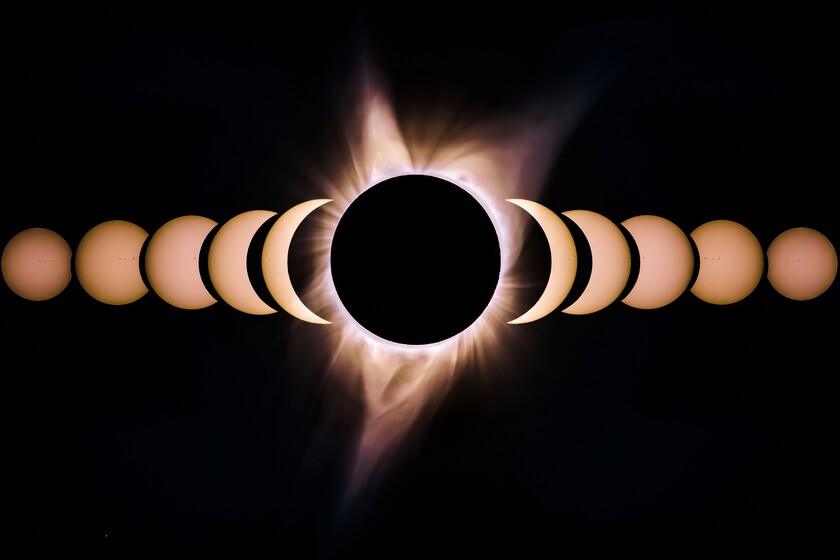
The upcoming total solar eclipse on August 12, 2026, presents a unique, albeit brief, opportunity for scientific observation. Beyond the visual spectacle, researchers are enlisting the public through citizen science projects to collect valuable environmental data during the few minutes of totality. These initiatives aim to shed light on the impact of the eclipse on light pollution and animal behavior.
Studying Light Pollution with EclipseDSM
A key project, dubbed EclipseDSM, focuses on measuring light pollution during the eclipse. Solar eclipses provide an unusual scenario where daytime skies darken significantly, allowing for clearer observations of artificial light. This project, developed by scientists from research centers in Catalonia, Galicia, and Navarre, intends to deploy photometers across the path of totality.
The public can participate by obtaining photometers, with several options available. Participants can build their own using instructions and material lists provided on the project’s website, with most components costing around 30 euros. However, a shortage of a specific component has led to alternative participation methods. These include attending workshops organized by the EclipseDSM team in areas within the path of totality to build a photometer, or requesting a pre-assembled unit via email, though supplies are limited.
The data gathered will help in understanding the efficiency of lighting systems in rural and urban environments, ultimately aiming to reduce light pollution. By comparing the changes in sky brightness during the eclipse in different locations, researchers can assess the effectiveness of local luminaires.
Investigating Animal Behavior with ECOECLIPSE
Another initiative, ECOECLIPSE, spearheaded by scientists from the Spanish Network for Research in Ecoacoustics (REIE), calls on citizens to record natural sounds during the eclipse. This project builds on historical citizen science efforts, dating back to a 1932 study where observations of flora and fauna during an eclipse provided foundational data for subsequent research.
Participation in ECOECLIPSE requires an autonomous sound recorder placed in an area experiencing at least 98% totality. Participants are responsible for providing their own recording equipment. The recorders are to be deployed two days before the eclipse and retrieved two days after. While all sounds will be captured, the primary focus will be on the activity of birds and bats to understand their response to the astronomical event. Researchers have indicated that an application may be developed in the future to allow participation without dedicated recording devices.
The data collected from these projects, though gathered over a short period, promises to provide significant insights into environmental conditions and wildlife responses, showcasing the power of citizen science in advancing scientific understanding.
Key facts
| Project | Focus | Participation Method | Data Type |
|---|---|---|---|
| EclipseDSM | Light Pollution | DIY photometer, workshop, or direct request | Sky brightness levels |
| ECOECLIPSE | Animal Behavior (Birds, Bats) | Autonomous sound recorder (future app planned) | Sound recordings |
The August 2026 solar eclipse is more than just a celestial event; it’s a call to action for citizen scientists. The data collected through projects like EclipseDSM and ECOECLIPSE will contribute to a deeper understanding of our environment and the intricate ways natural phenomena affect wildlife and our own surroundings. The low-cost nature of some participation methods and the potential for future app-based involvement make these projects accessible avenues for public contribution to scientific discovery.
Source: Un eclipse, dos minutos y miles de datos: la ciencia ciudadana se prepara para el gran apagón de 2026 – Xataka (https://www.xataka.com/espacio/eclipse-dos-minutos-miles-datos-ciencia-ciudadana-se-prepara-para-gran-apagon-2026)
Source
Xataka IA Publicacion original: 2026-07-15T15:01:55+00:00
Related articles
IBM CEO Puts a Number on the Open-Weight AI Value Proposition: 90% of the Performance at 10% of the Token Cost
IBM CEO Arvind Krishna told analysts that open-weight models now deliver about 90% of frontier-model effectiveness while costing between 10% and 25%…
Read article
OCU Finds Spanish Homeowner Communities Overpaying Up to €1,500 on Electricity and €3,515 on Gas—Can AI Tools Optimize Shared Energy Bills?
A new OCU analysis of Spanish homeowner community bills reveals widespread overpayment due to non-competitive tariffs and excess contracted power. Could AI-driven…
Read article
Mayotte fiber dispute does not meet ReviewArticle’s AI news brief
Le Monde reports that France’s competition authority has ordered Orange to suspend part of its fiber-optic rollout in Mayotte. The dispute is…
Read article
DiffEEG Model Uses Diffusion Pre-Training to Improve Seizure Detection from Minimal Labeled Data
Researchers have introduced DiffEEG, a 9.6-million-parameter foundation model that combines denoising diffusion pre-training with reinforcement learning fine-tuning to detect seizure events from…
Read articleWiki relacionada

AI Model API Pricing and Context Window Comparison: Current Rates and Limits
Compare the latest API pricing, context windows, and capabilities of leading AI model providers including OpenAI, Anthropic, Google, and Mistral. Practical guidance…
Read article
AI Agent Evaluation Frameworks: How to Benchmark Agentic Systems
A practical guide to evaluating AI agents — from task completion metrics to safety, cost, and robustness. Covers major frameworks, primary sources,…
Read article
LLM Benchmarks Decoded: What MMLU, HumanEval, and GSM8K Actually Measure for Developers
A developer-focused breakdown of the most-cited LLM benchmarks — MMLU, HumanEval, GSM8K, MATH, Chatbot Arena — including what they test, their hidden…
Read article
What Is RAG? A Practical Guide to Retrieval-Augmented Generation in 2025
Retrieval-Augmented Generation (RAG) grounds LLM outputs in external data, reducing hallucinations and enabling enterprise use cases. This guide covers how RAG works,…
Read article