
Cuenca’s Byzantine Municipal Boundaries Offer Prime Viewing for Upcoming Solar Eclipse
Spain's Cuenca municipality, known for its sprawling and convoluted territory, presents a unique opportunity for observing the August 2026 total solar eclipse, though its complex geography presents its own set of challenges.
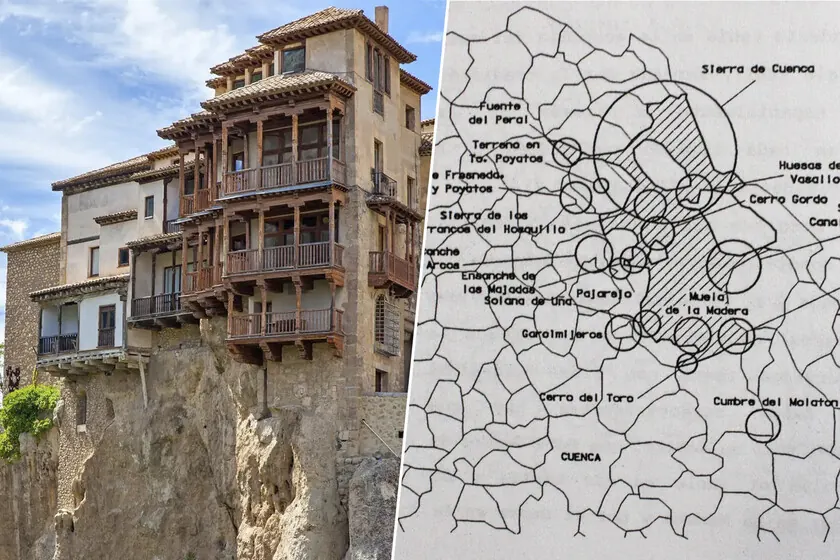
The municipality of Cuenca, Spain, is set to be a prime location for viewing the total solar eclipse on August 12, 2026. This celestial event, the first total solar eclipse visible in the Iberian Peninsula in over a century, will pass over Cuenca, offering a spectacular, albeit brief, viewing opportunity. However, the very nature of Cuenca’s territory—a sprawling and remarkably complex administrative patchwork—adds a unique layer of consideration for potential observers.
A Historical Administrative Anomaly
Cuenca’s municipal boundaries are not a product of modern planning but rather a centuries-old legacy of historical land grants and disputes. The current administrative map is a testament to medieval territorial claims, which have persisted through centuries of legal battles and administrative adjustments. The municipality covers an expansive 911.6 square kilometers, with over 80% of this area being forest land, making it one of the most heavily wooded municipalities in Spain and a significant forest area in Europe.
The historical roots of this complexity trace back to 1177 when Alfonso VIII granted Cuenca its extensive territories upon its reconquest. This grant encompassed montes, pastos (pastures), rivers, salt mines, and mineral resources. Over the ensuing centuries, neighboring villages engaged in persistent efforts to claim portions of this land, leading to numerous lawsuits and boundary disputes. For instance, historical records indicate ongoing conflicts with villages like Huélamo and Beamud over pasture lands as far back as the 18th century.
The territorial organization of Spain, largely based on administrative divisions established in 1833, aimed to link municipalities to their nearest provincial capital for administrative convenience. Cuenca, however, stands as a significant deviation from this model due to its historical development.
Navigating the Terrain for the Eclipse
The vastness and fragmented nature of Cuenca’s municipality mean that traveling from one point to another within its own borders can be a lengthy undertaking, often requiring traversing significant natural terrain. Some estimates suggest that traveling across the municipality from north to south can take over half a jornada (a day’s journey) by car, with road distances potentially reaching 300 kilometers.
Adding to this complexity are the “islands” of smaller municipalities entirely surrounded by Cuenca’s territory. Villages like Vega del Codorno, Tragacete, and Poyatos are examples of enclaves that have distinct administrative identities but are geographically enveloped by the larger Cuenca municipality. This creates a patchwork of jurisdictions that can be disorienting for navigation.
For eclipse viewers, this means that identifying the optimal viewing spot requires careful consideration of local topography. While the Serranía region within Cuenca offers numerous elevated viewpoints, the precise location within the totality band will be crucial. Popular sites like the Ventano del Diablo near Villalba de la Sierra and Castillo de Cañete are mentioned as potential viewing locations, but observers must be aware that even a small hill can obstruct the view of the celestial event.
A Shared Astronomical Event
Ironically, the dispute over El Entredicho, a 2,000-hectare mountain at the headwaters of the Tagus River, between Cuenca and Albarracín (Teruel), highlights the shared geographical destiny of these historically contentious areas. Both municipalities, despite their long-standing territorial disagreements, will fall within the path of totality for the solar eclipse. The Institute Geográfico Nacional ruled in favor of Albarracín in 2024, a decision Cuenca is currently contesting. This shared astronomical spectacle will occur over a region that has been a focal point of administrative and territorial debate for centuries.
The total phase of the eclipse is expected to occur at 20:32 local time, lasting between 54 and 56 seconds. With the Sun positioned low on the western-northwestern horizon at an altitude of only 6 degrees, and setting shortly thereafter at 21:09, clear sightlines towards the horizon will be essential. The complex geography of Cuenca, while potentially challenging for access, also promises a wealth of natural vantage points for those prepared to navigate them.
Key facts
| Feature | Detail |
| :—————— | :—————————————————————————— |
| Eclipse Date | August 12, 2026 |
| Totality Duration | Approximately 54-56 seconds |
| Viewing Time | Total phase begins at 20:32 local time |
| Municipality Area | 911.6 square kilometers |
| Forest Cover | Over 80% of the municipality |
| Historical Context | Medieval land grants and ongoing territorial disputes |
The intricate and often convoluted administrative map of Cuenca, a result of its unique historical development, presents both a challenge and an opportunity for viewers of the 2026 solar eclipse. While the municipality’s vast and fragmented territory requires careful planning for optimal viewing, its elevated terrain offers numerous natural observatories for this rare celestial event.
Source: El término municipal de Cuenca es perfecto para ver el eclipse: el único problema es que es un galimatías incomprensible – Xataka, https://www.xataka.com/magnet/termino-municipal-cuenca-perfecto-para-ver-eclipse-unico-problema-que-galimatias-incomprensible
Datos clave
| Punto | Detalle |
|---|---|
| Fuente | Xataka IA |
| Fecha | 2026-07-16T10:31:55+00:00 |
| Tema | El término municipal de Cuenca es perfecto para ver el eclipse: el único problema es que es un galimatías incomprensible |
Source
Xataka IA Publicacion original: 2026-07-16T10:31:55+00:00
Related articles

IBM CEO Puts a Number on the Open-Weight AI Value Proposition: 90% of the Performance at 10% of the Token Cost
IBM CEO Arvind Krishna told analysts that open-weight models now deliver about 90% of frontier-model effectiveness while costing between 10% and 25%…
Read article
OCU Finds Spanish Homeowner Communities Overpaying Up to €1,500 on Electricity and €3,515 on Gas—Can AI Tools Optimize Shared Energy Bills?
A new OCU analysis of Spanish homeowner community bills reveals widespread overpayment due to non-competitive tariffs and excess contracted power. Could AI-driven…
Read article
Mayotte fiber dispute does not meet ReviewArticle’s AI news brief
Le Monde reports that France’s competition authority has ordered Orange to suspend part of its fiber-optic rollout in Mayotte. The dispute is…
Read article
DiffEEG Model Uses Diffusion Pre-Training to Improve Seizure Detection from Minimal Labeled Data
Researchers have introduced DiffEEG, a 9.6-million-parameter foundation model that combines denoising diffusion pre-training with reinforcement learning fine-tuning to detect seizure events from…
Read articleWiki relacionada

AI Model API Pricing and Context Window Comparison: Current Rates and Limits
Compare the latest API pricing, context windows, and capabilities of leading AI model providers including OpenAI, Anthropic, Google, and Mistral. Practical guidance…
Read article
AI Agent Evaluation Frameworks: How to Benchmark Agentic Systems
A practical guide to evaluating AI agents — from task completion metrics to safety, cost, and robustness. Covers major frameworks, primary sources,…
Read article
LLM Benchmarks Decoded: What MMLU, HumanEval, and GSM8K Actually Measure for Developers
A developer-focused breakdown of the most-cited LLM benchmarks — MMLU, HumanEval, GSM8K, MATH, Chatbot Arena — including what they test, their hidden…
Read article
What Is RAG? A Practical Guide to Retrieval-Augmented Generation in 2025
Retrieval-Augmented Generation (RAG) grounds LLM outputs in external data, reducing hallucinations and enabling enterprise use cases. This guide covers how RAG works,…
Read article