
Earth Continues to Receive Radioactive “Rain” from Distant Supernova Collisions
New research suggests Earth has been bombarded by radioactive material from ancient supernova events for over 100 million years, with implications for planetary science and our understanding of cosmic history.
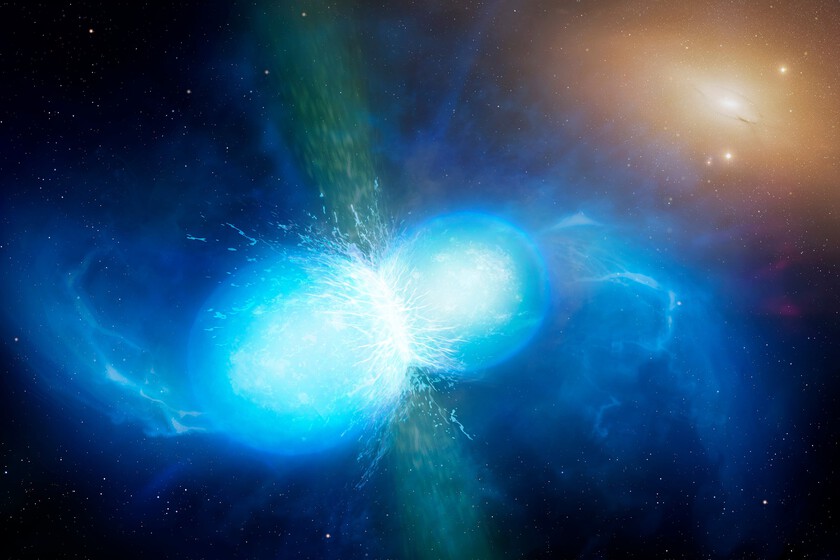
German scientists have uncovered compelling evidence that Earth has been continuously receiving radioactive “rain” for over 100 million years, a phenomenon stemming from the violent collision of two supernovas. This ongoing cosmic bombardment, previously thought to be a more recent event, is shedding new light on the long-term processes shaping our planet and the universe.
The discovery hinges on the analysis of deep-sea ferromanganese crusts, which act as geological time capsules, preserving a record of materials that have settled on the ocean floor over eons. These crusts form slowly, accumulating metals like iron and manganese from seawater, and in doing so, trap other substances that fall into the ocean.
Cosmic Origins of Radioactive Isotopes
At the heart of this finding is the detection of plutonium-244, a radioactive isotope that does not occur naturally on Earth. Plutonium-244 is primarily formed during extreme cosmic events known as the “r-process,” where light atoms rapidly absorb neutrons. The most common source of this process is the kilonova, an explosion resulting from the merger of two neutron stars.
Scientists also examined levels of curium-247, another isotope formed during such mergers, which has a significantly shorter half-life than plutonium-244. The absence of curium-247 in the analyzed deep-sea crust samples indicates that it has completely decayed, a process that would take more than 100 million years. This absence, coupled with the presence of plutonium-244, points to an event that occurred well over 100 million years ago, but less than a billion years ago.
A Persistent “Rain”
While the initial supernova event may have occurred millions of years ago, the study suggests that the radioactive fallout has not ceased. The uniform presence of plutonium in the upper layers of the crust indicates a continuous, albeit likely low-level, deposition of this material. This ongoing “rain” means Earth continues to be influenced by these ancient cosmic cataclysms, even today.
Previous analyses of similar deep-sea crusts had identified iron-60, another radioisotope associated with supernova explosions. Iron-60 has a much shorter half-life of 2.6 million years. The earlier conclusion, based on the presence of iron-60, was that the radioactive shower originated from a supernova event around 3 million years ago. However, the new research, by incorporating the analysis of curium-247, refines this timeline considerably and establishes a much longer duration for the radioactive fallout.
The researchers explain that the iron-60 detected in the samples likely originated from different, distinct cosmic events than the plutonium-244 and curium-247. The varying levels of iron-60 do not align with the deposition patterns of the plutonium isotopes, supporting the idea of multiple cosmic sources contributing to Earth’s radioactive inventory.
Implications for Earth Science and Astrobiology
The continuous influx of extraterrestrial radioactive material has long-term implications for planetary science. While the levels detected are not considered a threat to life on Earth, they contribute to the planet’s overall elemental composition and can provide insights into the history of cosmic events and their impact on our solar system.
The researchers speculate that the immense cataclysm that triggered this prolonged radioactive shower might have had a more significant impact on Earth than currently understood, potentially even affecting life. However, further investigation is required to confirm any such connections. This discovery underscores the dynamic and interconnected nature of the cosmos, where ancient stellar events continue to influence our planet in subtle yet profound ways.
Key facts
| Isotope | Half-life | Origin | Significance for Study |
|---|---|---|---|
| Plutonium-244 | 81 million years | Merger of neutron stars (r-process) | Presence indicates a cosmic event >100 million years ago; continuous fallout detected. |
| Curium-247 | 6 million years | Merger of neutron stars (r-process) | Absence in samples suggests complete decay, confirming event predates 100 million years. |
| Iron-60 | 6 million years | Supernova explosions | Indicates separate, more recent cosmic events; deposition patterns differ from plutonium. |
This research highlights how studying the deep ocean can unlock secrets of the universe, connecting the seemingly disparate fields of geology and astrophysics. By analyzing the chemical signatures left in the Earth’s crust, scientists can piece together a history of cosmic events that have shaped our planet over billions of years.
Source: Científicos alemanes han descubierto que la Tierra lleva más de 100 millones de años recibiendo lluvia radiactiva por el violento “beso” de dos supernovas – Xataka (https://www.xataka.com/espacio/cientificos-alemanes-han-descubierto-que-tierra-lleva-100-millones-anos-recibiendo-lluvia-radiactiva-violento-beso-dos-supernovas)
Source
Xataka IA Publicacion original: 2026-06-21T12:31:07+00:00
Related articles

OCU Finds Spanish Homeowner Communities Overpaying Up to €1,500 on Electricity and €3,515 on Gas—Can AI Tools Optimize Shared Energy Bills?
A new OCU analysis of Spanish homeowner community bills reveals widespread overpayment due to non-competitive tariffs and excess contracted power. Could AI-driven…
Read article
Mayotte fiber dispute does not meet ReviewArticle’s AI news brief
Le Monde reports that France’s competition authority has ordered Orange to suspend part of its fiber-optic rollout in Mayotte. The dispute is…
Read article
DiffEEG Model Uses Diffusion Pre-Training to Improve Seizure Detection from Minimal Labeled Data
Researchers have introduced DiffEEG, a 9.6-million-parameter foundation model that combines denoising diffusion pre-training with reinforcement learning fine-tuning to detect seizure events from…
Read article
The Technology Trap: Why AI Cannot Escape the Unchanging Fundamentals of War
A new Foreign Affairs essay by former Pentagon official Mara Karlin warns that over-reliance on AI and advanced tech in military planning…
Read articleWiki relacionada

AI Model API Pricing and Context Window Comparison: Current Rates and Limits
Compare the latest API pricing, context windows, and capabilities of leading AI model providers including OpenAI, Anthropic, Google, and Mistral. Practical guidance…
Read article
AI Agent Evaluation Frameworks: How to Benchmark Agentic Systems
A practical guide to evaluating AI agents — from task completion metrics to safety, cost, and robustness. Covers major frameworks, primary sources,…
Read article
LLM Benchmarks Decoded: What MMLU, HumanEval, and GSM8K Actually Measure for Developers
A developer-focused breakdown of the most-cited LLM benchmarks — MMLU, HumanEval, GSM8K, MATH, Chatbot Arena — including what they test, their hidden…
Read article
What Is RAG? A Practical Guide to Retrieval-Augmented Generation in 2025
Retrieval-Augmented Generation (RAG) grounds LLM outputs in external data, reducing hallucinations and enabling enterprise use cases. This guide covers how RAG works,…
Read article