
Earth’s Rotation Axis Shifted by 1 Meter Due to Dam Construction
A new study reveals that the accumulation of water in thousands of dams worldwide has caused a measurable shift in Earth's rotation axis, impacting geographical poles and potentially sea levels.
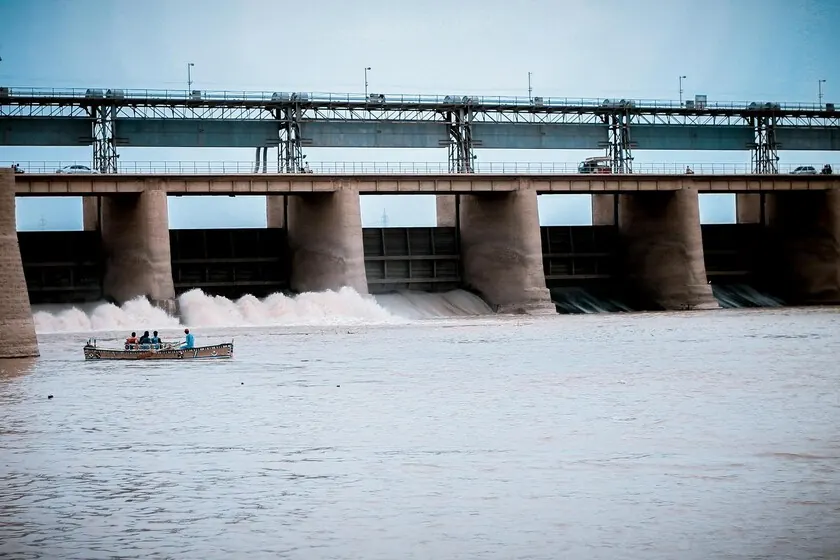
The construction of dams over the past 190 years has not only altered the length of Earth’s day but has also caused a displacement of its rotation axis, according to a recent study. The sheer volume of water impounded behind thousands of dams worldwide has led to a redistribution of mass on the planet’s surface, influencing its spin and geographical poles.
Shifting the Poles
A new study, published in Geophysical Research Letters, provides evidence of the geological impacts of dam construction on a global scale. Researchers observed that the impoundment of water behind dams has caused a slight, yet measurable, shift in the Earth’s geographical poles.
For decades, scientists have understood that while magnetic poles wander, geographical poles were considered largely static, defining Earth’s axis of rotation. However, this new research highlights that geographical poles can indeed shift. This phenomenon is linked to Earth’s layered structure, where the solid crust “floats” on a less dense mantle, allowing for movement influenced by surface mass distribution.
Redistributing Global Mass
The study analyzed the impact of water accumulation in 6,862 dams between 1835 and 2011. This combined volume of water, equivalent to twice the volume of the Grand Canyon, has significantly altered the planet’s mass distribution.
“As we trap water behind dams, we are not only removing water from the oceans, thus reducing sea level, but we are also distributing the mass in a different way around the world,” explained Natasha Valencic, a co-author of the study, in a press release.
The research suggests that this redistribution of water could be responsible for an almost one-meter displacement of Earth’s rotation axis relative to its surface over the studied period. The displacement occurred in two phases. From 1835 to 1954, dam construction in Europe and North America caused the pole to shift approximately 20.5 cm towards the 103° East meridian. The subsequent phase, from 1954 to 2011, was dominated by construction in Asia and East Africa, shifting the pole an additional 57 cm towards the 117° West meridian.
Earlier estimates from NASA’s Jet Propulsion Laboratory had already suggested that filling China’s Three Gorges Dam alone could lengthen Earth’s day by 0.06 microseconds due to its immense water mass. This new study broadens that perspective to encompass the cumulative effect of thousands of dams globally.
Implications for Earth Dynamics
While the detected shifts are not extreme enough to cause dramatic geological events like ice ages, they have significant implications for understanding Earth’s dynamics and humanity’s impact on the planet. The movement of tectonic plates continues irrespective of these water-induced shifts, but knowing these smaller influences can refine our understanding of geological processes.
“We are not going to fall into a new ice age because the pole has been modified by about a meter in total, but it does have implications for sea level,” Valencic clarified. The long-term effects of such mass redistribution on sea levels and other geophysical phenomena are areas that warrant further investigation. This research underscores how large-scale engineering projects can have far-reaching, albeit subtle, consequences on our planet’s fundamental properties.
Key facts
| Aspect | Detail |
|—|—|
| Number of dams studied | 6,862 |
| Total water volume impounded | Twice the volume of the Grand Canyon |
| Period of study | 1835 – 2011 |
| Estimated axis shift | Almost 1 meter |
| Contributing regions (1835-1954) | Europe and North America |
| Contributing regions (1954-2011) | Asia and East Africa |
This development is relevant to ReviewArticle readers interested in the intersection of large-scale engineering, environmental science, and planetary geophysics. It demonstrates how human-induced changes, even those not directly related to AI or advanced technology, can have profound physical impacts on Earth, influencing our understanding of geological processes and their long-term consequences.
Source: Hemos construido tantas presas en los últimos 190 años que no solo hemos cambiado la duración del día: también hemos cambiado el eje de rotación – Xataka: https://www.xataka.com/ecologia-y-naturaleza/hemos-construido-tantas-presas-ultimos-190-anos-que-no-solo-hemos-cambiado-duracion-dia-tambien-hemos-cambiado-eje-rotacion-1
Datos clave
| Punto | Detalle |
|---|---|
| Fuente | Xataka IA |
| Fecha | 2026-07-12T07:31:57+00:00 |
| Tema | Hemos construido tantas presas en los últimos 190 años que no solo hemos cambiado la duración del día: también hemos cam |
Source
Xataka IA Publicacion original: 2026-07-12T07:31:57+00:00
Related articles

OCU Finds Spanish Homeowner Communities Overpaying Up to €1,500 on Electricity and €3,515 on Gas—Can AI Tools Optimize Shared Energy Bills?
A new OCU analysis of Spanish homeowner community bills reveals widespread overpayment due to non-competitive tariffs and excess contracted power. Could AI-driven…
Read article
Mayotte fiber dispute does not meet ReviewArticle’s AI news brief
Le Monde reports that France’s competition authority has ordered Orange to suspend part of its fiber-optic rollout in Mayotte. The dispute is…
Read article
DiffEEG Model Uses Diffusion Pre-Training to Improve Seizure Detection from Minimal Labeled Data
Researchers have introduced DiffEEG, a 9.6-million-parameter foundation model that combines denoising diffusion pre-training with reinforcement learning fine-tuning to detect seizure events from…
Read article
The Technology Trap: Why AI Cannot Escape the Unchanging Fundamentals of War
A new Foreign Affairs essay by former Pentagon official Mara Karlin warns that over-reliance on AI and advanced tech in military planning…
Read articleWiki relacionada

AI Model API Pricing and Context Window Comparison: Current Rates and Limits
Compare the latest API pricing, context windows, and capabilities of leading AI model providers including OpenAI, Anthropic, Google, and Mistral. Practical guidance…
Read article
AI Agent Evaluation Frameworks: How to Benchmark Agentic Systems
A practical guide to evaluating AI agents — from task completion metrics to safety, cost, and robustness. Covers major frameworks, primary sources,…
Read article
LLM Benchmarks Decoded: What MMLU, HumanEval, and GSM8K Actually Measure for Developers
A developer-focused breakdown of the most-cited LLM benchmarks — MMLU, HumanEval, GSM8K, MATH, Chatbot Arena — including what they test, their hidden…
Read article
What Is RAG? A Practical Guide to Retrieval-Augmented Generation in 2025
Retrieval-Augmented Generation (RAG) grounds LLM outputs in external data, reducing hallucinations and enabling enterprise use cases. This guide covers how RAG works,…
Read article