
German Rail Network Grinds to a Halt Due to Communications System Failure
A widespread outage in the GSM-R communications network forced Deutsche Bahn to suspend all train services across Germany for several hours, highlighting the critical reliance on outdated infrastructure.
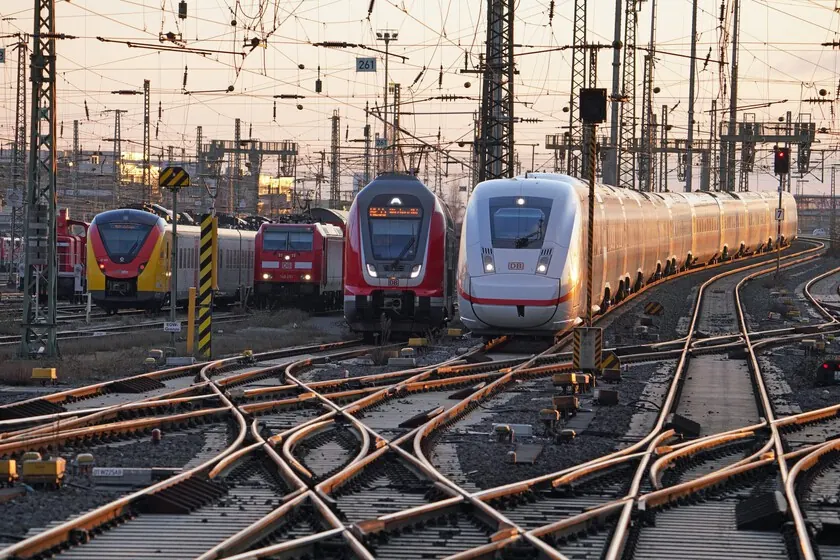
Germany’s national rail operator, Deutsche Bahn (DB), was compelled to halt all train services across the country for over two and a half hours on Tuesday night. The disruption was caused by a widespread failure in the Global System for Mobile Communications–Railway (GSM-R) network, the essential digital communication system connecting train drivers with traffic control centers.
The incident, which began around 10:30 PM local time, led to the immediate suspension of all long-distance, regional, and S-Bahn (suburban) trains. The service was eventually restored around 12:50 AM on Wednesday, after technicians worked to stabilize the situation.
Critical Infrastructure Vulnerability
The GSM-R system, an adaptation of the 2G mobile standard specifically designed for railways, has been a cornerstone of European rail operations since 2000. Its primary function is to ensure secure communication between train operators and signaling control posts, making it a mandatory and indispensable component for safe train operation. Without this active communication line, no train can safely proceed.
Deutsche Bahn has been aware of the obsolescence of the GSM-R system. The company has already entered into a contract with Nokia to replace it with a 5G-based network utilizing the Future Railway Mobile Communication System (FRMCS) standard. However, until the full transition, the network remains dependent on the aging GSM-R.
Incident Management and Passenger Impact
Following the outage, Deutsche Bahn’s CEO, Evelyn Palla, informed the Bild newspaper that an emergency system was deployed to stabilize the situation. The company took measures to mitigate the impact on passengers, distributing taxi vouchers and accommodation for those stranded. Alternative transportation was arranged where possible, and stationary train carriages were made available at stations to provide waiting areas.
While the exact cause of the failure has not been publicly disclosed by Deutsche Bahn, a report from The Register suggests there are no immediate indications of a cyberattack or physical cable cuts being responsible. The same report, however, points to a potential lack of sufficient redundancy layers within the communication network, which is crucial for supporting such critical infrastructure and preventing total paralysis.
Infrastructure Renewal and Future Outlook
This widespread outage comes at a time when Germany’s rail network has been experiencing an increase in delays and disruptions. Deutsche Bahn has been engaged in extensive renovations of its main lines for years to address the gradual deterioration of its infrastructure, a result of decades of underinvestment.
While technical failures have occurred previously, a complete shutdown of the entire network is an unusual event. Historically, such nationwide halts have been attributed to meteorological causes rather than technical faults. The incident underscores the urgent need for the modernization of Germany’s rail infrastructure, particularly its communication systems, to ensure reliability and safety. The transition to FRMCS, leveraging 5G technology, is expected to provide a more robust and secure communication backbone for the future of European railways, potentially mitigating risks associated with outdated systems.
Key facts
| Aspect | Detail |
|---|---|
| Event | Complete shutdown of German rail network |
| Cause | Failure of GSM-R communications system |
| Duration | Over 2.5 hours |
| Operator | Deutsche Bahn |
| Replacement Technology | FRMCS (5G-based) |
| Reported Impact | Widespread travel disruption, passenger inconvenience |
This event has significant implications for the reliability and safety of critical infrastructure, directly impacting millions of daily commuters and freight operations. The reliance on aging communication systems like GSM-R highlights the vulnerability of essential services and the pressing need for upgrades to more advanced, AI-ready technologies like FRMCS to prevent future widespread disruptions.
Source: Alemania no ha tenido más remedio que paralizar todos sus trenes durante horas. El fallo: un sistema de comunicaciones que ya piensa sustituir – Xataka
Source
Xataka IA Publicacion original: 2026-06-24T09:47:01+00:00
Related articles

IBM CEO Puts a Number on the Open-Weight AI Value Proposition: 90% of the Performance at 10% of the Token Cost
IBM CEO Arvind Krishna told analysts that open-weight models now deliver about 90% of frontier-model effectiveness while costing between 10% and 25%…
Read article
OCU Finds Spanish Homeowner Communities Overpaying Up to €1,500 on Electricity and €3,515 on Gas—Can AI Tools Optimize Shared Energy Bills?
A new OCU analysis of Spanish homeowner community bills reveals widespread overpayment due to non-competitive tariffs and excess contracted power. Could AI-driven…
Read article
Mayotte fiber dispute does not meet ReviewArticle’s AI news brief
Le Monde reports that France’s competition authority has ordered Orange to suspend part of its fiber-optic rollout in Mayotte. The dispute is…
Read article
DiffEEG Model Uses Diffusion Pre-Training to Improve Seizure Detection from Minimal Labeled Data
Researchers have introduced DiffEEG, a 9.6-million-parameter foundation model that combines denoising diffusion pre-training with reinforcement learning fine-tuning to detect seizure events from…
Read articleWiki relacionada

AI Model API Pricing and Context Window Comparison: Current Rates and Limits
Compare the latest API pricing, context windows, and capabilities of leading AI model providers including OpenAI, Anthropic, Google, and Mistral. Practical guidance…
Read article
AI Agent Evaluation Frameworks: How to Benchmark Agentic Systems
A practical guide to evaluating AI agents — from task completion metrics to safety, cost, and robustness. Covers major frameworks, primary sources,…
Read article
LLM Benchmarks Decoded: What MMLU, HumanEval, and GSM8K Actually Measure for Developers
A developer-focused breakdown of the most-cited LLM benchmarks — MMLU, HumanEval, GSM8K, MATH, Chatbot Arena — including what they test, their hidden…
Read article
What Is RAG? A Practical Guide to Retrieval-Augmented Generation in 2025
Retrieval-Augmented Generation (RAG) grounds LLM outputs in external data, reducing hallucinations and enabling enterprise use cases. This guide covers how RAG works,…
Read article