
Germany’s Shifting Alliances Threaten Spain’s European Fighter Jet Ambitions
A potential German shift towards Italy's Global Combat Air Programme (GCAP) could leave Spain's independent defense strategy in jeopardy, highlighting Europe's ongoing challenges in consolidating its aerospace projects.
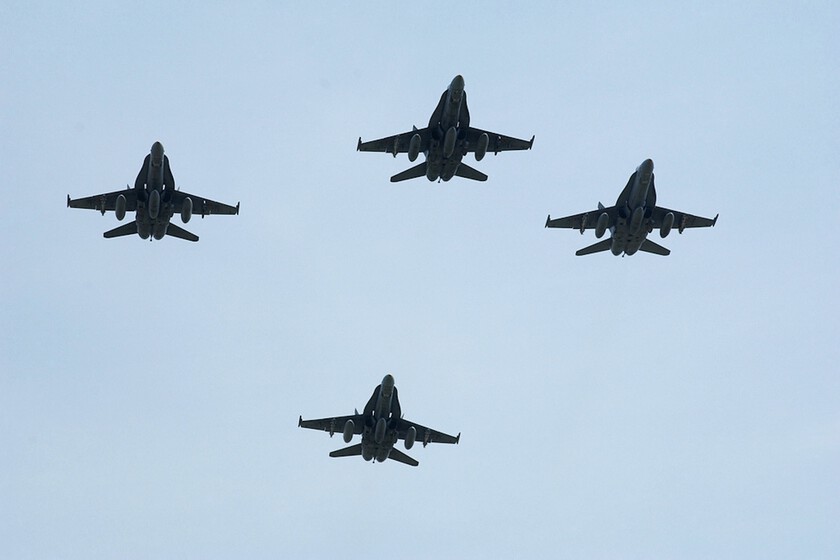
Europe’s ambitious plans for next-generation fighter jets are facing renewed turbulence, with Germany reportedly considering a significant shift in its alliances that could sideline Spain. The Future Combat Air System (FCAS), a flagship European defense program, has been plagued by industrial and political disagreements, particularly between France and Germany. Now, a potential move by Germany towards Italy’s Global Combat Air Programme (GCAP) could leave Spain in a precarious position, jeopardizing its strategic goals in the future of European air power.
This development underscores a recurring challenge in European defense: the difficulty in consolidating projects amidst competing national interests and industrial rivalries. While the United States and China pursue more centralized programs, Europe has struggled to align its efforts, leading to fragmentation and potential strategic disadvantages.
The FCAS program, envisioned as a sixth-generation fighter jet system, has been stalled by tensions between major industry players like Airbus and Dassault Aviation over work-sharing, leadership, and technological architecture. Spain, a key partner in FCAS alongside France and Germany, had developed a contingency plan, often referred to as its “Plan B.” This strategy involved building an alternative axis with Germany and Sweden, focusing on satellite technologies such as sensors, combat cloud, and drone escorts. The aim was to maintain an industrial foothold in next-generation air combat capabilities without being solely reliant on Paris.
A New Dance Partner
The situation has dramatically shifted with Italy’s apparent interest in expanding the GCAP program. Leonardo, a prominent Italian defense company, has indicated a willingness to welcome Germany into the GCAP initiative. On paper, this presents a logical opportunity for Germany, bringing its financial resources, industrial capacity, and experience gained from the Eurofighter Typhoon program.
However, for Spain, this development represents a significant strategic blow. Germany’s potential pivot towards GCAP could mean that its focus shifts away from the Spanish-Swedish axis and towards a partnership involving Rome, London, and Tokyo. This change could transform Spain’s carefully crafted escape route into a dead end, leaving it with fewer options for participation in future European air combat systems.
Germany’s Position
Germany’s apparent pursuit of a more prominent role within any European fighter jet project is consistent with its stance in previous endeavors. Berlin has made it clear that it seeks a position commensurate with its investment and industrial weight. While this ambition proved difficult to reconcile with France’s Dassault Aviation within the FCAS framework, it appears to align more readily with the flexibility offered by Italy. Furthermore, the successful collaboration between BAE Systems and the German branch of Airbus on the Eurofighter Typhoon suggests a pre-existing foundation for cooperation that might make GCAP a more appealing continuation for Berlin.
Spain’s Dilemma
The potential integration of Germany into GCAP creates a significant dilemma for Spain. Madrid could find itself caught between a faltering FCAS and an alternative plan that is losing its most crucial partner before it has fully materialized. Spain might attempt to remain closely aligned with France within the FCAS, but this would likely mean accepting a significantly more subordinate role. Alternatively, pursuing a direct approach to Italy, Japan, or the United Kingdom could be challenging, as entering an already structured program late in the game would severely limit Spain’s negotiating power. The ultimate risk is being excluded from the decisions shaping the future of European air combat.
Recurrent European Challenges
This situation highlights a persistent issue within Europe’s defense industrial landscape: the proliferation of projects, the influence of national egos, and the significant overlap in capabilities. As the United States and China advance with more unified programs, Europe continues to divide its resources across competing blocs. Spain’s “Plan B” was intended as a safety net following the FCAS’s difficulties, but its viability now appears dependent on Germany’s continued engagement, a commitment that seems to be wavering.
Key facts
| Aspect | Detail |
|—|—|
| Original European Fighter Program | Future Combat Air System (FCAS) involving France, Germany, and Spain. |
| Spain’s Contingency Plan | Developing an alternative axis with Germany and Sweden, focusing on supporting technologies. |
| New Potential Program | Global Combat Air Programme (GCAP) involving the UK, Italy, and Japan, with Germany reportedly considering joining. |
| Strategic Implication for Spain | Risk of being sidelined from future European fighter jet development if Germany joins GCAP. |
Source: España tenía un plan maestro para el caza europeo. El problema es que a Alemania le acaba de salir una novia con mucha “pasta”, Xataka, https://www.xataka.com/magnet/espana-tenia-plan-b-para-caza-europeo-problema-que-a-alemania-le-acaba-salir-novia-inesperada-italia
Datos clave
| Punto | Detalle |
|---|---|
| Fuente | Xataka IA |
| Fecha | 2026-06-22T12:31:00+00:00 |
| Tema | España tenía un plan maestro para el caza europeo. El problema es que a Alemania le acaba de salir una novia con mucha " |
Source
Xataka IA Publicacion original: 2026-06-22T12:31:00+00:00
Related articles

OCU Finds Spanish Homeowner Communities Overpaying Up to €1,500 on Electricity and €3,515 on Gas—Can AI Tools Optimize Shared Energy Bills?
A new OCU analysis of Spanish homeowner community bills reveals widespread overpayment due to non-competitive tariffs and excess contracted power. Could AI-driven…
Read article
Mayotte fiber dispute does not meet ReviewArticle’s AI news brief
Le Monde reports that France’s competition authority has ordered Orange to suspend part of its fiber-optic rollout in Mayotte. The dispute is…
Read article
DiffEEG Model Uses Diffusion Pre-Training to Improve Seizure Detection from Minimal Labeled Data
Researchers have introduced DiffEEG, a 9.6-million-parameter foundation model that combines denoising diffusion pre-training with reinforcement learning fine-tuning to detect seizure events from…
Read article
The Technology Trap: Why AI Cannot Escape the Unchanging Fundamentals of War
A new Foreign Affairs essay by former Pentagon official Mara Karlin warns that over-reliance on AI and advanced tech in military planning…
Read articleWiki relacionada

AI Model API Pricing and Context Window Comparison: Current Rates and Limits
Compare the latest API pricing, context windows, and capabilities of leading AI model providers including OpenAI, Anthropic, Google, and Mistral. Practical guidance…
Read article
AI Agent Evaluation Frameworks: How to Benchmark Agentic Systems
A practical guide to evaluating AI agents — from task completion metrics to safety, cost, and robustness. Covers major frameworks, primary sources,…
Read article
LLM Benchmarks Decoded: What MMLU, HumanEval, and GSM8K Actually Measure for Developers
A developer-focused breakdown of the most-cited LLM benchmarks — MMLU, HumanEval, GSM8K, MATH, Chatbot Arena — including what they test, their hidden…
Read article
What Is RAG? A Practical Guide to Retrieval-Augmented Generation in 2025
Retrieval-Augmented Generation (RAG) grounds LLM outputs in external data, reducing hallucinations and enabling enterprise use cases. This guide covers how RAG works,…
Read article