
Global Population Trends Highlight Stark Divide: Nations Facing Decline Versus Growth
A new map based on UN data reveals a global demographic split, with some countries experiencing natural population decline while others see significant growth, impacting economies and public services.
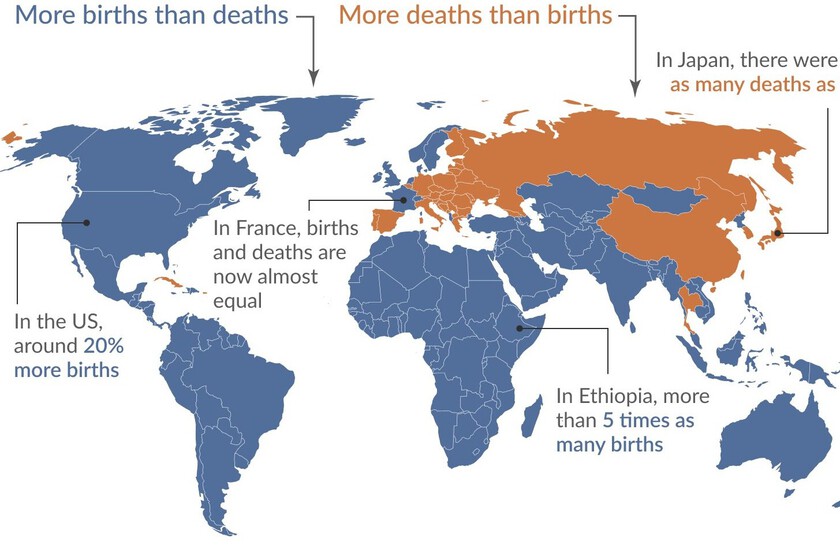
A recent analysis of global demographic trends has illuminated a stark division across nations, categorizing them into those experiencing natural population decline and those with sustained growth. The findings, derived from the UN’s World Population Prospects 2024 report, paint a picture of diverging futures for economies and public systems worldwide.
The map, compiled using data from 1,910 censuses, birth and death records across 169 countries, and 3,189 demographic surveys, focuses on the natural change in population for 2023. It specifically excludes migration to isolate the impact of birth and death rates on population dynamics. Countries colored blue indicate more births than deaths, signifying natural growth, while those in orange show more deaths than births, pointing to a natural contraction.
Por que importa
Key Facts
| Category | Detail |
|---|---|
| Data Source | UN World Population Prospects 2024 |
| Year of Data | 2023 |
| Metric | Natural population change (births minus deaths) |
| Excluded Factor | Migration |
| Stability Metric | Historically, 2.1 births per woman |
The implications of sustained natural population decline are significant. Experts warn that an aging population and an inverted population pyramid can strain social welfare systems, including healthcare and education, which were designed for larger, younger populations. Projections from the UN indicate that by 2070, the global population aged 65 and over will surpass those under 18. This trend is particularly pronounced in many global powers, some of which face nearly irreversible demographic decline.
Countries prominently featured in the “orange” category, indicating natural decline, include Japan, China, South Korea, Russia, and much of Eastern Europe. Japan stands out with twice as many deaths as births, and countries like South Korea, Hong Kong, and Taiwan are well below the historical stability benchmark of 2.1 births per woman. China’s demographic challenges are partly attributed to the structural impact of its former one-child policy. In Europe, Germany has experienced more deaths than births since the 1970s, and France, historically a demographic outlier due to supportive maternity policies, has also seen its balance shift, registering more deaths than births in 2025 for the first time since World War II.
Contexto
In contrast, the “blue” category, representing natural population growth, encompasses most of Latin America, sub-Saharan Africa, the Middle East, and South and Southeast Asia. Ethiopia, for instance, shows a birth rate more than five times its death rate. These regions often feature high fertility rates and younger populations. However, rapid growth in these areas can present its own set of challenges, including potential strain on employment, education, and resources, particularly in developing nations that may also contend with high infant mortality and lower life expectancies.
The United States is noted as a specific case within the growing nations, with approximately 20% more births than deaths. While the map highlights natural population changes, it’s crucial to remember that migration plays a vital role in offsetting natural decline in some countries. Nations like Germany, Italy, and Spain, despite natural population contraction, maintain or grow their populations through immigration, introducing a different set of integration and institutional challenges not captured by this specific demographic map.
The divergence in population trends underscores the complex interplay of social, economic, and policy factors shaping the global demographic landscape and presents distinct challenges and opportunities for nations on both sides of this divide.
Source: El mapa que parte el mundo en dos: los países que están abocados a la extinción y los que no – Xataka, https://www.xataka.com/magnet/mapa-que-parte-mundo-dos-paises-que-estan-abocados-a-extincion-que-no
Source
Xataka IA Publicacion original: 2026-06-14T08:00:17+00:00
Related articles

IBM CEO Puts a Number on the Open-Weight AI Value Proposition: 90% of the Performance at 10% of the Token Cost
IBM CEO Arvind Krishna told analysts that open-weight models now deliver about 90% of frontier-model effectiveness while costing between 10% and 25%…
Read article
OCU Finds Spanish Homeowner Communities Overpaying Up to €1,500 on Electricity and €3,515 on Gas—Can AI Tools Optimize Shared Energy Bills?
A new OCU analysis of Spanish homeowner community bills reveals widespread overpayment due to non-competitive tariffs and excess contracted power. Could AI-driven…
Read article
Mayotte fiber dispute does not meet ReviewArticle’s AI news brief
Le Monde reports that France’s competition authority has ordered Orange to suspend part of its fiber-optic rollout in Mayotte. The dispute is…
Read article
DiffEEG Model Uses Diffusion Pre-Training to Improve Seizure Detection from Minimal Labeled Data
Researchers have introduced DiffEEG, a 9.6-million-parameter foundation model that combines denoising diffusion pre-training with reinforcement learning fine-tuning to detect seizure events from…
Read articleWiki relacionada

AI Model API Pricing and Context Window Comparison: Current Rates and Limits
Compare the latest API pricing, context windows, and capabilities of leading AI model providers including OpenAI, Anthropic, Google, and Mistral. Practical guidance…
Read article
AI Agent Evaluation Frameworks: How to Benchmark Agentic Systems
A practical guide to evaluating AI agents — from task completion metrics to safety, cost, and robustness. Covers major frameworks, primary sources,…
Read article
LLM Benchmarks Decoded: What MMLU, HumanEval, and GSM8K Actually Measure for Developers
A developer-focused breakdown of the most-cited LLM benchmarks — MMLU, HumanEval, GSM8K, MATH, Chatbot Arena — including what they test, their hidden…
Read article
What Is RAG? A Practical Guide to Retrieval-Augmented Generation in 2025
Retrieval-Augmented Generation (RAG) grounds LLM outputs in external data, reducing hallucinations and enabling enterprise use cases. This guide covers how RAG works,…
Read article