
‘Hunger Stones’ Reappear in Drying European Rivers as Droughts Intensify, Carrying Centuries-Old Warnings
Centuries-old "hunger stones" carved with warnings of famine are re-emerging in the Elbe and Rhine rivers as severe drought grips Europe in 2026, offering a stark hydrological record and a grim omen for the future.
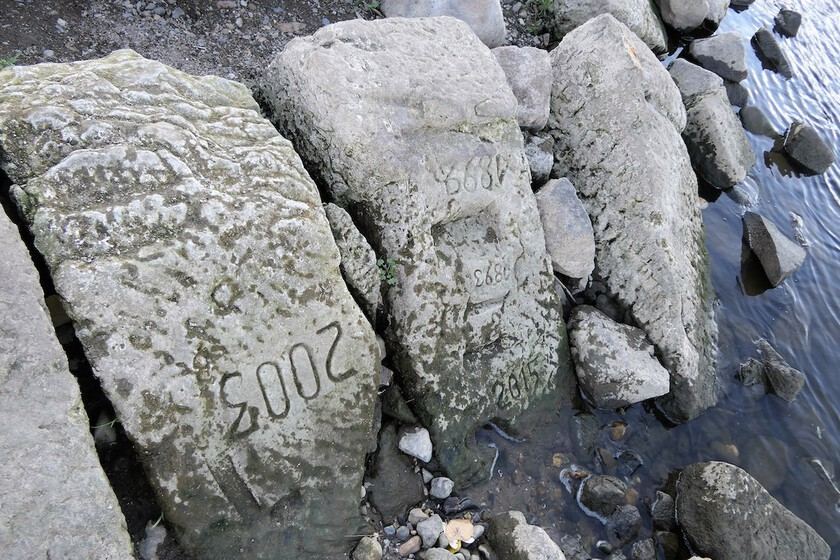
Low water levels in the Elbe and Rhine rivers this summer have exposed carved stones known as “hunger stones” (Hungersteine), which have not been seen since the severe droughts of 2018 and 2022. These stones, inscribed with warnings of famine and hardship dating back to the 15th century, are a stark physical record of past hydrological crises in Central Europe.
The reappearance of these markers is a direct consequence of the ongoing drought across the continent. The European Drought Observatory classified the summer of 2022 as the driest in 500 years, and the 2026 dry spell is now revealing these historical warnings once again.
What are the hunger stones?
The stones are found primarily in the riverbeds of the Elbe and Rhine. For centuries, local inhabitants carved warnings, dates, and initials into rocks that were only exposed during periods of extreme low water. The most famous of these is the stone in Děčín, Czech Republic, which bears the inscription “Wenn du mich siehst, dann weine” (If you see me, weep), carved in 1904 by a boatman and tavern keeper named F. Mayer.
Other stones have been sighted this year in Oberposta, near Pirna, Germany, with inscriptions dating back to 1707, as well as near Leverkusen on the Rhine and in Dolní Žleb near the German-Czech border. The director of the Regional Museum of Děčín, Vlastimil Pažourek, explained to Smithsonian magazine that these stones served as a primitive but effective form of hydrological record-keeping, marking years of drought and hardship for future generations.
A surprisingly accurate historical record
While they appear as folklore, the hunger stones function as a remarkably precise historical dataset. A research paper that analyzed 11 inscriptions from the Děčín hunger stone, carved between 1868 and 1957, found that the water levels indicated by the stones deviated by less than 4 centimeters from official hydrological records of the same periods. This accuracy underscores their value as a pre-instrumental record of drought frequency and intensity.
The stones are not isolated markers. The current drought has also revealed other artifacts from the riverbeds, including World War II-era ships, and even a Pleistocene-era mammoth skeleton, as reported by Xataka. This is not the first time these stones have been seen in recent memory. They were also visible during the droughts of 2018 and 2022, which were each described as the worst in five centuries.
What this means for the future
The increasing frequency of these reappearances is a clear signal. The European Environment Agency has documented that drought events are becoming more common and severe, particularly in southern Europe. The hunger stones, once a rare warning, are now becoming a more regular sight, suggesting that the region is entering a period of more persistent water scarcity.
For readers of ReviewArticle, this story highlights how historical data, even from non-digital sources like carved stones, can be a powerful tool for understanding long-term environmental trends. The accuracy of these stones as hydrological markers offers a unique dataset that can be compared with modern climate models and satellite-based drought monitoring systems. The reappearance of the stones is not just a curiosity; it is a data point in a larger, accelerating pattern of climate change.
Key facts
| Fact | Detail |
|---|---|
| Location | Elbe and Rhine river basins, primarily in Germany and the Czech Republic |
| Oldest known inscription | 1707, in Oberposta, Pirna, Germany |
| Accuracy | Inscriptions deviate by less than 4 cm from official 19th-20th century records |
| Recent reappearances | 2018, 2022, and now 2026 |
Source: Xataka IA, “Si me ves, llora”. La sequía europea está haciendo reaparecer piedras grabadas hace siglos para advertir de futuras hambrunas, https://www.xataka.com/magnet/me-ves-llora-sequia-europea-esta-haciendo-reaparecer-piedras-grabadas-hace-siglos-para-advertir-futuras-hambrunas
Source
Xataka IA Publicacion original: 2026-08-29T13:31:03+00:00
Related articles

OCU Finds Spanish Homeowner Communities Overpaying Up to €1,500 on Electricity and €3,515 on Gas—Can AI Tools Optimize Shared Energy Bills?
A new OCU analysis of Spanish homeowner community bills reveals widespread overpayment due to non-competitive tariffs and excess contracted power. Could AI-driven…
Read article
Mayotte fiber dispute does not meet ReviewArticle’s AI news brief
Le Monde reports that France’s competition authority has ordered Orange to suspend part of its fiber-optic rollout in Mayotte. The dispute is…
Read article
DiffEEG Model Uses Diffusion Pre-Training to Improve Seizure Detection from Minimal Labeled Data
Researchers have introduced DiffEEG, a 9.6-million-parameter foundation model that combines denoising diffusion pre-training with reinforcement learning fine-tuning to detect seizure events from…
Read article
The Technology Trap: Why AI Cannot Escape the Unchanging Fundamentals of War
A new Foreign Affairs essay by former Pentagon official Mara Karlin warns that over-reliance on AI and advanced tech in military planning…
Read articleWiki relacionada

AI Model API Pricing and Context Window Comparison: Current Rates and Limits
Compare the latest API pricing, context windows, and capabilities of leading AI model providers including OpenAI, Anthropic, Google, and Mistral. Practical guidance…
Read article
AI Agent Evaluation Frameworks: How to Benchmark Agentic Systems
A practical guide to evaluating AI agents — from task completion metrics to safety, cost, and robustness. Covers major frameworks, primary sources,…
Read article
LLM Benchmarks Decoded: What MMLU, HumanEval, and GSM8K Actually Measure for Developers
A developer-focused breakdown of the most-cited LLM benchmarks — MMLU, HumanEval, GSM8K, MATH, Chatbot Arena — including what they test, their hidden…
Read article
What Is RAG? A Practical Guide to Retrieval-Augmented Generation in 2025
Retrieval-Augmented Generation (RAG) grounds LLM outputs in external data, reducing hallucinations and enabling enterprise use cases. This guide covers how RAG works,…
Read article