
Apple’s iPhone Calendar Erases Ten Days in October 1582 — Here’s Why
If you scroll your iPhone calendar back to October 1582, you’ll see it jump from the 4th to the 15th. Apple respects the Gregorian calendar reform that deleted ten days to fix a centuries-old drift in the Julian calendar — a digital trace of a 16th-century papal decision still enforced by modern operating systems.
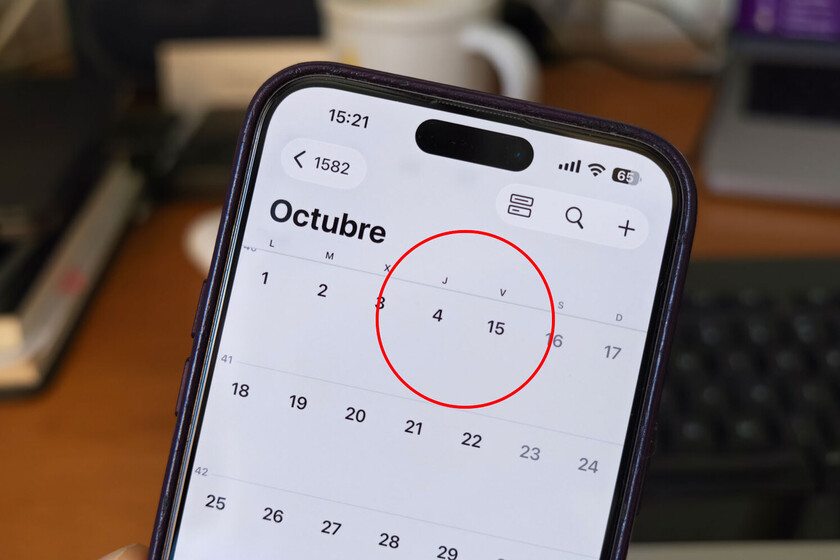
If you open the calendar app on an iPhone and scroll back more than four centuries, you’ll find a historical oddity: the date jumps directly from October 4, 1582, to October 15, 1582. Ten days simply vanish. Apple has chosen to replicate the Gregorian calendar reform exactly as it was implemented in Catholic Europe in 1582, meaning the digital calendar on your phone preserves a 440-year-old papal decision.
The missing days are not a bug. They are the result of the most significant calendar correction in Western history, and they still affect how modern software handles dates before October 1582.
Why the calendar needed fixing
The root cause is a mismatch between the Julian calendar, introduced by Julius Caesar in 45 BCE, and the actual solar year. The Julian calendar assumed a year of 365.25 days and added a leap day every four years. In reality, the solar year is about 365.2422 days. The difference — 11 minutes and 14 seconds per year — accumulated to one full day every 128 years.
By the 16th century, the cumulative drift had reached ten days. That mattered for more than astronomy. The First Council of Nicaea in 325 CE had fixed Easter to the first Sunday after the first full moon following the vernal equinox, set at March 21. By 1582, the real equinox was falling around March 11. If left uncorrected, Easter would eventually drift into summer.
Pope Gregory XIII issued the bull Inter gravissimas in February 1582, ordering two changes: a new calendar (the Gregorian calendar) with a more precise leap-year rule, and the immediate removal of ten accumulated days to reset the equinox to March 21.
Key facts
| Aspect | Detail |
|---|---|
| Drift per year in Julian calendar | 11 minutes 14 seconds |
| Total drift by 1582 | 10 days |
| Papal bull | Inter gravissimas, February 1582 |
| Date of calendar reform | October 4, 1582 → October 15, 1582 |
Why October was chosen for the deletion
The Church selected October for practical reasons. October had few major religious feasts, and the cut respected the feast of Saint Francis of Assisi on October 4. In territories that adopted the reform immediately — Spain, Italy, Portugal, and Poland — residents went to bed on Thursday, October 4, and woke up on Friday, October 15. Ten days of rent, wages, and interest payments had to be recalculated.
Adoption was uneven across Europe. France switched in December 1582. Protestant and Orthodox states largely refused. The British Empire waited until September 1752, by which time the drift had reached 11 days. Russia adopted the Gregorian calendar only in 1918, and Greece in 1923 — both skipping 13 days.
Apple follows the historical record
Apple’s calendar implementation respects the exact date of the Gregorian reform’s introduction. When you scroll before October 15, 1582, the iPhone calendar uses the Julian system and then jumps to the Gregorian dates. That is why the ten days are absent.
Android’s default calendar app also accounts for the reform, but Google Calendar restricts backward navigation to 1900, so most Android users never encounter the gap. Third-party calendar apps may handle the transition differently, and some historical date libraries used in software development treat the pre-Gregorian period inconsistently.
What this means for developers and data historians
The October 1582 gap is a known edge case in date-time libraries. Developers working with historical data, genealogy software, or astronomical calculations must account for the transition. Python’s calendar module, for example, raises errors for dates before the Gregorian reform unless the developer explicitly uses a proleptic Gregorian calendar — one that extends the Gregorian rules backward. Apple’s approach, by contrast, mirrors the actual historical adoption, which is correct for event dating but can break date arithmetic across the gap.
For most users, the missing days are a historical curiosity visible only by deliberately scrolling four centuries back. But for anyone working with dates before 1582, the gap is a reminder that calendar systems are human constructs — and that modern software still reflects decisions made by a 16th-century pope.
Source: Xataka IA — Por qué faltan diez días en el calendario de tu móvil si viajas hasta octubre de 1582 (https://www.xataka.com/aplicaciones/que-faltan-diez-dias-calendario-tu-movil-viajas-octubre-1582)
Source
Xataka IA Publicacion original: 2026-10-10T16:00:28+00:00
Related articles

Trump Announces Deal for Russia to Resume Diesel Sales to US as Zelensky Warns of ‘Gift to Putin’
The US Treasury’s OFAC issued a temporary license allowing Russian diesel imports through April 2027. President Trump claims the deal will lower…
Read article
Why the 24-Hour Day Is a Convenient Fiction, Not a Scientific Fact
The 24-hour day is an average, not a constant. Earth’s elliptical orbit and axial tilt mean most days are slightly shorter or…
Read article
Lightweight AI Framework Turns Smartphone Photos of Paper ECGs Into Heart Attack Screenings
A new compute-light framework called ECGLight can digitize paper ECG printouts from a smartphone photo and screen for myocardial infarction in under…
Read article
AWS CEO Warns Over 100 US Data Center Moratoriums Risk “Potentially Irreparable” Damage to AI Leadership
Amazon Web Services CEO Matt Garman warns that more than 100 local moratoriums on data center construction across the US threaten the…
Read articleWiki relacionada

AI Model API Pricing and Context Window Comparison: Current Rates and Limits
Compare the latest API pricing, context windows, and capabilities of leading AI model providers including OpenAI, Anthropic, Google, and Mistral. Practical guidance…
Read article
AI Agent Evaluation Frameworks: How to Benchmark Agentic Systems
A practical guide to evaluating AI agents — from task completion metrics to safety, cost, and robustness. Covers major frameworks, primary sources,…
Read article
LLM Benchmarks Decoded: What MMLU, HumanEval, and GSM8K Actually Measure for Developers
A developer-focused breakdown of the most-cited LLM benchmarks — MMLU, HumanEval, GSM8K, MATH, Chatbot Arena — including what they test, their hidden…
Read article
What Is RAG? A Practical Guide to Retrieval-Augmented Generation in 2025
Retrieval-Augmented Generation (RAG) grounds LLM outputs in external data, reducing hallucinations and enabling enterprise use cases. This guide covers how RAG works,…
Read article