
James Webb Telescope Detects Theoretical “Black Hole Star” for the First Time
The James Webb Space Telescope has provided unprecedented detail on a distant red point, revealing an object previously only theorized: a star containing a black hole within it.
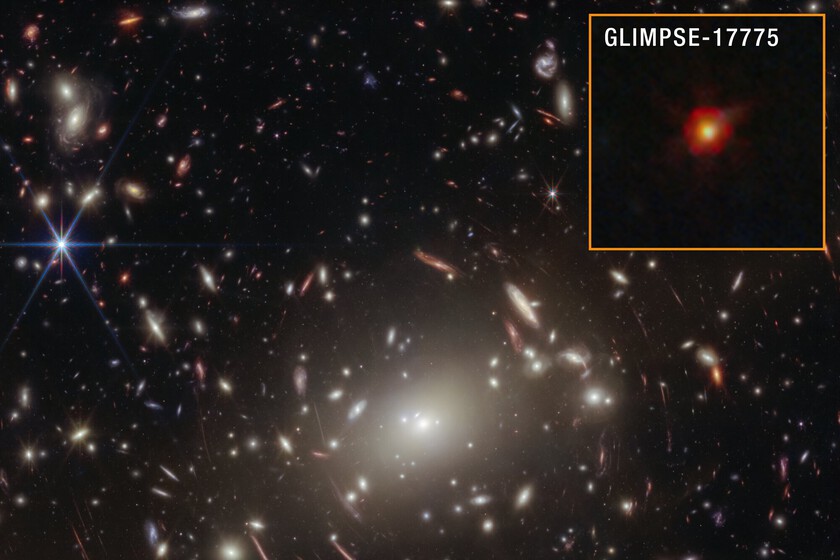
The James Webb Space Telescope (JWST) has achieved a significant astronomical milestone, detecting an object that has long existed only in theory: a star with a black hole nestled inside it. This groundbreaking observation, made possible by JWST’s advanced observational capabilities, sheds new light on the extreme environments of the early universe.
The discovery centers on a distant “red point” designated GLIMPSE-17775, one of hundreds identified by JWST since 2022. These objects, believed to have formed approximately 600 million years after the Big Bang, have presented a persistent enigma for astronomers. However, JWST’s ability to conduct deep-field observations is now beginning to unravel their mysteries.
Enhanced Observation Precision
The observation of GLIMPSE-17775 was significantly enhanced by its proximity to a massive galactic cluster. The gravitational pull of this cluster acts as a cosmic magnifying glass, warping spacetime and amplifying the light from objects behind it. This gravitational lensing effect allowed JWST to focus on GLIMPSE-17775 with unprecedented detail, gathering the equivalent of 80 hours of observation in just 30 hours.
The telescope’s spectrograph analyzed 40 spectral lines from the object, providing the most detailed spectral analysis of such a distant entity to date. This data offered crucial clues about its composition and structure.
The Theoretical Black Hole Star
When a massive star exhausts its nuclear fuel, it can collapse under its own gravity, typically forming a black hole. In most cases, the entire star is converted into a black hole. However, a theoretical phenomenon known as a “quasi-star” or “black hole star” proposes that a portion of the star might not be fully consumed, leaving a stellar-mass black hole embedded within the remnant star’s dense, partially ionized gas cocoon. Until now, no such object had been directly detected.
Interpreting the Spectral Data
The 40 spectral lines observed by JWST acted as pieces of a cosmic puzzle. Analysis revealed lines associated with hydrogen, oxygen, and helium that did not align with the typical signature of a rotating gas cloud around a black hole. Instead, the data indicated the presence of oxygen lines formed by immense energy, consistent with emissions from a black hole. Additionally, iron lines suggested the star was in its final stages of fuel fusion, while other lines pointed to electron scattering within a dense gas cocoon.
The spectral data also indicated fluorescence and helium absorption, characteristics of a dense medium surrounding a powerful energy source. This composite signature strongly supports the identification of GLIMPSE-17775 as a black hole star. Researchers speculate that other red points might also be black hole stars, with their stellar cocoons potentially absorbing X-ray emissions, explaining why such objects have not been detected by other telescopes.
Key facts
| Feature | Description |
|---|---|
| Telescope | James Webb Space Telescope (JWST) |
| Detected Object | Theoretical “black hole star” (quasi-star) |
| Designation | GLIMPSE-17775 |
| Significance | First direct detection of a star containing a black hole within it. |
| Context | Early universe, approx. 600 million years after the Big Bang. |
This discovery is significant for astrophysics, offering empirical evidence for a class of celestial objects previously confined to theoretical models. It provides a new avenue for understanding the extreme physics governing the early universe and the formation of black holes. Further analysis of other distant red points by JWST may reveal more such objects, expanding our understanding of cosmic evolution.
Source: El James Webb acaba de encontrar un objeto que solo existía en teoría: una estrella con un agujero negro en su interior – Xataka (https://www.xataka.com/espacio/james-webb-acaba-encontrar-objeto-que-solo-existia-teoria-estrella-agujero-negro-su-interior)
Source
Xataka IA Publicacion original: 2026-06-12T10:00:17+00:00
Related articles

OCU Finds Spanish Homeowner Communities Overpaying Up to €1,500 on Electricity and €3,515 on Gas—Can AI Tools Optimize Shared Energy Bills?
A new OCU analysis of Spanish homeowner community bills reveals widespread overpayment due to non-competitive tariffs and excess contracted power. Could AI-driven…
Read article
Mayotte fiber dispute does not meet ReviewArticle’s AI news brief
Le Monde reports that France’s competition authority has ordered Orange to suspend part of its fiber-optic rollout in Mayotte. The dispute is…
Read article
DiffEEG Model Uses Diffusion Pre-Training to Improve Seizure Detection from Minimal Labeled Data
Researchers have introduced DiffEEG, a 9.6-million-parameter foundation model that combines denoising diffusion pre-training with reinforcement learning fine-tuning to detect seizure events from…
Read article
The Technology Trap: Why AI Cannot Escape the Unchanging Fundamentals of War
A new Foreign Affairs essay by former Pentagon official Mara Karlin warns that over-reliance on AI and advanced tech in military planning…
Read articleWiki relacionada

AI Model API Pricing and Context Window Comparison: Current Rates and Limits
Compare the latest API pricing, context windows, and capabilities of leading AI model providers including OpenAI, Anthropic, Google, and Mistral. Practical guidance…
Read article
AI Agent Evaluation Frameworks: How to Benchmark Agentic Systems
A practical guide to evaluating AI agents — from task completion metrics to safety, cost, and robustness. Covers major frameworks, primary sources,…
Read article
LLM Benchmarks Decoded: What MMLU, HumanEval, and GSM8K Actually Measure for Developers
A developer-focused breakdown of the most-cited LLM benchmarks — MMLU, HumanEval, GSM8K, MATH, Chatbot Arena — including what they test, their hidden…
Read article
What Is RAG? A Practical Guide to Retrieval-Augmented Generation in 2025
Retrieval-Augmented Generation (RAG) grounds LLM outputs in external data, reducing hallucinations and enabling enterprise use cases. This guide covers how RAG works,…
Read article