
Mechanics Warn: Neglecting Timing Belt Replacement is a “Death Sentence” for Car Engines
Experts emphasize that delaying the crucial timing belt replacement can lead to catastrophic engine failure, with repair costs potentially reaching thousands of dollars.
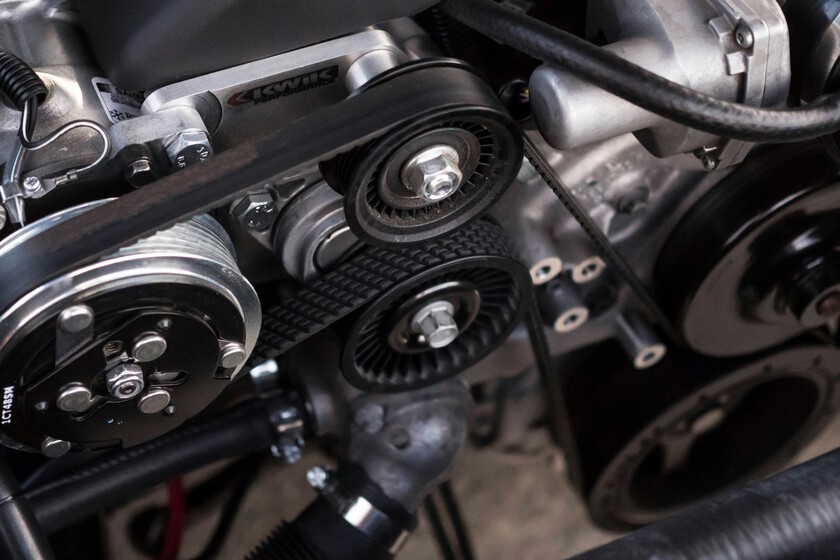
Mechanics across the industry are issuing a stark warning: failing to replace a car’s timing belt within recommended intervals is akin to delivering a “death sentence” to the engine. This critical component, often overlooked in routine maintenance, can cause irreversible and financially devastating damage if it fails.
What the Timing Belt Does
The timing belt is a toothed rubber band that synchronizes the rotation of the crankshaft and the camshaft. This synchronization ensures that the engine’s pistons and valves move in perfect coordination, with valves opening and closing at precisely the right moments relative to the piston’s position. Any deviation from this precise timing can lead to reduced engine efficiency, and a complete failure can result in catastrophic damage.
The Perils of Belt Failure
When a timing belt breaks while the engine is running, it can cause the pistons to collide violently with the valves in most modern vehicles. This catastrophic event, described by specialists as “the beginning of a mechanical and financial nightmare,” can lead to severely bent valves, damaged pistons, and in the most severe cases, a cracked cylinder head or a fractured camshaft. The subsequent repairs can be exceptionally costly, often running into thousands of dollars.
Recommended Replacement Intervals and Factors
Manufacturers typically specify replacement intervals in kilometers, ranging from 60,000 to 240,000 km, depending on the vehicle model. However, time is also a critical factor. Experts advise that if a maximum time limit is not specified in the owner’s manual, the belt should be inspected every five years, regardless of mileage. The rubber degrades over time, even when the car is stationary, making an old, brittle belt a ticking time bomb.
A general recommendation from mechanics like Juan José Ebenezer is to replace the timing belt every 100,000 kilometers or five years, whichever comes first. For specific systems, such as oil-bathed timing belts in Stellantis group vehicles, some mechanics suggest replacement as early as 50,000 km, noting that going beyond 60,000 km may already be too late. It is generally recommended to replace the entire kit, which includes the belt, pulleys, tensioner rollers, and often the water pump.
Accelerated Wear and Environmental Factors
Certain driving conditions and environments can accelerate the deterioration of the timing belt. Driving predominantly in urban settings, with frequent cold starts, stop-and-go traffic, and constant gear changes, can increase wear. Experts suggest reducing the replacement interval by 20-25% in such cases.
Extreme climates also play a role. High temperatures, dust, and humidity can all contribute to the premature aging of the rubber. Official Volkswagen service centers in areas prone to intense heat and dust, for instance, recommend earlier visual inspections, even for engines with official intervals of up to 210,000 km. Similarly, workshops like Midas advise advancing maintenance for vehicles operating in extreme hot or cold conditions.
Financial Implications of Neglect
The cost of a preventative timing belt kit replacement in Spain typically ranges from €300 to €1,000, depending on the vehicle and the workshop. In contrast, repairing an engine damaged by a broken timing belt can start at €1,000 and easily escalate to €6,000. In the worst-case scenarios, where pistons, cylinder heads, or camshafts are severely damaged, the cost of a complete engine replacement can be prohibitive.
Key facts
| Factor | Recommendation |
|—|—|
| General Mileage Interval | 100,000 km (or 5 years) |
| Stellantis Oil-Bathed Belts | ~50,000 km |
| Urban Driving | Reduce interval by 20-25% |
| Extreme Climates | Advise earlier inspection/replacement |
This information is crucial for car owners as it highlights a critical, yet often underestimated, maintenance item. Understanding the risks associated with a neglected timing belt can help drivers avoid potentially crippling repair bills and ensure the longevity of their vehicle’s engine.
Source: Los mecánicos coinciden: tardar demasiado en cambiar la correa de distribución es “una sentencia de muerte para el motor” – Xataka: https://www.xataka.com/movilidad/mecanicos-coinciden-tardar-demasiado-cambiar-correa-distribucion-sentencia-muerte-para-motor
Datos clave
| Punto | Detalle |
|---|---|
| Fuente | Xataka IA |
| Fecha | 2026-06-18T07:00:17+00:00 |
| Tema | Los mecánicos coinciden: tardar demasiado en cambiar la correa de distribución es "una sentencia de muerte para el motor |
Source
Xataka IA Publicacion original: 2026-06-18T07:00:17+00:00
Related articles

IBM CEO Puts a Number on the Open-Weight AI Value Proposition: 90% of the Performance at 10% of the Token Cost
IBM CEO Arvind Krishna told analysts that open-weight models now deliver about 90% of frontier-model effectiveness while costing between 10% and 25%…
Read article
OCU Finds Spanish Homeowner Communities Overpaying Up to €1,500 on Electricity and €3,515 on Gas—Can AI Tools Optimize Shared Energy Bills?
A new OCU analysis of Spanish homeowner community bills reveals widespread overpayment due to non-competitive tariffs and excess contracted power. Could AI-driven…
Read article
Mayotte fiber dispute does not meet ReviewArticle’s AI news brief
Le Monde reports that France’s competition authority has ordered Orange to suspend part of its fiber-optic rollout in Mayotte. The dispute is…
Read article
DiffEEG Model Uses Diffusion Pre-Training to Improve Seizure Detection from Minimal Labeled Data
Researchers have introduced DiffEEG, a 9.6-million-parameter foundation model that combines denoising diffusion pre-training with reinforcement learning fine-tuning to detect seizure events from…
Read articleWiki relacionada

AI Model API Pricing and Context Window Comparison: Current Rates and Limits
Compare the latest API pricing, context windows, and capabilities of leading AI model providers including OpenAI, Anthropic, Google, and Mistral. Practical guidance…
Read article
AI Agent Evaluation Frameworks: How to Benchmark Agentic Systems
A practical guide to evaluating AI agents — from task completion metrics to safety, cost, and robustness. Covers major frameworks, primary sources,…
Read article
LLM Benchmarks Decoded: What MMLU, HumanEval, and GSM8K Actually Measure for Developers
A developer-focused breakdown of the most-cited LLM benchmarks — MMLU, HumanEval, GSM8K, MATH, Chatbot Arena — including what they test, their hidden…
Read article
What Is RAG? A Practical Guide to Retrieval-Augmented Generation in 2025
Retrieval-Augmented Generation (RAG) grounds LLM outputs in external data, reducing hallucinations and enabling enterprise use cases. This guide covers how RAG works,…
Read article