
Nepal’s “Flood-Proof” Google Maps Landmark Is Not a Verified Safety Rating
A house that survived a destructive Himalayan flood reportedly appeared on Google Maps as a “flood-proof” attraction. The viral label should not be mistaken for an engineering assessment or an AI-generated safety rating.
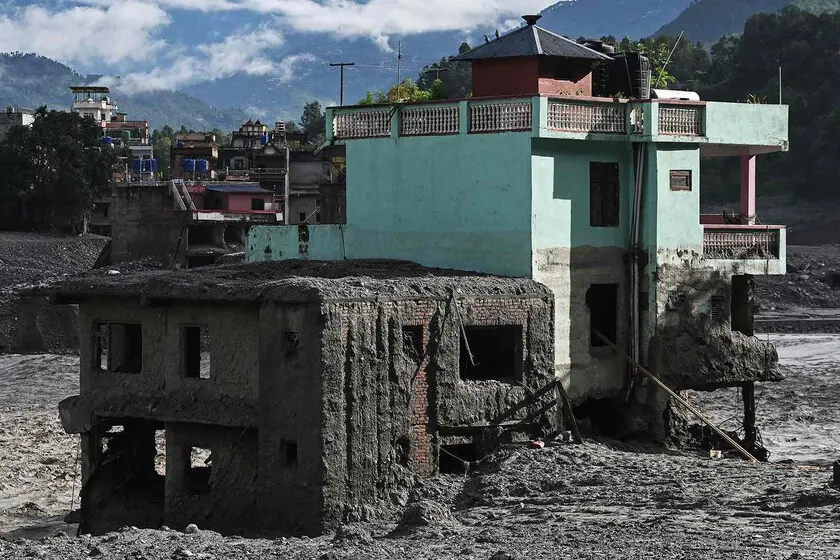
A green house left standing after a destructive flood in Nepal has reportedly become a Google Maps attraction under a “flood-proof” label. The unusual listing reflects the speed at which viral images can reshape digital maps, but it does not establish that Google, an automated system or an engineer has certified the building as resistant to floods.
The house belongs to the Pyakurel family in Dhunge Bazaar, in Nepal’s Nuwakot district. Photographs showing it isolated amid mud and debris circulated widely online, earning the building the nicknames “Miracle House” and “Viral House,” according to Xataka’s account.
For technology readers, the relevant distinction is between a label displayed on a mapping platform and a verified classification. The available reporting does not identify who submitted the place, how it was categorized or whether Google reviewed the “flood-proof” description.
What happened in Dhunge Bazaar
Xataka, citing reporting by The New York Times, said the Pyakurel family was inside the three-story building when a torrent of water, mud and debris reached the area following a glacial collapse in the Himalayan region between Nepal and Tibet.
The family reportedly moved from the third floor to the roof as the current struck the building for more than an hour. After the water began to recede, neighbors used metal pipes as an improvised ladder to help them escape.
The surrounding area suffered extensive destruction. More than 1,200 homes in Nuwakot district were completely destroyed and approximately 1,000 sustained partial damage, according to the figures reproduced by Xataka. Bridges and sections of road disappeared. Electrical turbines across the river were swept away, while a nearby bazaar and several homes were destroyed.
| Point to verify | What the reporting says |
|---|---|
| Location | Dhunge Bazaar, Nuwakot district, Nepal |
| Reported damage | More than 1,200 homes destroyed and about 1,000 partially damaged |
| Map description | The house appeared as a “flood-proof” attraction on Google Maps |
| Proposed explanation | Deeply anchored pillars may have helped, but a nearby ridge may also have reduced the force |
| Verification status | No independent structural assessment is cited |
How a private home became a map attraction
Once the road partially reopened, visitors reportedly began traveling to the area to view and photograph the building. Its online visibility increased when a dedicated place marker appeared on Google Maps.
That marker turned a family residence into a searchable destination associated with the disaster. However, the source material does not show that “flood-proof” is an official Google category, a finding produced by artificial intelligence or a technical designation approved by local authorities.
This matters because map listings can acquire an appearance of authority even when their descriptions originate from incomplete or user-supplied information. A prominent label may influence tourists, journalists and other users who encounter the listing without knowing its provenance.
The uncertain reason the house remained standing
Chhatra Bahadur Pyakurel believes the building’s foundations contributed to its survival. He said its pillars had been installed by drilling deeply enough to reach bedrock. The ground floor was built in 1995 for the family’s grocery business, with additional floors added later as the business prospered.
There is also another possible explanation. A ridge in front of the flood’s path may have shielded the building from part of the current. The available reporting cites no geological survey, structural inspection or comparative analysis capable of separating the effect of the foundations from the influence of the terrain.
The house also did not emerge undamaged. Its first two floors were heavily affected, family possessions and important documents were lost, and little beyond structural elements reportedly remained at the lower levels. Objects on the third floor and roof survived, including water tanks, a solar heater and a small family shrine.
Why the “flood-proof” label is misleading
Surviving one event does not prove that a structure can withstand another flood with a different depth, speed, debris load or direction. “Flood-proof” is therefore a stronger claim than the evidence supports.
The Google Maps marker should be understood as part of the house’s viral afterlife, not as a resilience benchmark. It would be unsafe to use the label when making construction decisions, evaluating local risk or identifying shelter during an emergency.
The case also illustrates a broader platform problem: descriptive text on a digital map can blur the line between a cultural nickname and a factual safety claim. Nothing in the cited reporting indicates that an AI system analyzed the building or determined why it survived.
What remains unclear
The source does not establish who created the Google Maps listing, when it first appeared, whether the wording remains active or whether Google has reviewed it. It also provides no independent engineering report confirming the condition of the foundations.
Readers checking the listing should look for recent edits, official notices and photographs rather than relying on the attraction name. Any claim about the building’s future safety would require an on-site assessment by qualified structural and geotechnical specialists.
For the Pyakurel family, the outcome was ultimately about survival rather than online fame. Their grandson had left for a school on higher ground shortly before the flood, and the family was reunited safely the following day.
Source: https://www.xataka.com/magnet/nepal-tiene-nueva-atraccion-google-maps-casa-verde-que-sobrevivio-a-riada-cuyo-secreto-esta-enterrado-tierra
Source
Xataka IA Publicacion original: 2026-09-12T16:31:00+00:00
Related articles

OCU Finds Spanish Homeowner Communities Overpaying Up to €1,500 on Electricity and €3,515 on Gas—Can AI Tools Optimize Shared Energy Bills?
A new OCU analysis of Spanish homeowner community bills reveals widespread overpayment due to non-competitive tariffs and excess contracted power. Could AI-driven…
Read article
Mayotte fiber dispute does not meet ReviewArticle’s AI news brief
Le Monde reports that France’s competition authority has ordered Orange to suspend part of its fiber-optic rollout in Mayotte. The dispute is…
Read article
DiffEEG Model Uses Diffusion Pre-Training to Improve Seizure Detection from Minimal Labeled Data
Researchers have introduced DiffEEG, a 9.6-million-parameter foundation model that combines denoising diffusion pre-training with reinforcement learning fine-tuning to detect seizure events from…
Read article
The Technology Trap: Why AI Cannot Escape the Unchanging Fundamentals of War
A new Foreign Affairs essay by former Pentagon official Mara Karlin warns that over-reliance on AI and advanced tech in military planning…
Read articleWiki relacionada

AI Model API Pricing and Context Window Comparison: Current Rates and Limits
Compare the latest API pricing, context windows, and capabilities of leading AI model providers including OpenAI, Anthropic, Google, and Mistral. Practical guidance…
Read article
AI Agent Evaluation Frameworks: How to Benchmark Agentic Systems
A practical guide to evaluating AI agents — from task completion metrics to safety, cost, and robustness. Covers major frameworks, primary sources,…
Read article
LLM Benchmarks Decoded: What MMLU, HumanEval, and GSM8K Actually Measure for Developers
A developer-focused breakdown of the most-cited LLM benchmarks — MMLU, HumanEval, GSM8K, MATH, Chatbot Arena — including what they test, their hidden…
Read article
What Is RAG? A Practical Guide to Retrieval-Augmented Generation in 2025
Retrieval-Augmented Generation (RAG) grounds LLM outputs in external data, reducing hallucinations and enabling enterprise use cases. This guide covers how RAG works,…
Read article