
Russian Customs Seize 2.5-Ton Meteorite Posing as Garden Ornament
Russian authorities intercepted a massive 2.5-ton meteorite being smuggled out of the country disguised as a garden statue, highlighting the illicit trade in valuable extraterrestrial materials.
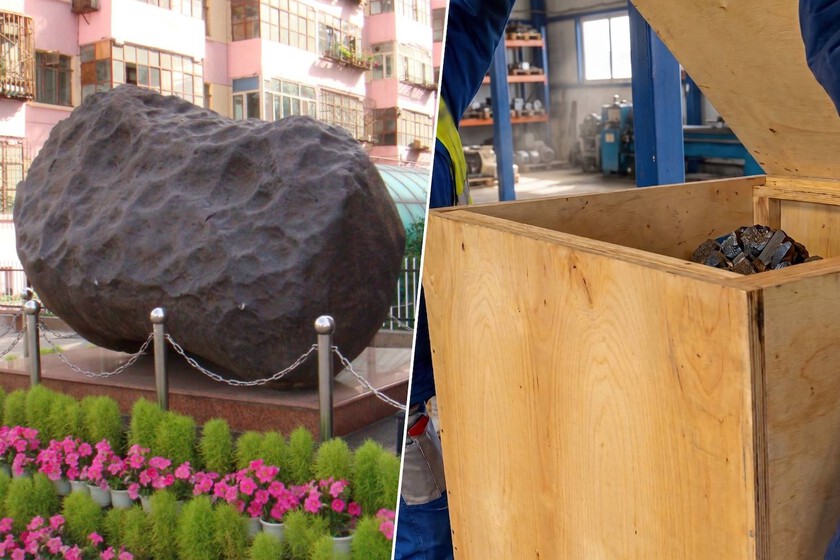
Russian customs officials have confiscated a colossal 2.5-ton meteorite that was being smuggled out of the country under the guise of a garden ornament. The discovery, made during a routine inspection at a St. Petersburg port, has brought attention to the clandestine trade and significant value of extraterrestrial materials.
The large wooden crate was declared to contain a garden statue, but discrepancies in its declared origin and value prompted customs officers to investigate further. Upon opening the crate, they found a substantial grey rock, which subsequent forensic examination confirmed to be a fragment of the Aletai meteorite.
The Aletai meteorite was originally discovered in 1898 in the Xinjiang region of northwestern China. This particular fragment is estimated to be worth approximately 323 million rubles, equivalent to about 3.8 million euros.
Why This Matters
The seizure underscores the substantial financial and scientific value attributed to meteorites. The Aletai meteorite is of particular scientific interest. It belongs to the extremely rare IIIE-an chemical group, known for containing anomalous amounts of gold, cobalt, and iridium. Its age, estimated at 4.5 billion years, aligns with the age of our Solar System, making it a crucial resource for understanding planetary formation.
The potential loss of such a significant scientific artifact to a private collector highlights the importance of robust customs and heritage protection measures. The illicit trade in rare geological and extraterrestrial materials poses a threat to scientific research and the preservation of unique planetary records.
Context of the Aletai Meteorite
The Aletai meteorite is notable not only for its composition but also for its extensive dispersal. With a total recovered mass of approximately 74,500 kg, it is recognized as one of the largest known iron meteorites. Its fragments are scattered across a vast area exceeding 400 kilometers in the Xinjiang region.
This extensive scattering has led to intriguing hypotheses about its trajectory, with some suggesting it behaved like a skipping stone, explaining the absence of a central crater and the linear distribution of fragments. This unique characteristic adds to its scientific and geological significance.
Unanswered Questions
Authorities have not yet disclosed the identities of the individuals attempting to export the meteorite or the intended recipient in the United Kingdom. Details regarding how the fragment arrived in Russia and its prior location, given its Chinese origin, also remain unclear.
It is known that the rock entered Russia from an unspecified country within the Eurasian Economic Union, a bloc that includes Russia, Armenia, Belarus, Kazakhstan, and Kyrgyzstan. This membership apparently allowed the cargo to pass through the port with minimal inspection until it reached St. Petersburg.
Legal Ramifications
Following the discovery, Russian authorities have launched a criminal investigation into the smuggling of strategic goods. This offense carries a potential penalty of up to three years in prison, indicating the seriousness with which such contraband is treated. The incident is likely to prompt a review of import and export controls for high-value geological and extraterrestrial materials.
Key facts
| Detail | Information |
|---|---|
| Item | 5-ton meteorite fragment |
| Identified as | Aletai meteorite (IIIE-an chemical group) |
| Declared purpose | Garden ornament |
| Estimated value | 323 million rubles (approx. 3.8 million euros) |
| Origin | Discovered 1898, Xinjiang, China; entered Russia from an EAEU country |
| Investigation | Smuggling of strategic goods (potential 3-year prison sentence) |
Source: La Aduana rusa abrió una caja que supuestamente era “un adorno de jardín”: encontró un meteorito de 2,5 toneladas (Xataka) – https://www.xataka.com/magnet/aduana-rusa-abrio-caja-que-supuestamente-era-adorno-jardin-encontro-meteorito-2-5-toneladas
Source
Xataka IA Publicacion original: 2026-06-21T13:01:08+00:00
Related articles
Mayotte fiber dispute does not meet ReviewArticle’s AI news brief
Le Monde reports that France’s competition authority has ordered Orange to suspend part of its fiber-optic rollout in Mayotte. The dispute is…
Read article
DiffEEG Model Uses Diffusion Pre-Training to Improve Seizure Detection from Minimal Labeled Data
Researchers have introduced DiffEEG, a 9.6-million-parameter foundation model that combines denoising diffusion pre-training with reinforcement learning fine-tuning to detect seizure events from…
Read article
The Technology Trap: Why AI Cannot Escape the Unchanging Fundamentals of War
A new Foreign Affairs essay by former Pentagon official Mara Karlin warns that over-reliance on AI and advanced tech in military planning…
Read article
Supabase Releases .NET SDK for C# Developers Across ASP.NET, Unity, and Mobile
Supabase has launched a .NET SDK for C# developers, extending its backend-as-a-service platform to ASP.NET Core, console apps, desktop, Unity, and mobile…
Read articleWiki relacionada

AI Model API Pricing and Context Window Comparison: Current Rates and Limits
Compare the latest API pricing, context windows, and capabilities of leading AI model providers including OpenAI, Anthropic, Google, and Mistral. Practical guidance…
Read article
AI Agent Evaluation Frameworks: How to Benchmark Agentic Systems
A practical guide to evaluating AI agents — from task completion metrics to safety, cost, and robustness. Covers major frameworks, primary sources,…
Read article
LLM Benchmarks Decoded: What MMLU, HumanEval, and GSM8K Actually Measure for Developers
A developer-focused breakdown of the most-cited LLM benchmarks — MMLU, HumanEval, GSM8K, MATH, Chatbot Arena — including what they test, their hidden…
Read article
What Is RAG? A Practical Guide to Retrieval-Augmented Generation in 2025
Retrieval-Augmented Generation (RAG) grounds LLM outputs in external data, reducing hallucinations and enabling enterprise use cases. This guide covers how RAG works,…
Read article