
Satellite Imagery Reveals Significant Russian Military Buildup Near NATO Borders
New satellite data and intelligence analyses indicate Russia is expanding military infrastructure and preparing for a substantial troop deployment in areas bordering Finland and Norway, signaling a potential shift in European security dynamics.
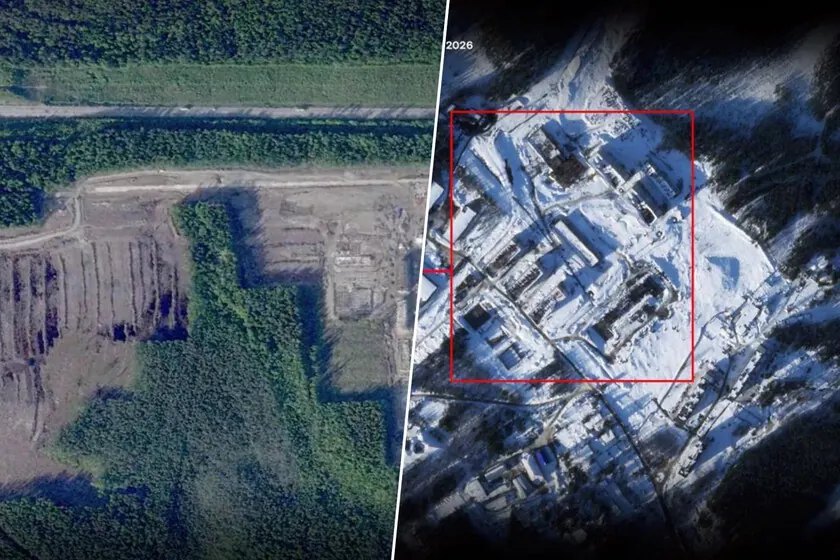
Recent satellite imagery and intelligence analyses point to a substantial military buildup by Russia along its borders with Finland and Norway, raising concerns about shifting European security landscapes. The developments suggest Moscow is preparing new infrastructure capable of housing up to 80,000 soldiers, even as its forces remain engaged in Ukraine.
Northern Border Reinforcement
For years, the border between Russia and Finland was considered one of Northern Europe’s most stable regions, with a relatively low military presence. However, this appears to be changing rapidly. Analysts at TWZ, cited in a report from Xataka, indicate that Russia has been actively expanding military bases, constructing new barracks, and establishing logistical depots in the vicinity of the Finnish and Norwegian frontiers over recent months.
Estimates from Finnish intelligence suggest that Moscow could potentially increase its troop presence in the area from approximately 20,000 to nearly 100,000 once these new facilities are fully operational. This significant increase in capacity could alter the military balance in the region, moving from a surveillance-oriented presence to a structure designed for large-scale troop concentration.
Strategic Importance of the Arctic
The intensified military activity in the Arctic region is attributed to its growing global significance. The ongoing melting of ice is opening up previously impassable shipping routes, while the area holds vast energy reserves. Control over the Arctic is increasingly viewed as offering decisive military advantages. Russia has been actively reinforcing its position in the region for years, with China also showing growing interest. What was once considered a peripheral geographical area is now a nexus of major economic, military, and strategic interests.
NATO’s Response
In response to these developments, NATO has reacted swiftly. The alliance has activated a new advanced land force in Finland, with support primarily from Sweden. This force includes command and deployment centers spread across northern Scandinavia. While the initial troop numbers may be smaller compared to Russia’s preparations, the political message is clear: Finland and Sweden have transitioned from neutrality to becoming central players in European defense. This suggests that the northern region is no longer a quiet rear guard but is emerging as a new line of contact.
Concerns Beyond Ukraine
NATO’s primary concern is not necessarily immediate Russian action, given the significant commitment of Russian forces in Ukraine. Instead, the true unease lies in the potential for what may come after the conflict. If the war in Ukraine freezes or concludes, and Moscow decides to redeploy veteran units to the north, the newly constructed infrastructure could be occupied rapidly. This suggests that current preparations, which may appear to be a medium-term plan, could quickly evolve into a tangible threat. The ongoing war in Ukraine is thus seen by some as a transitional period toward a broader strategic shift.
Shifting European Outlook
The developments indicate that the rivalry between Russia and the West is no longer confined to the Ukrainian front. There is evidence that this tension is expanding into new zones where direct conflict is not yet occurring, but where all parties are preparing for its possibility. Russia is strengthening its positions, NATO is reorganizing its defenses, and the United States is adapting its military structure to the evolving Arctic landscape. While direct hostilities may not be present on this new frontier, the movements, investments, and deployments suggest a coordinated preparation for future contingencies.
Key facts
| Aspect | Details |
|---|---|
| Troop Capacity | Facilities prepared for up to 80,000 soldiers. |
| Potential Increase | From ~20,000 to ~100,000 troops near Finland/Norway border. |
| Strategic Focus | Growing importance of the Arctic due to melting ice and resources. |
| NATO Response | Activation of new advanced land force in Finland, supported by Sweden. |
| Source of Analysis | Satellite imagery and intelligence analyses, cited by TWZ and MUST. |
This development is significant for ReviewArticle readers as it highlights the evolving geopolitical landscape driven by technological advancements like satellite surveillance and intelligence analysis. It underscores how AI and advanced imaging are being used to monitor and predict shifts in global military strategy, directly impacting international security and the potential for future conflicts in strategically vital regions like the Arctic.
Source: “Están preparando el despliegue de 80.000 soldados”: los satélites señalan hacia dónde se dirige Rusia en Europa tras Ucrania, Xataka IA, https://www.xataka.com/magnet/esta-preparando-despliegue-80-000-soldados-satelites-han-revelado-donde-se-dirige-rusia-ucrania-europa
Source
Xataka IA Publicacion original: 2026-06-17T12:00:17+00:00
Related articles

IBM CEO Puts a Number on the Open-Weight AI Value Proposition: 90% of the Performance at 10% of the Token Cost
IBM CEO Arvind Krishna told analysts that open-weight models now deliver about 90% of frontier-model effectiveness while costing between 10% and 25%…
Read article
OCU Finds Spanish Homeowner Communities Overpaying Up to €1,500 on Electricity and €3,515 on Gas—Can AI Tools Optimize Shared Energy Bills?
A new OCU analysis of Spanish homeowner community bills reveals widespread overpayment due to non-competitive tariffs and excess contracted power. Could AI-driven…
Read article
Mayotte fiber dispute does not meet ReviewArticle’s AI news brief
Le Monde reports that France’s competition authority has ordered Orange to suspend part of its fiber-optic rollout in Mayotte. The dispute is…
Read article
DiffEEG Model Uses Diffusion Pre-Training to Improve Seizure Detection from Minimal Labeled Data
Researchers have introduced DiffEEG, a 9.6-million-parameter foundation model that combines denoising diffusion pre-training with reinforcement learning fine-tuning to detect seizure events from…
Read articleWiki relacionada

AI Model API Pricing and Context Window Comparison: Current Rates and Limits
Compare the latest API pricing, context windows, and capabilities of leading AI model providers including OpenAI, Anthropic, Google, and Mistral. Practical guidance…
Read article
AI Agent Evaluation Frameworks: How to Benchmark Agentic Systems
A practical guide to evaluating AI agents — from task completion metrics to safety, cost, and robustness. Covers major frameworks, primary sources,…
Read article
LLM Benchmarks Decoded: What MMLU, HumanEval, and GSM8K Actually Measure for Developers
A developer-focused breakdown of the most-cited LLM benchmarks — MMLU, HumanEval, GSM8K, MATH, Chatbot Arena — including what they test, their hidden…
Read article
What Is RAG? A Practical Guide to Retrieval-Augmented Generation in 2025
Retrieval-Augmented Generation (RAG) grounds LLM outputs in external data, reducing hallucinations and enabling enterprise use cases. This guide covers how RAG works,…
Read article