
Satellite Images Reveal Mysterious Chinese Desert Structures Aimed at Taiwan
New satellite imagery from China's Jilantai base shows two unidentified rectangular structures with retractable roofs, sparking speculation about their purpose and potential implications for Taiwan.
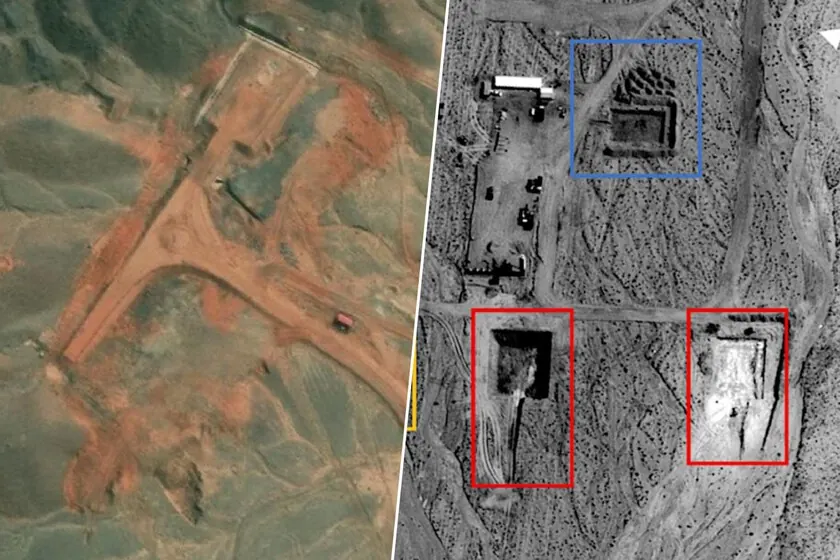
Recent satellite imagery from China’s Jilantai base in Inner Mongolia has captured the attention of military analysts, revealing the construction of two unique, hardened rectangular structures equipped with retractable roofs. These installations, located in a known testing and expansion center for China’s intercontinental ballistic missile (ICBM) silos, differ significantly from existing nuclear missile facilities, leading to widespread speculation about their true purpose.
Key facts
| Fact | Detail |
|---|---|
| Location | Jilantai base, Inner Mongolia, China |
| Structures | Two hardened rectangular buildings with retractable roofs |
| Potential Purpose | Rapid deployment of short/medium-range missiles, cruise missiles, or hypersonic systems |
| Primary Hypothesis | Enhanced conventional strike capability against Taiwan and regional U.S. assets |
| Source of Analysis | Eli Tirk report, TWZ analysts |
The initial discovery was made through high-resolution satellite photographs, which have become an increasingly vital tool in monitoring military developments globally. Historically, aerial reconnaissance has played a critical role in intelligence gathering, from revealing Soviet missile installations during the Cuban Missile Crisis to tracking modern military advancements. The Jilantai base has been a focal point for China’s ICBM program since the late 2010s, making the appearance of these novel structures particularly noteworthy.
Analysis of Dimensions and Potential Armaments
According to an analysis by military analyst Eli Tirk, the dimensions of these newly identified structures suggest they are not designed to house large ICBMs like the DF-31 or DF-41. Tirk noted that “these structures appear to have a shallower depth than silos intended for intercontinental ballistic missiles.” This observation leads to the hypothesis that they are more suited for smaller weaponry.
The dimensions are considered more compatible with systems such as short- and medium-range ballistic missiles, cruise missiles, or even advanced hypersonic weapons like the DF-17. While official confirmation of their function remains absent, the distinct design, particularly the retractable roofs, sets them apart from China’s previously constructed nuclear silos.
The “Taiwan Hypothesis”
A leading theory, highlighted by analysts at TWZ, posits that Beijing is developing a new capability for rapid conventional strikes. Instead of solely focusing on nuclear deterrence, these facilities could be intended to launch a high volume of missiles early in a conflict, overwhelming enemy defenses.
Tirk’s report suggests that a widespread deployment of such launchers could accelerate escalation from a naval blockade to a full-scale attack against targets in Taiwan, U.S. bases in the first island chain, or naval groups operating in the region. This strategic shift would emphasize speed and saturation in conventional warfare.
Infrastructure Designed for Survivability
Beyond the type of missile they might house, the design of these structures reflects a broader trend in the modernization of the Chinese military. The retractable roofs serve a dual purpose: concealing launch systems until the last possible moment and protecting them from precision strikes and drone attacks.
Researchers believe these could be part of a vertical launch system, allowing for the deployment of various types of ordnance from a single platform. This would enhance operational flexibility and reduce the time required for successive attacks.
A Wider Trend in Chinese Military Hardening
These new structures are not isolated developments but part of a larger effort by China to fortify its military installations. Over recent years, reports have detailed the construction of hundreds of new nuclear missile silos, reinforced aircraft shelters, enclosed hangars, and protected facilities both domestically and in strategic locations near borders with India and the South China Sea. The ongoing conflict in Ukraine and the increasing prevalence of drones have underscored the necessity of protecting fixed military infrastructure against increasingly accessible and precise attacks.
Lingering Questions and Future Implications
Despite the detailed analysis, the precise function of these structures remains a mystery. The authors of the report acknowledge that alternative uses are possible, including testing new systems or concealing deeper underground facilities.
However, the satellite evidence has raised a significant concern: China may be developing a new generation of military installations focused not just on expanding its arsenal but on increasing the speed and efficacy of its deployment in a potential conflict. As Tirk concludes, “if built in sufficient numbers, these systems would allow the Chinese military to quickly transition from a quarantine or blockade of Taiwan to a massive preparatory strike campaign against targets on the island, U.S. bases in the first island chain, or U.S. naval groups.” The development signals a potential shift in China’s military strategy, emphasizing rapid conventional power projection.
Source: Imágenes satelitales no dejan dudas: China ha levantado dos misteriosos “rectángulos” en mitad del desierto que apuntan a Taiwán – Xataka, https://www.xataka.com/magnet/imagenes-satelitales-no-dejan-dudas-china-ha-levantado-dos-misteriosos-rectangulos-mitad-desierto-que-apuntan-a-taiwan
Source
Xataka IA Publicacion original: 2026-07-08T08:01:19+00:00
Related articles

IBM CEO Puts a Number on the Open-Weight AI Value Proposition: 90% of the Performance at 10% of the Token Cost
IBM CEO Arvind Krishna told analysts that open-weight models now deliver about 90% of frontier-model effectiveness while costing between 10% and 25%…
Read article
OCU Finds Spanish Homeowner Communities Overpaying Up to €1,500 on Electricity and €3,515 on Gas—Can AI Tools Optimize Shared Energy Bills?
A new OCU analysis of Spanish homeowner community bills reveals widespread overpayment due to non-competitive tariffs and excess contracted power. Could AI-driven…
Read article
Mayotte fiber dispute does not meet ReviewArticle’s AI news brief
Le Monde reports that France’s competition authority has ordered Orange to suspend part of its fiber-optic rollout in Mayotte. The dispute is…
Read article
DiffEEG Model Uses Diffusion Pre-Training to Improve Seizure Detection from Minimal Labeled Data
Researchers have introduced DiffEEG, a 9.6-million-parameter foundation model that combines denoising diffusion pre-training with reinforcement learning fine-tuning to detect seizure events from…
Read articleWiki relacionada

AI Model API Pricing and Context Window Comparison: Current Rates and Limits
Compare the latest API pricing, context windows, and capabilities of leading AI model providers including OpenAI, Anthropic, Google, and Mistral. Practical guidance…
Read article
AI Agent Evaluation Frameworks: How to Benchmark Agentic Systems
A practical guide to evaluating AI agents — from task completion metrics to safety, cost, and robustness. Covers major frameworks, primary sources,…
Read article
LLM Benchmarks Decoded: What MMLU, HumanEval, and GSM8K Actually Measure for Developers
A developer-focused breakdown of the most-cited LLM benchmarks — MMLU, HumanEval, GSM8K, MATH, Chatbot Arena — including what they test, their hidden…
Read article
What Is RAG? A Practical Guide to Retrieval-Augmented Generation in 2025
Retrieval-Augmented Generation (RAG) grounds LLM outputs in external data, reducing hallucinations and enabling enterprise use cases. This guide covers how RAG works,…
Read article