
Spanish Farms Cover Manure Pits with Solar Panels to Reduce Emissions and Generate Energy
A pilot project in Spain is exploring the dual benefits of solar energy and environmental management by placing floating solar panels on pig manure lagoons, aiming to cut down on harmful emissions and produce clean electricity.
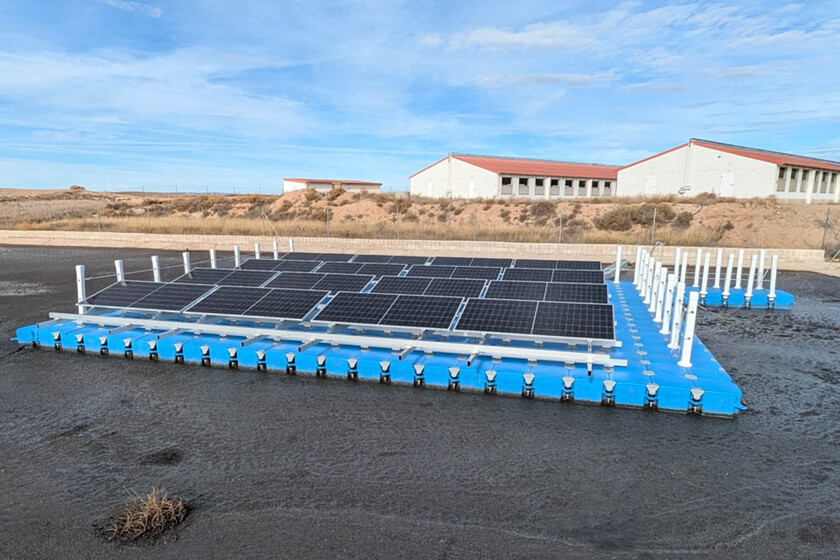
Farms in Spain, particularly in the Aragón region, are beginning to implement an innovative solution to manage pig manure lagoons: covering them with floating solar panels. This initiative, spearheaded by companies like Intergia Energía Sostenible, aims to tackle the environmental challenges posed by manure emissions while simultaneously generating renewable energy.
The Problem of Manure Management
Spain is a significant producer of pork in the European Union, with thousands of farms generating millions of tons of manure annually. These pig manure lagoons are a major source of environmental concern, releasing harmful gases such as methane, ammonia, and nitrous oxide, which contribute to greenhouse gas emissions and air pollution. Environmentalists and regulators have long focused on better management practices for these lagoons, including measures to cover them and reduce their emissions.
A “Win-Win” Solution
Recognizing the dual challenge and opportunity, a consortium including Intergia Energía Sostenible initiated a project between 2020 and 2023, supported by the European Feader fund and the Government of Aragón. The core idea was to utilize the surface area of manure lagoons for solar energy generation. By covering the lagoons with floating solar panels, the project sought to achieve a “win-win” scenario: reducing harmful emissions to comply with regulations and transforming these environmental liabilities into sources of clean solar power.
Addressing Corrosion Challenges
Early projects revealed that the ammonia present in pig manure could corrode certain components of standard floating photovoltaic systems, specifically the module mounting hardware and cabling. To overcome this, Intergia, in collaboration with partners like the University of Zaragoza, launched the Fotopur project. This initiative focuses on developing specialized floating solar solutions that can withstand the corrosive environment of manure lagoons, thereby extending the lifespan and efficiency of the installations.
Pilot Projects Underway
Fotopur has deployed two pilot installations to test and refine its technology.
One prototype was installed in November at a pig farm in Calzada de Tera, Zamora. This installation features a 13.5 x 25-meter floating platform with 56 panels, offering a peak power of 33.04 kWp. Covering 90% of the 880 m² manure lagoon, it is expected to offset up to 22% of the farm’s electricity bill. Notably, this setup uses commercial floating solar components adapted with corrosion-resistant materials, such as aluminum and stainless steel parts replacing standard steel, and includes a plastic sheet to reduce friction.
The second prototype was deployed at a farm in Tauste, Zaragoza. This system was specifically designed for manure lagoons, featuring a structure that minimizes contact between the floating elements and the manure surface. It includes an anodized aluminum frame supporting 16 panels with a total power of 9.44 kWp, tilted at 15 degrees. This installation is projected to cover 10% of the lagoon’s surface and generate approximately 15.2 MWh per year, potentially meeting up to 53% of the farm’s electricity demand and reducing its reliance on costly and polluting fuels.
Future Outlook
The Fotopur project aims to analyze data from these pilot installations, focusing on gas emission reductions and energy generation metrics. The goal is to determine which system is more effective and cost-efficient, paving the way for wider adoption in the agricultural sector. This innovative approach could offer a sustainable pathway for farms to manage waste, comply with environmental regulations, and contribute to renewable energy goals.
Datos clave
| Aspecto | Detalles |
|—|—|
| Proyecto | Fotopur |
| Ubicación de prototipos | Zamora y Zaragoza, España |
| Objetivo principal | Cubrir balsas de purines con paneles solares flotantes |
| Beneficios esperados | Reducción de emisiones contaminantes, generación de energía solar |
| Desafío clave | Corrosión por amoniaco en las balsas |
Fuente: En Aragón, las granjas están empezando a hacer algo con sus balsas de purines: cubrirlas de paneles solares – Xataka (https://www.xataka.com/energia/balsas-purines-dolor-muelas-medioambiental-aragon-han-tenido-idea-cubrirlas-paneles-solares)
Datos clave
| Punto | Detalle |
|---|---|
| Fuente | Xataka IA |
| Fecha | 2026-06-03T09:31:58+00:00 |
| Tema | En Aragón, las granjas están empezando a hacer algo con sus balsas de purines: cubrirlas de paneles solares |
Source
Xataka IA Publicacion original: 2026-06-03T09:31:58+00:00
Related articles

IBM CEO Puts a Number on the Open-Weight AI Value Proposition: 90% of the Performance at 10% of the Token Cost
IBM CEO Arvind Krishna told analysts that open-weight models now deliver about 90% of frontier-model effectiveness while costing between 10% and 25%…
Read article
OCU Finds Spanish Homeowner Communities Overpaying Up to €1,500 on Electricity and €3,515 on Gas—Can AI Tools Optimize Shared Energy Bills?
A new OCU analysis of Spanish homeowner community bills reveals widespread overpayment due to non-competitive tariffs and excess contracted power. Could AI-driven…
Read article
Mayotte fiber dispute does not meet ReviewArticle’s AI news brief
Le Monde reports that France’s competition authority has ordered Orange to suspend part of its fiber-optic rollout in Mayotte. The dispute is…
Read article
DiffEEG Model Uses Diffusion Pre-Training to Improve Seizure Detection from Minimal Labeled Data
Researchers have introduced DiffEEG, a 9.6-million-parameter foundation model that combines denoising diffusion pre-training with reinforcement learning fine-tuning to detect seizure events from…
Read articleWiki relacionada

AI Model API Pricing and Context Window Comparison: Current Rates and Limits
Compare the latest API pricing, context windows, and capabilities of leading AI model providers including OpenAI, Anthropic, Google, and Mistral. Practical guidance…
Read article
AI Agent Evaluation Frameworks: How to Benchmark Agentic Systems
A practical guide to evaluating AI agents — from task completion metrics to safety, cost, and robustness. Covers major frameworks, primary sources,…
Read article
LLM Benchmarks Decoded: What MMLU, HumanEval, and GSM8K Actually Measure for Developers
A developer-focused breakdown of the most-cited LLM benchmarks — MMLU, HumanEval, GSM8K, MATH, Chatbot Arena — including what they test, their hidden…
Read article
What Is RAG? A Practical Guide to Retrieval-Augmented Generation in 2025
Retrieval-Augmented Generation (RAG) grounds LLM outputs in external data, reducing hallucinations and enabling enterprise use cases. This guide covers how RAG works,…
Read article