
Spanish “Longevity Corridors” Identified, Mirroring Global “Blue Zones
A new map by demographer Michel Poulain highlights northern and interior regions of Spain with significantly higher life expectancy, echoing findings from global "Blue Zones" and emphasizing lifestyle factors.
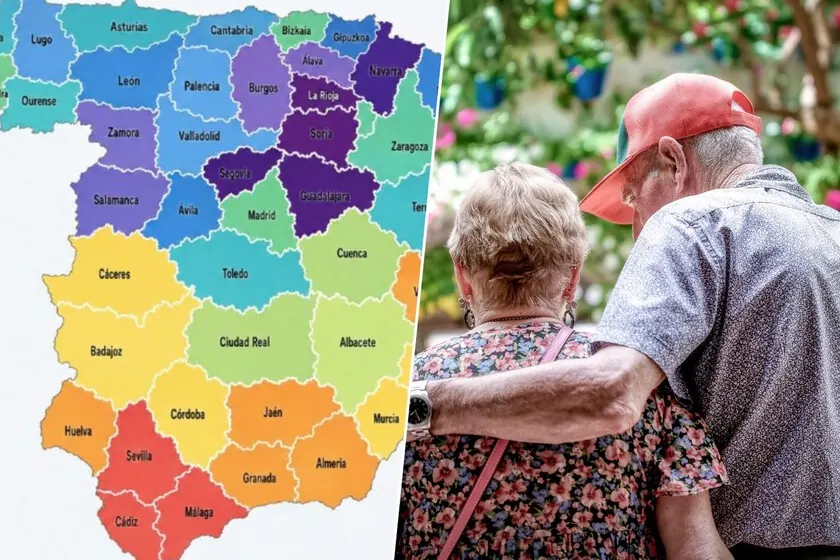
A recent demographic study has identified specific regions in Spain with a dramatically higher probability of residents reaching 100 years of age, a finding that echoes the well-known “Blue Zones” phenomenon observed globally. The research, spearheaded by demographer Michel Poulain, a key figure in defining the original “Blue Zones,” suggests that these Spanish “longevity corridors” are characterized by a confluence of lifestyle, social, and environmental factors.
The study, which applied an extreme longevity index to Spanish territory, revealed a clear pattern: the northern and interior parts of the country show a life expectancy up to three times higher than in the south. This statistical insight moves beyond anecdotal evidence, pinpointing specific areas where centenarians are not a rarity but a more common occurrence.
The “Holy Land” of Longevity in Spain
The map highlights a distinct “privileged belt” across Spain. Navarra, La Rioja, Soria, Guadalajara, and Segovia emerge at the top of the ranking. They are followed by other areas in Castilla y León, Catalonia, Álava, and a significant portion of the northwest peninsula. In stark contrast, regions like Seville, Cádiz, and Málaga show a considerably lower probability of reaching 100 years. The magnitude of this difference within a single country, sharing the same healthcare system and political framework, points to factors beyond genetics.
From “Blue Zones” to “Longevity Corridors”
Poulain’s work has historically focused on iconic “Blue Zones” such as Sardinia, Okinawa, and Ikaria. However, he now proposes a shift in terminology and focus towards “longevity corridors”—broader areas where a combination of social, environmental, health, and cultural factors creates an ecosystem conducive to a longer and healthier life. Spain, particularly its northern half, is now emerging as one such European corridor.
Lifestyle as the Key Ingredient
Researchers emphasize that the exceptional longevity in these areas is not attributable to a single miracle cure or superfood. Instead, it stems from a sustained adoption of simple, yet powerful, habits over decades. These include sensible eating, natural movement, adequate sleep, effective stress management, strong family ties, and a connection with nature. The foundational lesson, according to experts, is that healthy longevity is not achieved in later life but is built from childhood through prevention and early education.
The Invisible Social Network
Beyond diet and exercise, a crucial, often overlooked, factor is the strength of the social network. Maintaining strong family and community bonds, feeling supported, and retaining a sense of purpose and utility to others appears to act as a silent protective shield against physical and mental decline. Rural areas within these provinces often retain a denser social structure than large urban centers, contributing significantly to well-being.
An Evolving Landscape
A significant warning accompanies these findings: these longevity corridors are not immutable. Changes in diet, increased sedentary lifestyles, rapid urbanization, the erosion of community ties, and social isolation are actively undermining the very factors that have fostered such longevity. The risk is that healthy longevity could be lost within a single generation if the environment continues to shift. Therefore, the focus is now on understanding and replicating the conditions that have led to these outcomes, rather than merely admiring the centenarians.
Key facts
| Factor | Description |
|---|---|
| Identified Regions | Northern and interior Spain (Navarra, La Rioja, Soria, Guadalajara, Segovia, etc.) |
| Key Researcher | Michel Poulain, demographer and “Blue Zones” expert |
| Longevity Probability | Up to three times higher than in southern Spain |
| Contributing Factors | Diet, natural movement, sleep, stress management, social ties, nature connection, sense of purpose, social network |
| Emerging Concept | “Longevity corridors” replacing or augmenting “Blue Zones” |
This development is relevant to ReviewArticle readers interested in AI’s role in health and demographic analysis. While this specific study predates immediate AI application, the identification of these demographic patterns and the underlying lifestyle factors are precisely the kind of data that AI can analyze further. AI tools could potentially be used to:
- Predictive Health Modeling: Analyze vast datasets to identify similar patterns in other populations or predict individuals at higher risk of age-related diseases based on lifestyle indicators.
- Personalized Health Recommendations: Develop AI-driven platforms that offer tailored advice on diet, exercise, and social engagement based on the principles observed in longevity corridors.
- Social Network Analysis: Use AI to understand the impact of social connectivity on health outcomes, potentially identifying ways to foster stronger community bonds in urban or isolated areas.
- Environmental Health Factors: Analyze environmental data alongside demographic and lifestyle information to pinpoint specific ecological or geographical advantages contributing to longevity.
Understanding these “longevity corridors” through data-driven approaches, potentially enhanced by AI, can offer valuable insights into public health strategies and the future of aging well.
Source: Intuíamos que había zonas en España donde la longevidad era mayor. Un mapa acaba de confirmar dónde está la “Tierra Santa” – Xataka, https://www.xataka.com/magnet/intuiamos-que-habia-zonas-espana-donde-longevidad-era-mayor-mapa-acaba-confirmar-donde-hay-que-ir
Source
Xataka IA Publicacion original: 2026-06-12T12:00:17+00:00
Related articles

IBM CEO Puts a Number on the Open-Weight AI Value Proposition: 90% of the Performance at 10% of the Token Cost
IBM CEO Arvind Krishna told analysts that open-weight models now deliver about 90% of frontier-model effectiveness while costing between 10% and 25%…
Read article
OCU Finds Spanish Homeowner Communities Overpaying Up to €1,500 on Electricity and €3,515 on Gas—Can AI Tools Optimize Shared Energy Bills?
A new OCU analysis of Spanish homeowner community bills reveals widespread overpayment due to non-competitive tariffs and excess contracted power. Could AI-driven…
Read article
Mayotte fiber dispute does not meet ReviewArticle’s AI news brief
Le Monde reports that France’s competition authority has ordered Orange to suspend part of its fiber-optic rollout in Mayotte. The dispute is…
Read article
DiffEEG Model Uses Diffusion Pre-Training to Improve Seizure Detection from Minimal Labeled Data
Researchers have introduced DiffEEG, a 9.6-million-parameter foundation model that combines denoising diffusion pre-training with reinforcement learning fine-tuning to detect seizure events from…
Read articleWiki relacionada

AI Model API Pricing and Context Window Comparison: Current Rates and Limits
Compare the latest API pricing, context windows, and capabilities of leading AI model providers including OpenAI, Anthropic, Google, and Mistral. Practical guidance…
Read article
AI Agent Evaluation Frameworks: How to Benchmark Agentic Systems
A practical guide to evaluating AI agents — from task completion metrics to safety, cost, and robustness. Covers major frameworks, primary sources,…
Read article
LLM Benchmarks Decoded: What MMLU, HumanEval, and GSM8K Actually Measure for Developers
A developer-focused breakdown of the most-cited LLM benchmarks — MMLU, HumanEval, GSM8K, MATH, Chatbot Arena — including what they test, their hidden…
Read article
What Is RAG? A Practical Guide to Retrieval-Augmented Generation in 2025
Retrieval-Augmented Generation (RAG) grounds LLM outputs in external data, reducing hallucinations and enabling enterprise use cases. This guide covers how RAG works,…
Read article