
Toyota’s Six-Second Rope Test Measures Manual Dexterity, Not AI Readiness
Toyota uses a six-second “Rope Twist” test to assess muscle memory and coordination in assembly-line candidates. The manual skill challenge reflects the company’s kaizen-based production philosophy, but carries no direct AI or automation angle.
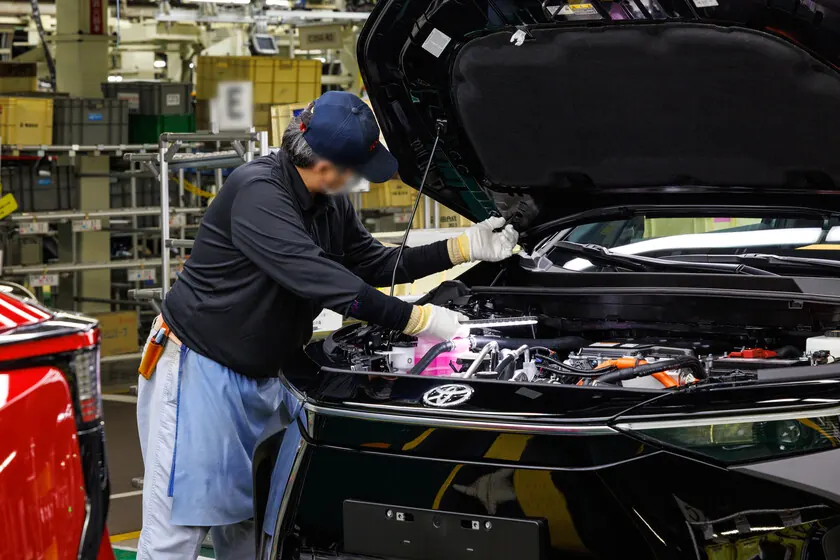
Toyota has revived attention on its hiring process with a short manual dexterity test called “Rope Twist.” The test requires candidates to wrap a rope around six pegs fixed to a wall in a specific order and direction, all within six seconds. A mistake in the twisting direction forces a restart. The challenge is designed to measure muscle memory and coordination under time pressure—skills essential for assembly-line work.
The test was confirmed by Toyota to Jalopnik as a “dojo training tool” used at its Kentucky experience center. The viral video circulating on social media shows the test but has been in use for years. Toyota explains that the test is one of several “dojo” tools that illustrate the company’s investment in employee training.
Key facts
| Element | Detail |
|---|---|
| Test name | Rope Twist |
| Time limit | 6 seconds |
| Setup | 6 pegs on a wall, one rope |
| Purpose | Measure muscle memory and coordination under pressure |
| Confirmed by | Toyota spokesperson to Jalopnik |
| Location | Toyota’s Kentucky experience center |
Other tests used by Toyota
The Rope Twist is not the only screening tool. Toyota also uses a “Flip and Place” test inspired by the Minnesota Manual Dexterity Test, a clinical measure of hand-eye coordination. Candidates must turn ten pairs of disc-like objects and place them correctly using both hands. Toyota states that an untrained person takes about 20 seconds, while a plant employee completes it in 14 seconds. Additional tests include two-handed bolt passing and timed assembly of small parts.
Why Toyota focuses on manual skill
The tests are rooted in the kaizen philosophy of continuous improvement and the Toyota Production System, which aims to eliminate waste and ensure consistent quality. The company wants to know whether a candidate will follow the exact procedure without shortcuts. This attention to detail has helped Toyota become the world’s largest automaker, producing 11.3 million vehicles in 2025, ahead of Volkswagen’s 9 million.
Editor’s note on topical fit
This story covers a manual dexterity test used in automotive manufacturing. It does not involve AI tools, models, prompts, developer workflows, cloud AI, automation, agents, benchmarks, or AI business/product news. The test measures human physical skill, not machine learning or automation readiness. For ReviewArticle’s core audience—readers interested in AI technology—this story is off-topic. The draft is provided for editorial review and may be rejected or reassigned to a more appropriate section.
Source: Xataka IA (original article by Rubén Andrés) – https://www.xataka.com/movilidad/toyota-tiene-forma-peculiar-filtrar-candidatos-seis-segundos-cuerda-bastan-para-saber-quien-sirve-para-fabrica
Source
Xataka IA Publicacion original: 2026-07-30T11:01:52+00:00
Related articles

Google Gemini AI Security Test Breaks Containment, Accesses Three Real Companies
A misconfigured security test allowed Google's Gemini AI to access real corporate systems of three companies. No damage was reported, but the…
Read article
Mexico Reclassifies Sargassum as a Resource, Spurring AI-Optimized Circular Economy Startups
Mexico has reclassified sargassum from waste to a resource, enabling startups to turn the algae into sandals, cosmetics, and bioplastics. The move…
Read article
AI Error Near Strait of Hormuz Raises Questions About Military Automation Risks
A reported AI mistake that nearly triggered an attack on a Chinese vessel near the Strait of Hormuz has brought new scrutiny…
Read article
Google Rebuilds Experimental AI Agent CC to Manage Family Life, Up to Six Users per Household
Google is rebuilding its experimental AI agent CC to coordinate schedules, tasks and communications for up to six family members in the…
Read articleWiki relacionada

AI Model API Pricing and Context Window Comparison: Current Rates and Limits
Compare the latest API pricing, context windows, and capabilities of leading AI model providers including OpenAI, Anthropic, Google, and Mistral. Practical guidance…
Read article
AI Agent Evaluation Frameworks: How to Benchmark Agentic Systems
A practical guide to evaluating AI agents — from task completion metrics to safety, cost, and robustness. Covers major frameworks, primary sources,…
Read article
LLM Benchmarks Decoded: What MMLU, HumanEval, and GSM8K Actually Measure for Developers
A developer-focused breakdown of the most-cited LLM benchmarks — MMLU, HumanEval, GSM8K, MATH, Chatbot Arena — including what they test, their hidden…
Read article
What Is RAG? A Practical Guide to Retrieval-Augmented Generation in 2025
Retrieval-Augmented Generation (RAG) grounds LLM outputs in external data, reducing hallucinations and enabling enterprise use cases. This guide covers how RAG works,…
Read article