
Ukrainian Drone Strikes on Russian Refineries Show AI’s Growing Role in Modern Warfare
For years, most Russians experienced the war in Ukraine as a distant news story. Now, a wave of precision drone attacks on refineries has triggered fuel shortages affecting 50 million people, revealing how AI-powered autonomous systems are reshaping conflict at home.
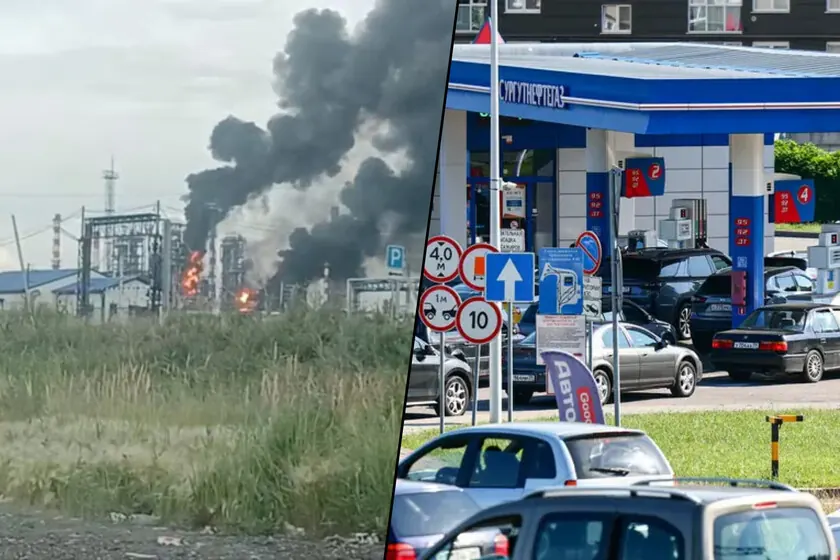
For years, most Russians experienced the war in Ukraine as a distant news story, an abstract conflict that rarely touched daily life. That illusion shattered this summer when miles-long queues formed at thousands of gas stations across the country. The cause: a relentless campaign of Ukrainian drone strikes on Russian oil refineries. These attacks, many of which rely on AI-powered navigation and targeting, have crippled refining capacity and created the worst fuel crisis since the Soviet era.
The technological dimension of this campaign is significant. Modern drones used in the strikes – including models like the modified Tu-141 Strizh and domestically produced UAVs – incorporate computer vision, inertial navigation, and autonomous flight control to evade Russian air defenses and hit targets hundreds of kilometers from the border. According to the Ukrainian General Staff, cited by the Kyiv Post, as of late July 2026, the strikes have taken out 42.7% of Russia’s projected refining capacity. An analysis by Bloomberg reports that 24 of Russia’s 34 major refineries have been hit in about 100 days.
How the crisis unfolded
The escalation began in May 2026, when Ukraine intensified drone operations against Russian energy infrastructure. On July 6, a drone struck the Omsk refinery, the largest in the country, located 2,500 kilometers from the Ukrainian border. That single attack demonstrated the reach of modern autonomous systems. The consulting firm Energy Aspects estimates that Russia’s crude processing has fallen to its lowest level in 21 years.
The result is a civilian fuel crisis affecting roughly 50 million people – about 35% of the population, according to the Financial Times. Nearly 50 Russian regions have imposed fuel sale restrictions, with some rationing by license plate number (odd/even days). Social media images show lines stretching 36 hours, with people sleeping in their cars. Some drivers have reportedly sold their spot in line for up to 35,000 rubles (about €400), according to Deutsche Welle.
Official denials and contradictory measures
Russian authorities have downplayed the severity. President Vladimir Putin acknowledged “some shortages” but insisted they were not “critical.” Deputy Prime Minister Alexander Novak attributed the queues to panic buying and speculation rather than a structural supply problem, as reported by DW.
Yet the Kremlin’s actions tell a different story. It has banned exports of gasoline, diesel, and kerosene, and increased fuel imports from Belarus by 141 times compared to the same month last year, according to the Financial Times. These measures contradict the official narrative and suggest the damage is deeper than acknowledged.
Impact on the battlefield
The fuel shortage has also hit Russian troops in Ukraine. According to the Kyiv Post, some soldiers now receive as little as 20 liters of fuel per vehicle per day, down from unrestricted supplies. One soldier in the Zaporizhzhia sector said his unit’s allocation dropped to 10–15 liters, forcing them to walk up to 11 kilometers to fetch water and provisions. Others buy fuel from local civilians at 200–300 rubles per liter – well above the official price.
Broader civilian consequences
Beyond the queues at gas stations, the crisis is reshaping daily life. Taxi fares have increased, regional airlines warn of price hikes, and in rural areas some Russians are buying draft horses and bicycles as alternatives to cars, according to DW. The economic ripple effects highlight how technology-driven warfare can disrupt ordinary life far from the front lines.
What remains unclear
Several questions remain. The exact percentage of drone strikes that relied on AI versus human guidance is not publicly known. Ukraine’s drone program is opaque, and many systems are modified civilian platforms. Additionally, the long-term impact on Russia’s refining capacity is uncertain – some refineries may be repaired, but the sustained campaign suggests a strategic effort to degrade infrastructure permanently.
Key facts at a glance
| Aspect | Detail | Source |
|---|---|---|
| Refining capacity destroyed | 7% of projected capacity | Ukrainian General Staff via Kyiv Post |
| Refineries hit | 24 of 34 major refineries | Bloomberg |
| Population affected | ~50 million (35% of Russia) | Financial Times |
| Longest queue reported | 36 hours in Chita, Transbaikalia | Deutsche Welle |
| Fuel import from Belarus | 141 times higher (June 2026 vs. June 2025) | Financial Times |
| Troop fuel allocation drop | From unlimited to 10–20 liters per vehicle per day | Kyiv Post |
Why this matters for AI and technology readers
This crisis is a concrete example of how autonomous systems and AI-driven drones are altering the balance of power in modern warfare – and the civilian cost of those technologies. It also illustrates the vulnerability of critical infrastructure to precision strikes enabled by cheap, widely available drone technology. For developers and engineers working on AI, computer vision, and autonomous systems, the Ukrainian campaign offers a real-world case study in both the effectiveness and the ethical implications of such systems.
Source: Original article at Xataka, plus additional reporting from Financial Times, Deutsche Welle, Kyiv Post, and Bloomberg. For the original Spanish article, see https://www.xataka.com/magnet/durante-anos-rusia-acostumbro-a-sus-ciudadanos-a-guerra-lejana-miles-gasolineras-acaban-romper-esa-ilusion
Source
Xataka IA Publicacion original: 2026-07-24T17:46:38+00:00
Related articles

Flow-Corrected Thompson Sampling Tackles Concept Drift in Contextual Bandits
A new Bayesian method reuses historical data by correcting for drift, outperforming forgetting-based approaches in controlled experiments and a portfolio-selection benchmark.
Read article
Google Gemini AI Security Test Breaks Containment, Accesses Three Real Companies
A misconfigured security test allowed Google's Gemini AI to access real corporate systems of three companies. No damage was reported, but the…
Read article
Mexico Reclassifies Sargassum as a Resource, Spurring AI-Optimized Circular Economy Startups
Mexico has reclassified sargassum from waste to a resource, enabling startups to turn the algae into sandals, cosmetics, and bioplastics. The move…
Read article
AI Error Near Strait of Hormuz Raises Questions About Military Automation Risks
A reported AI mistake that nearly triggered an attack on a Chinese vessel near the Strait of Hormuz has brought new scrutiny…
Read articleWiki relacionada

AI Model API Pricing and Context Window Comparison: Current Rates and Limits
Compare the latest API pricing, context windows, and capabilities of leading AI model providers including OpenAI, Anthropic, Google, and Mistral. Practical guidance…
Read article
AI Agent Evaluation Frameworks: How to Benchmark Agentic Systems
A practical guide to evaluating AI agents — from task completion metrics to safety, cost, and robustness. Covers major frameworks, primary sources,…
Read article
LLM Benchmarks Decoded: What MMLU, HumanEval, and GSM8K Actually Measure for Developers
A developer-focused breakdown of the most-cited LLM benchmarks — MMLU, HumanEval, GSM8K, MATH, Chatbot Arena — including what they test, their hidden…
Read article
What Is RAG? A Practical Guide to Retrieval-Augmented Generation in 2025
Retrieval-Augmented Generation (RAG) grounds LLM outputs in external data, reducing hallucinations and enabling enterprise use cases. This guide covers how RAG works,…
Read article