
Vancouver’s Sen̓áḵw Project Explores Urban Density Solutions Amidst Housing Crisis
A large-scale residential development on Indigenous land in Vancouver is being closely watched as a potential model for addressing urban housing affordability challenges through increased density and streamlined regulations.
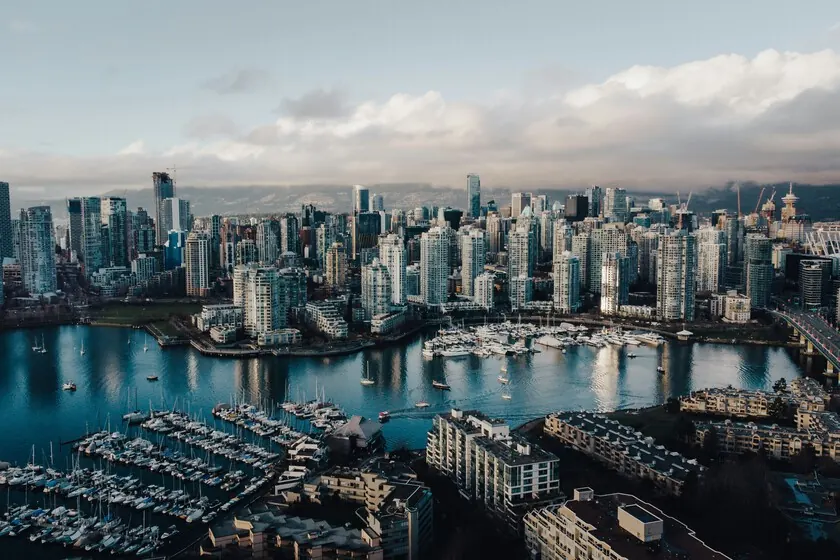
Vancouver is grappling with one of the world’s most unaffordable housing markets, prompting a critical examination of urban planning and regulatory frameworks. A significant development, Sen̓áḵw, on land returned to the Squamish Nation, is emerging as a real-world experiment in addressing these challenges through unprecedented density. The project aims to construct approximately 6,000 homes across 11 towers, offering a potential blueprint for cities seeking to alleviate housing crises.
Vancouver’s Housing Market Challenges
Living in Vancouver presents significant financial hurdles for many. A study by Frontier Centre indicates that Canadian families need to earn the equivalent of 10.8 years of gross income to purchase a typical home. Globally, only a few cities like Hong Kong and Sydney present greater affordability challenges. The rental market offers little respite, with average rents nearing $2,900 USD. In response, city authorities have set a goal to introduce 83,000 new homes into the market in the coming years.
Experts like Binyamin Appelbaum, a reporter for The New York Times, point to excessive bureaucratic rigidity and regulatory blockages as key contributors to the housing crisis, a problem extending beyond Canada. Appelbaum argues that cities have lost the authority to approve projects, leading to inaction that exacerbates the problem. This is compounded by historical construction limitations imposed in the 1960s, the effects of the 2008 financial crisis, and a structural housing deficit. Vancouver also faces geographical constraints, situated between mountains and the Pacific Ocean, with a predominantly low-density, single-family home urban fabric.
A Unique Development Approach
Sen̓áḵw, located on 10.48 acres near False Creek, is designed to be one of Canada’s most densely populated residential neighborhoods. The development, managed by the Squamish Nation, is exempt from many of the zoning and height restrictions that limit construction in other parts of Vancouver. This exemption stems from the land’s unique status, belonging to the Squamish Nation, who were forcibly removed from the area in 1913. After a decades-long legal battle, 4.4 hectares were returned to the Nation in 2003.
In 2019, the Squamish Nation approved the development of the land to create a legacy for future generations. The Sen̓áḵw project includes not only market-rate housing but also subsidized rentals for Nation members and spaces for showcasing Indigenous culture and art. The first phase of the project, comprising 1,049 homes in three towers of 27, 32, and 40 stories, is nearing completion.
Potential Implications and Unknowns
The Sen̓áḵw project’s ability to bypass traditional regulatory hurdles presents an opportunity to test the hypothesis that increased density and reduced bureaucracy can alleviate housing affordability. The development is being financed through rental income and partnerships, including with OPTrust, a major Canadian pension fund. The Squamish Nation retains significant ownership stakes in the project.
However, the project is not without its unknowns. Questions remain about the long-term impact of such high density on public services, including parks, parking, schools, and hospitals. Whether Sen̓áḵw’s model can indeed offer a scalable solution to Vancouver’s, and potentially other cities’, persistent housing crisis remains to be seen.
Key facts
| Aspect | Detail |
|---|---|
| Project Name | Sen̓áḵw |
| Location | Vancouver, Canada (Squamish Nation land) |
| Proposed Homes | Approximately 6,000 across 11 towers |
| Land Status | Exempt from many Vancouver zoning and height restrictions |
| Development Goal | Address housing affordability through high density and streamlined regulations |
Source: El mundo lleva décadas buscando la fórmula contra la crisis de la vivienda. Hay quien cree que la respuesta está en Vancouver – Xataka: https://www.xataka.com/magnet/mundo-lleva-decadas-buscando-formula-crisis-vivienda-hay-quien-cree-que-respuesta-esta-vancouver
Source
Xataka IA Publicacion original: 2026-06-19T17:00:17+00:00
Related articles
IBM CEO Puts a Number on the Open-Weight AI Value Proposition: 90% of the Performance at 10% of the Token Cost
IBM CEO Arvind Krishna told analysts that open-weight models now deliver about 90% of frontier-model effectiveness while costing between 10% and 25%…
Read article
OCU Finds Spanish Homeowner Communities Overpaying Up to €1,500 on Electricity and €3,515 on Gas—Can AI Tools Optimize Shared Energy Bills?
A new OCU analysis of Spanish homeowner community bills reveals widespread overpayment due to non-competitive tariffs and excess contracted power. Could AI-driven…
Read article
Mayotte fiber dispute does not meet ReviewArticle’s AI news brief
Le Monde reports that France’s competition authority has ordered Orange to suspend part of its fiber-optic rollout in Mayotte. The dispute is…
Read article
DiffEEG Model Uses Diffusion Pre-Training to Improve Seizure Detection from Minimal Labeled Data
Researchers have introduced DiffEEG, a 9.6-million-parameter foundation model that combines denoising diffusion pre-training with reinforcement learning fine-tuning to detect seizure events from…
Read articleWiki relacionada

AI Model API Pricing and Context Window Comparison: Current Rates and Limits
Compare the latest API pricing, context windows, and capabilities of leading AI model providers including OpenAI, Anthropic, Google, and Mistral. Practical guidance…
Read article
AI Agent Evaluation Frameworks: How to Benchmark Agentic Systems
A practical guide to evaluating AI agents — from task completion metrics to safety, cost, and robustness. Covers major frameworks, primary sources,…
Read article
LLM Benchmarks Decoded: What MMLU, HumanEval, and GSM8K Actually Measure for Developers
A developer-focused breakdown of the most-cited LLM benchmarks — MMLU, HumanEval, GSM8K, MATH, Chatbot Arena — including what they test, their hidden…
Read article
What Is RAG? A Practical Guide to Retrieval-Augmented Generation in 2025
Retrieval-Augmented Generation (RAG) grounds LLM outputs in external data, reducing hallucinations and enabling enterprise use cases. This guide covers how RAG works,…
Read article